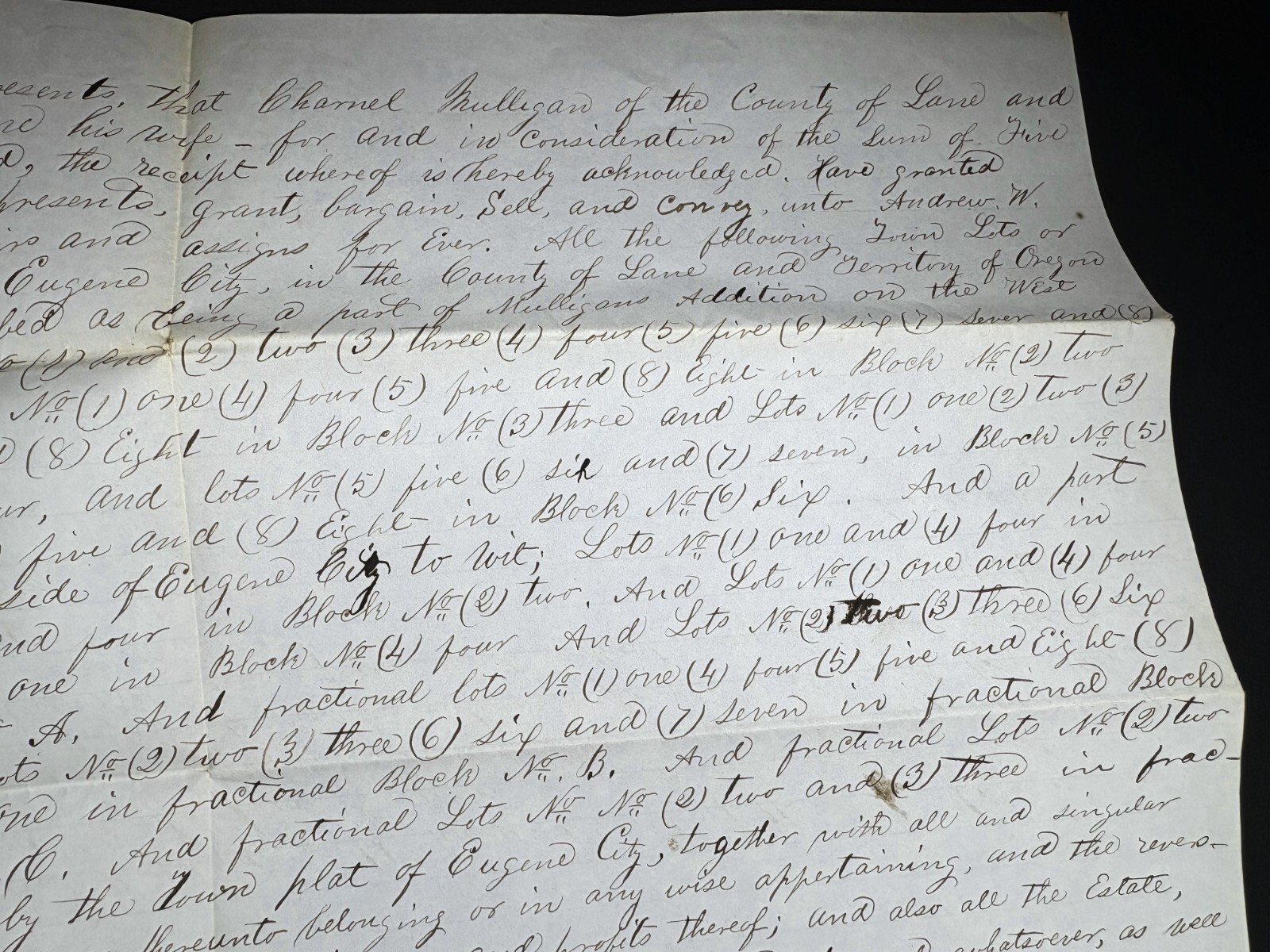
RARE Important ms Document 1856 Eugene Oregon Pioneers Patterson Signed Mulligan

When you click on links to various merchants on this site and make a purchase, this can result in this site earning a commission. Affiliate programs and affiliations include, but are not limited to, the eBay Partner Network.

RARE Important ms Document 1856 Eugene Oregon Pioneers Patterson Signed Mulligan:
$2900.00
RARE Early Oregon Document
Eugene City
Large Land contract between
Charnel Mulligan and Andrew W PattersonEarly Oregon PioneersSigned by others - including Paul Brattain - author of Oregon Constitution in 1857dated 1856
For offer, nice old pieces of ephemera! Fresh from a prominent estate. Never offered on the market until now.Vintage, Old, Original, Antique, NOTa Reproduction - Guaranteed !!
Remarkable and important early Eugene OR piece of history.Many lots of land in Eugene City originally owned by Charnel Mulligan, sold to Andrew W. Patterson for $5,000 - a lot of money in 1856. Document signed by Charnel Mulligan and his wife Martha, as well as other pioneers, Joseph Ogle, William E Elston, and Justice of the Peace, Richard Henry Parsons, Paul Brattain, and possibly D.C. Dade. See below for biographies of some of these people.
Manuscript ink on both sides - large folio sized paper. In very good condition. Fold marks. NOTE - will be sent folded, as found.Please seephotos. If you collect19thcentury Americana history, American documents, United States of America, etc.this is a treasureyou will not see again!Add this to your image orpaper/ ephemera collection.Important genealogy research importance too. Combine shipping on multiple offer wins! 3387
Dr. Andrew W. Patterson was the youngest son of Scots parentage, born on October 4, 1814 in Armstrong County, Pennsylvania to Andrew Patterson who was born in Bucks County and Jane Lindsay of Shippensburg. He was graduated from the Pennsylvania College of Medicine in March, 1841 and had practiced medicine in Greenfield, Indiana. But when he came to Oregon in August of 1852, he found pioneer families in astonishingly fine health but needing a surveyor. He took up a donation land claim about a mile west of what would become the city. In 1854 he took up the surveyor's chain and began, at the request of Eugene Skinner, to mark off and plat the "Town of Eugene City." Forty acres each had been donated by Eugene Skinner and Charnal Mulligan, with Eighth street forming the dividing line. He this success, he took up various government contracts for survey work in Oregon and Washington Territory. On July 4, 1859, he married Miss Amanda C. Olinger, the daughter of Abram Olinger and Rachel Stout, who had come to Oregon by wagon with the Great Emigration of 1843. The Pattersons were the parents of eight children.
Dr. Patterson was a member of the Territorial Legislature from Lane County in 1854, and later, after his election to the state Senate in 1870, he was a very determining influence in the fight to build the State University in his town. He fought in the Indian Wars in 1855 as a lieutenant, and later as Surgeon in the Medical Department of the Army. He was appointed chief clerk in the office of the Surveyor General, located in Eugene, in 1861. The following year Dr. Patterson resumed his medical practice in Eugene, retiring in 1897. He was one of the first to introduce hops in Lane County, obtaining his first roots in England. He became an extensive hop grower, operating a hopyard along the banks of the Willamette river. He was also quarter-owner of the Eugene City flour mills.
Dr. Patterson also served Eugene well as a school director, and as a county superintendent of schools for three terms, from 1882 to 1886. Although he lost his eyesight in the latter years of his life, he maintained a lively interest in all affairs of the town, and gave much financial aid to civic projects. Professionally Dr. Patterson was connected with the Lane County Medical Society to the time of his death, which occurred December 20, 1904. Fraternally he was a member of Eugene Lodge No. 11, A. F. & A. M., and his religious faith was that of the Unitarian church.Excerpt from the Daily Eugene Guard, May 31, 1899Charnelton Mulligan died May 30, 1899 at his home in Springfield of heart failure, age 72 years, 11 month, 10 days. The funeral occurred at 3 p.m. at the I.O.O.F. cemetery; services by Reverend Blackwell.Charnelton Mulligan was one of the best known and most respected of Lane County's pioneers. He arrived in 1847. Like Eugene F. Skinner, he gave 40 acres to Lane County for the purpose of locatingthe county seat in Eugene, his 40 acres lying south of the corner of Eighth Street. He gave freely of his money, time and property inbuilding up the commonwealth. His name has been a synonym for good deeds, uprightness, and manhood.Gravesite DetailsCo-founder of the city of Eugene. husband of Mary Spores Mulligan. Charnel may be a nickname since other records show him as Charnelton. Charnelton Street in Eugene is named for him.
Richard was born 30 January 1791 in Springfield, New York. He was the son of Eli Parsons and Mercy Atchison
He married Harriet Ludington 5 January 1817 in Canada.
He passed away 30 April 1869 at his residence in Eugene, Oregon.
1850 - West Creek Township, Lake, Indiana, United States.[1]1860 - Eugene City Precinct, Lane, Oregon, United States.[2]
Richard Parsons was a pioneer settler in Oregon.
Richard Parsons was involved in the westward expansion of the USA (Oregon Trail). See Trails and Wagon Trains.Paul F. Brattain (1801-1883) ─ The Primary Author of Oregon’s ConstitutionDuring his lifetime, from Indiana to Oregon, Paul Brattain left a unique literary thumbprint everywhere he moved: he drafted four state constitutions.
Through his interest in –and talent for –establishing foundations for new governments, during the 1800s Brattain became a familiar face in the settlement of the West. He filled many prominent official positions including the Constitutional Committees of Illinois, Indiana, Iowa and Oregon.
A farmer, Brattain was described as “a congenial and honest man, a true neighbor.” He also held the position of County Auditor of Lane County when Oregon was still a territory. In addition, he served as County Agent for Lane County for many years.
Born in North Carolina, Brattain was drawn to the frontier at an early age. As a young boy he migrated to Tennessee when it was a wilderness. By 1816 he had moved toIndiana and helped write that state’s original constitution.In the 1830’s he moved further west to Illinois when it was inhabited largely by Native Americans. At some point, Brattain was asked to help write the Illinois State Constitution, which he did.
Most at home when living was on the edge of civilization, in the 1840’s Brattain and family moved to the broad prairie east of Kensoqua, Iowa. Then in 1852, the Brattains re-located further west and claimed land in Lane County and built a farm in Springfield.
By 1857 Brattain was again drafting a state constitution, this time for the Oregon Territory. That version became official when Oregon obtained statehood two years later in 1859. Interestingly, a full third of it is word-for-word identical to the state constitution Brattain wrote years earlier for Indiana.
Little is known about Brattain’s education or origins. What can be said is that he consistently played a part in the development of the Western Territories in which he lived. He was a man of letters with a penchant for being on the forefront of things.
A sentence from Brattain’s obituary after he died on his farm in Springfield at the age of 92 reads:“The pioneers of the great Northwest are falling from the ranks of the living one by one, and soon they will be covered from our sight by the green turf, and then we will know them only by their noble deeds.”
Eugene (/juːˈdʒiːn/ yoo-JEEN) is a city in and the county seat of Lane County, Oregon, United States. It is located at the southern end of the Willamette Valley, near the confluence of the McKenzie and Willamette rivers, about 50 miles (80 km) east of the Oregon Coast.[10]
The second-most populous city in Oregon, Eugene had a population of 176,654 as of the 2020 United States census[11] and it covers city area of 44.21 sq mi (114.5 km2). The Eugene-Springfield metropolitan statistical area is the second largest in Oregon after Portland.[12] In 2022, Eugene's population was estimated to have reached 179,887.
Eugene is home to the University of Oregon, Bushnell University, and Lane Community College.[13][14][15] The city is noted for its natural Environment, recreational opportunities (especially bicycling, running/jogging, rafting, and kayaking), and focus on the arts, along with its history of civil unrest, riots, and green activism. Eugene's official slogan is "A Great City for the Arts and Outdoors".[16] It is also referred to as the "Emerald City" and as "Track Town, USA".[17] The Nike corporation had its beginnings in Eugene.[18] In July 2022, the city hosted the 18th World Athletics Championship.[19]
HistoryIndigenous presenceThe first people to settle in the Eugene area were the Kalapuyans, also written Calapooia or Calapooya. They made "seasonal rounds," moving around the countryside to collect and preserve local foods, including acorns, the bulbs of the wapato and camas plants, and berries. They stored these foods in their permanent winter village. When crop activities waned, they returned to their winter villages and took up hunting, fishing, and trading.[20][21] They were known as the Chifin Kalapuyans and called the Eugene area where they lived "Chifin", sometimes recorded as "Chafin" or "Chiffin".[22][23]Camas flowerOther Kalapuyan tribes occupied villages that are also now within Eugene city limits. Pee-you or Mohawk Calapooians, Winefelly or Pleasant Hill Calapooians, and the Lungtum or Long Tom. They were close-neighbors to the Chifin, intermarried, and were political allies. Some authorities suggest the Brownsville Kalapuyans (Calapooia Kalapuyans) were related to the Pee-you. It is likely that since the Santiam had an alliance with the Brownsville Kalapuyans that the Santiam influence also went as far at Eugene.[24]
According to archeological evidence, the ancestors of the Kalapuyans may have been in Eugene for as long as 10,000 years.[25] In the 1800s their traditional way of life faced significant changes due to devastating epidemics and settlement, first by French fur traders and later by an overwhelming number of American settlers.[26]
Settlement and impact19th Century book illustration, attributed by the Library of Congress at to the artist Alfred T. Agate (1812–1846) and the engraver William H. Dougal (1822–1895). A copy of the image resides at Library of Congress Rare Book and Special Collections Division Washington, D.C. 20540 USA. Published in the USA prior to 1923, public domain.Kalapuya man, c. 1840French fur traders had settled seasonally in the Willamette Valley by the beginning of the 19th century. Their settlements were concentrated in the "French Prairie" community in Northern Marion County but may have extended south to the Eugene area. Having already developed relationships with Native communities through intermarriage and trade, they negotiated for land from the Kalapuyans. By 1828 to 1830 they and their Native wives began year-round occupation of the land, raising crops and tending animals. In this process, the mixed race families began to impact Native access to land, food supply, and traditional materials for trade and religious practices.[27]
In July 1830, "intermittent fever" struck the lower Columbia region and a year later, the Willamette Valley. Natives traced the arrival of the disease, then new to the Pacific Northwest, to the USS Owyhee, captained by John Dominis. "Intermittent fever" is thought by researchers now to be malaria.[28] According to Robert T. Boyd, an anthropologist at Portland State University, the first three years of the epidemic, "probably constitute the single most important epidemiological event in the recorded history of what would eventually become the state of Oregon". In his book The Coming of the Spirit Pestilence Boyd reports there was a 92% population loss for the Kalapuyans between 1830 and 1841.[29] This catastrophic event shattered the social fabric of Kalapuyan society and altered the demographic balance in the Valley. This balance was further altered over the next few years by the arrival of Anglo-American settlers, beginning in 1840 with 13 people and growing steadily each year until within 20 years more than 11,000 American settlers, including Eugene Skinner, had arrived.[30]
As the demographic pressure from the settlers grew, the remaining Kalapuyans were forcibly removed to Indian reservations. Though some Natives avoided transfer into the reservation, most were moved to the Grand Ronde reservation in 1856.[31][32] Strict racial segregation was enforced and mixed race people, known as Métis in French, had to make a choice between the reservation and Anglo-American society. Native Americans could not leave the reservation without traveling papers and white people could not enter the reservation.[33]Replica of Skinner's original cabinEugene Franklin Skinner, after whom Eugene is named, arrived in the Willamette Valley in 1846 with 1,200 other settlers that year. Advised by the Kalapuyans to build on high ground to avoid flooding, he erected the first pioneer cabin[34] on south or west slope of what the Kalapuyans called Ya-po-ah. The "isolated hill" is now known as Skinner's Butte.[35] The cabin was used as a trading post and was registered as an official post office on January 8, 1850.[36]
At this time the settlement was known by settlers as Skinner's Mudhole. It was relocated in 1853 and named Eugene City in 1853.[37] Formally incorporated as a city in 1862, it was renamed to Eugene in 1889.[38][37] Skinner ran a ferry service across the Willamette River where the Ferry Street Bridge now stands.
Educational institutionsThe first major educational institution in the area was Columbia College, founded a few years earlier than the University of Oregon. It fell victim to two major fires in four years, and after the second fire, the college decided not to rebuild again.[39] The part of south Eugene known as College Hill was the former location of Columbia College. There is no college there today.[40]
The town raised the initial funding to start a public university, which later became the University of Oregon, with the hope of turning the small town into a center of learning. In 1872, the Legislative Assembly passed a bill creating the University of Oregon as a state institution. Eugene bested the nearby town of Albany in the competition for the state university. In 1873, community member J.H.D. Henderson donated the hilltop land for the campus, overlooking the city.[41] The university first opened in 1876 with the regents electing the first faculty and naming John Wesley Johnson as president. The first students registered on October 16, 1876. The first building was completed in 1877; it was named Deady Hall in honor of the first Board of Regents President and community leader Judge Matthew P. Deady.[42]
Other universities in Eugene include Bushnell University and New Hope Christian College.
Twentieth century
Downtown Eugene in 1925Eugene grew rapidly throughout most of the twentieth century, with the exception being the early 1980s when a downturn in the timber industry caused high unemployment. By 1985, the industry had recovered and Eugene began to attract more high-tech industries, earning it the moniker the "Emerald Shire". In 2012, Eugene and the surrounding metro area was dubbed the Silicon shire.
The first Nike shoe was used in 1972 during the US Olympic trials held in Eugene.[43]According to the United States Census Bureau, the city has a total area of 43.74 square miles (113.29 km2), of which 43.72 square miles (113.23 km2) is land and 0.02 square miles (0.05 km2) is water.[49] Eugene is at an elevation of 426 feet (130 m).
To the north of downtown is Skinner Butte. Northeast of the city are the Coburg Hills. Spencer Butte is a prominent landmark south of the city. Mount Pisgah is southeast of Eugene and includes the Mount Pisgah Arboretum and the Howard Buford Recreation Area, a Lane County Park. Eugene is surrounded by foothills and forests to the south, east, and west, while to the north the land levels out into the Willamette Valley and consists of mostly farmland.
The Willamette and McKenzie Rivers run through Eugene and its neighboring city, Springfield. Another important stream is Amazon Creek, whose headwaters are near Spencer Butte. The creek discharges into the Long Tom River north Fern Ridge Reservoir, maintained for winter flood control by the Army Corps of Engineers. The Eugene Yacht Club hosts a sailing school and sailing regattas at Fern Ridge during summer months.[50]
NeighborhoodsEugene has 21 [51] neighborhood associations:
Amazon Neighbors AssociationCal Young Neighborhood AssociationChurchill Area NeighborsDowntown Neighborhood AssociationFairmount Neighbors AssociationFriendly Area NeighborsGoodpasture Island NeighborsHarlow NeighborsIndustrial Corridor (Inactive)Jefferson Westside NeighborsLaurel Hill Valley CitizensNortheast NeighborsRiver Road Community OrganizationSanta Clara Community Organization (including Irving)South University Neighborhood AssociationSoutheast NeighborsSouthwest Hills Neighborhood AssociationTrainsong NeighborsWest Eugene Community OrganizationWest University NeighborsWhiteaker Community CouncilThe River Road and Santa Clara sections, which make up the northwestern part of the city, are within the urban growth boundary and generally perceived as part of Eugene, but are largely outside of the city limits.
RARE Important ms Document 1856 Eugene Oregon Pioneers Patterson Signed Mulligan:
$2900.00
Related Items:
Extremely Rare And Important Fedchenko Precision Regulator Clock
$55000.00
A VERY IMPORTANT AND RARE ROMAN MARBLE HEAD OF HERCULES OR A BARBARIAN.
$33695.00
KPM PORCELAIN PLAQUE "OTHELLO" RARE ARTIST SIGNED COLLECTIBLE IMPORTANT
$9800.00