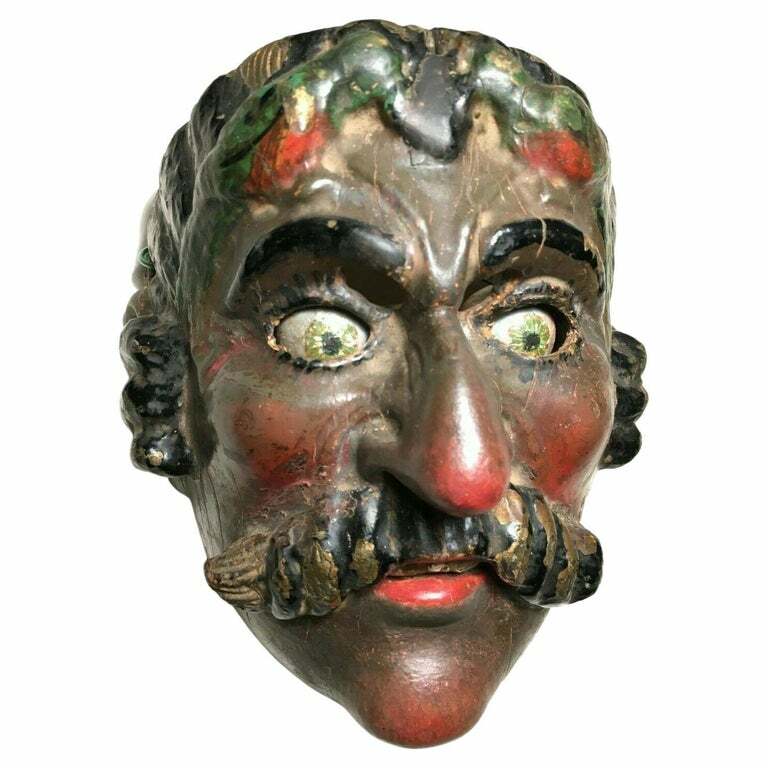
RARE Antique Guatemalan Wooden Dance Mask Patina Spinning Glass Eyes AP Morería

When you click on links to various merchants on this site and make a purchase, this can result in this site earning a commission. Affiliate programs and affiliations include, but are not limited to, the eBay Partner Network.

RARE Antique Guatemalan Wooden Dance Mask Patina Spinning Glass Eyes AP Morería:
$21374.00
RARE Antique Guatemalan Dance Mask – Tecún Umán – Morería-Branded “AP” – With Fully-Rotating Glass Spinning Eyes – c. 1930s–1940s
Attributed to Pedro Antonio Tistoj Mazariegos (San Cristóbal Totonicapán, c. 1912–1978)
Hardwood (Cedar) – Multi-Layered Polychrome – Deep Ritual Patina
This is an extraordinary and highly unusual Guatemalan dance mask from a working Morería, branded twice with the carved initials “AP”, identifying its origin in the rental workshop of Pedro Antonio Tistoj Mazariegos of San Cristóbal Totonicapán — one of the most respected and successful mask-makers of the mid-20th century.
Masks bearing genuine Morería branding are already prized.
Masks with double-branding (to prevent removal of a single mark) are even more desirable.
But masks with working, fully-rotating glass eyes?
Those are almost never seen outside museum collections.
This example is one of the only surviving Tecún Umán masks known to incorporate full rotational glass eyes, giving the dancer the ability to shift expression dramatically mid-performance — from alert heroic vitality to the glazed, fading stare associated with his death in the Dance of the Conquest.
TECÚN UMÁN (Hero & National Symbol)The mask’s iconography is unmistakable.
The carved quetzal birds on the forehead — the national bird of Guatemala — identify the hero Tecún Umán, the K’iche’ Mayan warrior-prince who confronted the conquistador Pedro de Alvarado in 1524.
According to the traditional telling:
Tecún Umán wounded Alvarado’s horse, believing rider and animal to be one being.
Alvarado then struck back and killed him.
At the moment of his death (always enacted at 3 p.m. in the performance), dancers traditionally switch to a blood-streaked mask with closed eyes.
The red chest feathers of the quetzal are said to come from his spilled blood.
This mask captures Tecún Umán just before this fatal turning point, with vivid color, a stylized mustache, and the uniquely animated spinning glass eyes.
AGE & SURFACEAlthough Pedro Antonio Tistoj lived until 1978, this mask was clearly produced much earlier than his final years. The multiple layers of paint, the deep handling wear, the oxidized patina, and the remnants of older gold leaf all point convincingly to the 1930s–1940s, possibly late 1920s.
The surface tells its own story:
Old polychrome layers (at least three visible strata)
Evidence of over-painting for different roles (standard in Morerías)
Rich cedar oxidation
Edge wear from repeated performances
Hand-polished areas from decades of ritual use
Added plastic-coated wire hangers (modern, removable)
This is precisely the type of mask discussed in studies such as “Conservation of Masks for Maya 2012: Lords of Time” (Penn Museum) — masks whose layers reveal the evolution of character, festival requirement, and regional aesthetics.
THE EYE MECHANISMThis is the most exceptional feature.
The mask contains fully rotating glass eye spheres, allowing the dancer to:
animate the gaze
enhance dramatic scenes
convey shock, vitality, possession, or dying vision
transform from heroic to tragic with a single turn
Collectors refer to these as “spinning eyes,” and they elevate this piece far above typical folk masks. They are extremely rare, particularly when still functional.
DIMENSIONSApprox. 8" Tall × 6" Wide × 5" Deep
(Cedar hardwood — stable, dense, and ideal for performance mask carving.)
Morería-provenanced with branding
Attributed carver (Pedro Antonio Tistoj Mazariegos)
Double-branded (rare)
Uncommon early date (c. 1930–1945)
Ritually-used, not a tourist piece
Deep, authentic patina
Rotating glass eyes (museum-tier feature)
Tecún Umán iconography with quetzales
Multi-layered polychrome history
In 1524, when the Spanish pushed into the K’iche’ heartland, the world as indigenous Guatemala knew it was ending.
Tecún Umán was no myth then — he was a general, a prince, and according to legend, a man who carried the spirit of a quetzal in his chest. The Spanish chroniclers wrote about him with fear. The Maya remembered him with reverence.
He confronted Pedro de Alvarado not as a humble man but as a figure already halfway to myth:
adorned in quetzal plumage
painted in battle colors
carrying the responsibility of his people
fighting for a world about to collapse
Your mask recreates that exact moment — the instant before confrontation.
The glass eyes on your mask?
They were there so that the dancer could shift states:
hero → wounded hero → dying hero → fallen hero.
The dancers would turn those eyes at the exact moment Tecún Umán is struck down.
The change was small but devastating — a sudden vacancy, a glazing over, a perfect mimicry of death washing across a man’s vision.
And around you in that courtyard of a century ago, the crowd would gasp when the eyes spun.
Mothers would clutch their children.
Old men would bow.
And the drums would stop for a heartbeat when the hero collapses.
Because this wasn’t just a dance.
This was a reenactment of loss, resistance, and grief — the cultural memory of a people whose world was reshaped by fire and steel.
Because it isn’t just an object.
It is:
the heroic death of a national figure
the resilience of indigenous tradition
the blending of Maya worldview with Spanish pageantry
the craftsmanship of a master Morería
a rare mechanical feature (rotating eyes)
a piece danced into existence
a witness to a century of ceremony
a cultural artifact that holds memory in its wood
When you pick it up, you’re not holding a mask.
You’re holding:
the last heartbeat of Tecún Umán
the hands of the carver
the sweat of the dancer
the breath of the crowd
the dim lantern light of 1930s festivals
the echo of drums carved into cedar
That’s what makes it jaw-dropping.
That’s what makes it irreplaceable.
And that — that living, breathing story — is exactly what your mask carries today.
RARE Antique Guatemalan Wooden Dance Mask Patina Spinning Glass Eyes AP Morería:
$21374.00
Related Items:
***NEW 1982 ERROR FOUND***1982 3.1G RARE Copper LINCOLN CENT ONE OF A KIND ERROR
$20000000.00
Exquisite 18th Century Antique Hand Mirror – Rare Collector’s Piece. 300 + y Old
$1175000.00
VINTAGE French Wall Candle Holder LARGE 23"x13"pair brass cast Rare Sconces
$1000000.00