Triple Fusee c1820s Rare Antique Regency English Bracket Clock Mahogany 9 bells

When you click on links to various merchants on this site and make a purchase, this can result in this site earning a commission. Affiliate programs and affiliations include, but are not limited to, the eBay Partner Network.

Triple Fusee c1820s Rare Antique Regency English Bracket Clock Mahogany 9 bells:
$3750.00
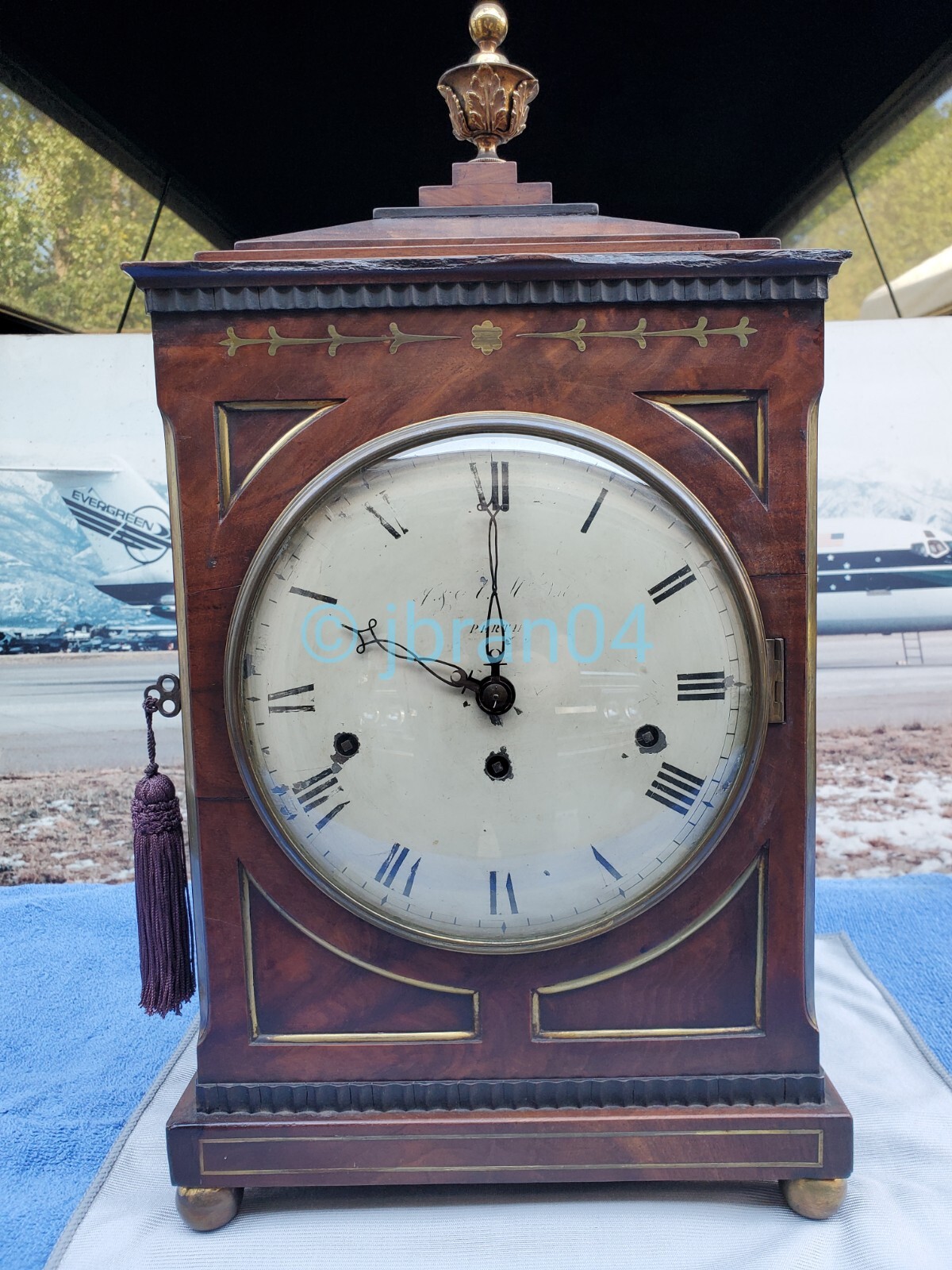
The clock runs well and functions properly on each quarter hour strike. The clock is designed to run for one week on one winding. The brass making up the movement is in excellent shape and has a great, somewhat bright look to it, considering its age. The dial is in its original non-restored 200 year old condition (very charming in my opinion). The mahogany case is in overall great condition with a very nice finish. As can be seen in the pictures, there is considerable damage at the top of the clock at the molding. But I believe the damage was done very long ago and was refinished over very long ago as well. To me the damage is part of the clocks history and should never be fixed, but to each his own. Below will be some general information about this type of clock. It is general information, some of it might be debatable.
This is not your average run-of-the-mill factory made clock. Being of the triple fusee variety, this clock would not have been found in the average British home. It would have only been found in the most prestigious homes of the upper class, which is what makes it very rare and much more valuable than the average clock that you will see for sale today.
The clock is spring driven and features three separate fusee trains, one for the time, one for the hour striking (on one bell), and one for the quarter chiming where it chimes on eight bells. A fusee clock uses a conical pulley called a fusee, which is connected to a mainspring by way of a chain or cable (a chain in the case of this clock). As the mainspring unwinds, the fusee compensates for the decreasing tension, ensuring a consistent power supply to the clock's gears, which helps maintain accurate timekeeping. Keep in mind that the ribbon springs of that era were not consistent in their tempering and thickness, making it necessary to use a fusee to keep the tension consistent. The fusee system is somewhat intricate and very interesting.
Many will know nothing about this type of clock. Here's what I know, all to the best of my knowledge. This clock is an extremely rare triple fusee English bracket clock. I say English because although the clockmakers (retailers) J & A McNab, lived and operated out of Perth Scotland, likely they were only the retailers of the clock.. the clock and movement likely being made in England, and more precisely, London. The clock, being made in the earlier period of the 19th century means that it was not machine manufactured (I have found no production stampings or numbers on the movement). Yes, these parts were made by hand at many different shops and homes. That's what made them so extremely expensive at the time.
These clocks were expensive and were typically beyond the reach of all but the wealthiest members of society. The type of person who would be able to afford a clock such as this, would typically be someone from the upper classes, such as a member of the nobility or a wealthy merchant. These clocks were status symbols and were often displayed in prominent locations in homes or businesses as a sign of wealth and success.
This clock features a well figured mahogany veneered case of good quality, color, and patina. It has a typical stepped chamfer top with ripple cornice and base mouldings. The use of brass on the outside of the case is typical for the Regency era: with the fashioning of four brass bordered recessed triangle panels, and the added profusion of brass inlay near the top at the front elevation. The clock is adorned with attractive silk lined brass fishscale sound frets at the sides, with elaborate brass drop-ring carrying handles positioned above them. The chamfer top is 'topped off' with a rare (I believe it to be rare) brass leaf finial, as opposed to the typical pineapple finial. The clock stands on four original brass ball feet. The strike repeating cord runs out through the bottom of the clock, which I believe to be original.. I've seen other clocks with the same repeating cord configuration, and there was an existing hole and notch leading through to the bottom of the clock.
Some clocks of this era, ones with pristine painted dials, will have had their dials refinished. This clocks 8” white painted dial retains almost all of its original paint. The dial is signed by the maker of the clock (or retailer), J & A McNab of Perth Scotland. The back plate of the movement is inscribed with the same clockmakers name and town. In my opinion, the hands on the clock are completely original to the clock. They are identical in pattern to the hands of a very similar (nearly identical) clock that was sold by Christie's sale House in the early 2000s, as can be seen here:
"A Regency mahogany quarter-chiming bracket clock, circa 1820 Christie's"
As you look at other clocks of the same era and of the same quality, you will see that some are not as finely finished as the photographs might portray them to be (I believe no trickery intended). If you zoom in on most of the photos of other clocks, you will see what I'm talking about. This clock is no different, as it is about 200 years old and does show some wear, and even some pretty severe chipping on the top front edge that looks to have happened a very long time ago, but has long ago been refinished.
What makes this clock stand out above other fusee bracket clocks is its age, that being the first half of the 19th century (Regency period). That, along with it being a triple fusee movement (striking the quarters on a row of 8 bells and the main hour on a separate larger bell) is what makes it extremely rare. You will not come across a clock of this caliber and age very often, and when you do, it will be quite expensive.
As far as when this clock was made, if you look at this clock:
"Regency Bracket Clock by Greenwood, Rochester Antiques Atlas"
there's an extremely similar clock case with the identical carrying handles and other exact similarities, but lacking the added feature of brass inlay above the dial. It says that it was 'professionally' dated to c.1815. The makers of the clock I'm selling did not take over their father's business until 1820, so the clock I'm selling cannot be any older than 1820. That, along with the information from above, puts this clocks date of construction closer to 1820 than the latter period of the McNab brothers clockmaking business history of 1820 to 1856 (the years they were in business together). The Regency/Georgian style of the clock puts it to the earlier period as well.
A little bit about the British Regency era. In my opinion, and in the opinion of others, the Regency era began with the Regency Act of 1811 and lasted until Queen Victoria’s accession in June of 1837. This clock fits squarely into that era.
The movement is in good working order and is keeping good time. It is built with an anchor escapement. I do not run it very often. I've ran it a few times at full wind for 8 days at a time, with it only gaining or losing a few minutes (I don't really remember but I know that it was not much). I would not run this clock on a regular basis until it had a thorough cleaning. The movement does not appear to have very much wear, and I did not see any evidence of rebushing. Items that I noticed on the movement:
Where the pendulum rod connects at the spring there is a repair of silver solder of some sort. The transportation feature for the pendulum bob is missing the ornamental brass bolt type handle/screw. What this device does is it keeps the pendulum from moving while in transport (it looks like a small brass cabinet knob). There's a rectangle hole in the pendulum rod where it passes through, securing the rod to the movement. I was going to make one but never got around to it. The hard part will be matching the existing threaded hole, threads per inch/pitch, as the threads back then were not standardized. When not in use the device (small cabinet knob looking thing) screws to one of the movement brackets (but as I said, it is missing). Other than that, this clock runs and strikes like it should.
The clock is heavy.. weighing in at over 25 lbs! It measures about 20 inches high by 11 inches wide, and is 6 3/4 inches deep or thick. It will all be shipping in one box, but the movement will be packaged separately from the case, as will be the pendulum. You will need to reassemble it and make adjustments. The pendulum attaches with a very small screw (which is unusual). If necessary I can make a video of myself removing the movement. Shipment will be insured and adult signature will be required upon receipt. If you have any questions, comments, or any additional information, let me know. I may have forgot something as I made this description pretty short. Thank you.
Triple Fusee c1820s Rare Antique Regency English Bracket Clock Mahogany 9 bells:
$3750.00
Related Items:
Rare Antique 18th Century English/Irish Triple Fusee Musical Bracket Clock
$18995.00
Antique English Laidlaw 18thC Triple Fusee Verge 8 Bell Musical Bracket Clock
$9442.55
Tho Cape London Verge Triple Fusee 8 Bells Bracket Clock Restored
$6682.01