Space Flown Watch Dr. Shannon Lucid NASA Astronaut STS-58 Columbia Mir W/ COA


When you click on links to various merchants on this site and make a purchase, this can result in this site earning a commission. Affiliate programs and affiliations include, but are not limited to, the eBay Partner Network.

Space Flown Watch Dr. Shannon Lucid NASA Astronaut STS-58 Columbia Mir W/ COA:
$50000.00
For your listing, I have focused on the unique "Space Flown" provenance of this item. Items personally owned and flown by record-breaking astronauts like Dr. Shannon Lucid are highly sought after by space memorabilia collectors.
Lucid's STS-58 Flown Armitron Watch Shannon Lucid's flown Armitron H2O watch she wore in space on her STS-58 mission. Excellent condition and probably just needs a battery to run. Comes with a signed COA from Lucid
Header Logos (Left to Right): 1. STS-51G Discovery 2. STS-34 Atlantis 3. STS-43 Atlantis 4. STS-58 Columbia (The Mission this watch flew on) 5. STS-76 Atlantis 6. STS-79 Atlantis 7. NASA/Mir Program Logo
Center Text:
Dr. Shannon Lucid - STS-51G, 34, 43, 58, 76, 79, Mir
Certification Statement:
I certify that the Armitron H20 watch shown above, was flown into space by me on my STS-58 mission. It has been in my personal collection ever since.
Signature: Hand-signed in black ink: Shannon Lucid Printed below: Dr. Shannon Lucid, STS-51G, 34, 43, 58, 76, 79, Mir
Item DescriptionHeadline: Rare NASA Artifact - Personally Flown Armitron H20 Watch from Dr. Shannon Lucid (STS-58)
Provenance & History: Up for sale is a truly one-of-a-kind piece of space history. This vintage Armitron H20 "Awatch" was personally owned and flown into space by legendary NASA Astronaut Dr. Shannon Lucid during the STS-58 mission aboard the Space Shuttle Columbia (October 18 – November 1, 1993).
This watch is accompanied by a Certificate of Authenticity (COA) signed by Dr. Lucid herself, confirming its flight status and its history within her private collection.
About Dr. Shannon Lucid: Dr. Shannon Lucid is one of the most decorated and respected astronauts in NASA history.
Record Breaker: At the time of her retirement, she held the record for the most flight hours in orbit by any woman in the world (5,354 hours).
Space Pioneer: A member of NASA's first astronaut class to include women (1978).
Mir Resident: Famous for her 188-day stay aboard the Russian Space Station Mir.
Honors: She was the first woman to receive the Congressional Space Medal of Honor.
The Mission (STS-58): STS-58 was a dedicated life sciences mission (SLS-2) focused on how the human body adapts to microgravity. During this 14-day flight, the crew of the Columbia traveled over 5.8 million miles. This watch was a witness to that incredible journey.
Item Details:
Model: Armitron H20 (Awatch)
Design: Classic 90s aesthetic with a vibrant pink/magenta strap, black bezel, and multi-colored index dots on the dial.
Condition: Flown/Used condition. The watch remains in its protective plastic sleeve as kept by Dr. Lucid. (Please note: As a vintage electronic item, it is sold as a collectible artifact; battery functionality is not guaranteed).
Keywords for Collectors: NASA, Space Shuttle, Columbia, Astronaut Autograph, Flown-in-Space, Space Artifact, Memorabilia, Shannon Lucid, STS-58, Mir Station, Vintage Armitron, Awatch, Space Exploration.
Shannon Matilda Wells Lucid (née Wells; born January 14, 1943) is an American biochemist and retired NASA astronaut. She has flown in space five times, including a prolonged mission aboard the Russian space station Mir in 1996, and is the only American woman to have stayed on Mir. From 1996 to 2007, Lucid held the record for the longest duration spent in space by an American and by a woman. She was awarded the Congressional Space Medal of Honor in December 1996, making her the tenth person and the first woman to be accorded the honor.Lucid is a graduate of the University of Oklahoma, where she earned a bachelor's degree in chemistry in 1963, a master's degree in biochemistry in 1970, and a PhD in biochemistry in 1973. She was a laboratory technician at the Oklahoma Medical Research Foundation from 1964 to 1966, a research chemist at Kerr-McGee from 1966 to 1968, and a research associate at the Oklahoma Medical Research Foundation from 1973 to 1978.In 1978, Lucid was recruited by NASA for astronaut training with NASA Astronaut Group 8, the first class of astronauts to include women. She flew in space five times: on STS-51-G, STS-34, STS-43, STS-58, and her mission to Mir, for which Lucid traveled to the space station on Space Shuttle Atlantis with STS-76 and returned six months later with STS-79. She was the NASA Chief Scientist from 2002 to 2003 and a capsule communicator (CAPCOM) at Mission Control for numerous Space Shuttle missions, including STS-135, the final mission of the Space Shuttle program. Lucid announced her retirement from NASA in 2012.
Early lifeShannon Matilda Wells was born in Shanghai, Republic of China, on January 14, 1943,[1][2] the daughter of Joseph Oscar Wells, a Baptist missionary, and his wife Myrtle, a missionary nurse. Due to America's ongoing war with Japan, when she was six weeks old, the family was detained by the Japanese, who had occupied Shanghai at the time. The three of them were imprisoned in an internment camp but were released during a prisoner exchange later that year. They returned to the United States on the Swedish ocean liner MS Gripsholm and stayed in the US until the end of the war.[3][4][5]After the war ended, the family returned to China but decided to leave again after the Chinese Communist Revolution in 1949.[3] They moved to Lubbock, Texas, and then settled in Bethany, Oklahoma, the family's original hometown, where Wells graduated from Bethany High School in 1960.[5] She was fascinated by stories of the American frontier and wanted to become an explorer. She concluded that she had been born too late for this, but discovered the works of Robert Goddard, the American rocket scientist, and decided that she could become a space explorer. Wells sold her bicycle to buy a telescope so she could look at the stars,[6] and began building her own rockets. Shortly after graduating from high school, Wells earned her private pilot's license with instrument and multi-engine ratings and bought a preowned Piper PA-16 Clipper that she used to fly her father to revival meetings. She applied for jobs as a commercial pilot, but was rejected, as women were not yet accepted for training as commercial pilots in the United States.[3][5][7]Wells attended Wheaton College in Illinois, where she majored in chemistry. She then transferred to the University of Oklahoma, where she earned her bachelor's degree in chemistry in 1963. She was a teaching assistant in the University of Oklahoma's Department of Chemistry from 1963 to 1964 and a senior laboratory technician at the Oklahoma Medical Research Foundation in Oklahoma City, from 1964 to 1966. She then became a research chemist at Kerr-McGee, an oil company there.[3][5] At Kerr-McGee she met Michael F. Lucid, a fellow research chemist. They married in 1967,[8] and their first child, Kawai Dawn, was born in 1968.[3][9]Afterward, Lucid left Kerr-McGee and returned to the University of Oklahoma as graduate assistant in the Department of Biochemistry and Molecular Biology, where she pursued a master's degree in biochemistry. She sat for her final examinations two days after the birth of her second daughter, Shandara Michelle, in 1970.[3][9] She went on to earn her PhD in biochemistry in 1973, writing her thesis on the Effect of Cholera Toxin on Phosphorylation and Kinase Activity of Intestinal Epithelial Cells and Their Brush Borders under the supervision of A. Chadwick Cox.[10][11] She then returned to the Oklahoma Medical Research Foundation as a research associate.[2] A third child, Michael Kermit, was born in 1975.[9]
NASA career
Selection and training
Main article: NASA Astronaut Group 8On July 8, 1976, the National Aeronautics and Space Administration (NASA) issued a call for applications for at least 15 pilot candidates and 15 mission specialist candidates. For the first time, new selections would be considered astronaut candidates rather than fully-fledged astronauts until they finished training and evaluation, which was expected to take two years.[12] The enactment of the Equal Employment Opportunity Act of 1972 reinforced the promise of the Civil Rights Act of 1964 to address the persistent and entrenched employment discrimination against women, African Americans and minority groups in American society. While they had never been explicitly precluded from becoming NASA astronauts, none had ever been selected either.[13][14] This time, minorities and women were encouraged to apply.[12] Lucid's was one of the first of 8,079 applications received.[15][16]
The first NASA women astronauts. Back row, left to right: Kathryn Sullivan, Shannon Lucid, Anna Fisher, Judith Resnik. Front row, left to right: Sally Ride and Rhea Seddon.As one of 208 finalists,[16] Lucid was invited to come to the Johnson Space Center (JSC) in Houston, Texas, for a week of interviews, evaluations and examinations, commencing on August 29, 1977. She was part of the third group of twenty applicants to be interviewed, and the first one that included women. The eight women in the group included Rhea Seddon, Anna Sims, Nitza Cintron and Millie Hughes-Wiley.[17] On January 16, 1978, NASA announced the names of the 35 successful candidates, of whom 20 were mission specialist candidates.[16] Of the six women in this first class with female astronauts, Lucid was the only one who was a mother at the time of being selected.[18] George Abbey, the Director of Flight Crew Operations at JSC and the chairman of the selection panel,[16] later stated that this was not taken into consideration during the selection process.[5]Group 8's name for itself was "TFNG". The abbreviation was deliberately ambiguous; for public purposes, it stood for "Thirty-Five New Guys", but within the group itself, it was known to stand for the military phrase, "the fucking new guy", used to denote newcomers to a military unit.[19] Much of the first eight months of their training was in the classroom.[20] Because there were so many of them, the TFNGs did not fit easily into the existing classrooms, so for classroom instruction they were split into two groups, red and blue, led by Rick Hauck and John Fabian respectively.[21] Classroom training was given on a wide variety of subjects, including an introduction to the Space Shuttle program, space flight engineering, astronomy, orbital mechanics, ascent and entry aerodynamics and space flight physiology. Those accustomed to military and academic Environments were surprised that subjects were taught, but not tested.[20] Training in geology, a feature of the training of earlier classes, was continued, but the locations visited changed because the focus was now on observations of the Earth rather than the Moon.[22]Astronaut candidates had to complete survival training, be able to swim and scuba dive, and master the basics of aviation safety, as well as the specifics of the spacecraft they would have to fly.[23] Water survival training was conducted with the 3613th Combat Crew Training Squadron at Homestead Air Force Base in Florida and parasail training at Vance Air Force Base in Oklahoma.[24] On August 31, 1979, NASA announced that the 35 astronaut candidates had completed their training and evaluation, and were now officially astronauts, qualified for selection on space flight crews.[25] Their training, which had been expected to last eighteen to twenty-four months, had been completed in fourteen. That of subsequent classes was shortened to twelve months.[26]Each of the new astronauts specialized in certain aspects of the Space Shuttle program, providing astronaut support and input. Lucid was involved with Spacelab 1 crew training, and the development of the Shuttle Avionics Integration Laboratory (SAIL) at JSC and Rockwell International's Flight Systems Laboratory (FSL) in Downey, California. She also worked on the Hubble Space Telescope and rendezvous proximity operations.[27] She was at Edwards Air Force Base as a member of the exchange crew for the landing of the STS-5 mission in November 1982. The exchange crew took over from the flight crew after they had landed, and handled the post-flight activities.[28] She was an astronaut support person (ASP) at the Kennedy Space Center (KSC) for the STS-8 mission in August 1983.[29] Also known as a "Cape Crusader", an ASP was an astronaut who supported vehicle and payload testing at KSC, and strapped the flight crew into their seats before takeoff.[30] For the STS-41-B mission in February 1984 she was the backup ASP and once again a member of the exchange crew.[31]
STS-51-G
Main article: STS-51-GOn November 17, 1983, Lucid was assigned to her first flight, the STS-51-A mission. Tentatively scheduled for October 24, 1984, the mission would be commanded by Daniel Brandenstein, with pilot John O. Creighton and Lucid, Fabian and Steven R. Nagel as mission specialists. She would be the last of the six women in the TFNG group to fly.[32] Due to slippages, the crew was reassigned to the STS-51-D mission in August 1984. This mission had a different payload, and it was scheduled to be launched on March 18, 1985.[33] The mission was scrubbed just three weeks before the launch date.[34] In May 1985 the crew was reassigned to the STS-51-G mission. A French astronaut, Patrick Baudry, and a Saudi Arabian prince, Sultan bin Salman Al Saud were assigned as payload specialists.[35]
On the STS-51-G missionSTS-51-G lifted off from Launch Complex 39A at KSC in the Space Shuttle Discovery on June 17, 1985. The seven-day mission was to deploy three communications satellites: Morelos I for Mexico, Arabsat-1B for the Arab League, and Telstar 303 for the United States.[36] The satellites were launched on successive days during the first three days of the mission. Lucid and Fabian operated the Remote Manipulator System (RMS) to deploy the satellites, which were boosted into geostationary transfer orbits by Payload Assist Module (PAM-D) booster stages.[37]Lucid also used the RMS to deploy the Spartan (Shuttle Pointed Autonomous Research Tool for Astronomy) satellite, which performed 17 hours of X-ray astronomy experiments while separated from the Space Shuttle, while Fabian handled its retrieval 45 hours later.[37][38] In addition to the satellite deployments, the crew activated the Automated Directional Solidification Furnace (ADSF), six Getaway Specials and participated in biomedical experiments. Discovery landed at Edwards Air Force Base in California on June 24. The mission was accomplished in 112 orbits of the Earth, traveling 4.7 million kilometers (2.9 million miles) in 169 hours and 39 minutes (just over one week).[36]The publicity tour that usually followed a Space Shuttle mission included a trip to Saudi Arabia. Married women were not permitted to travel to Saudi Arabia without their husband, and Michael Lucid was unavailable, so Lucid decided not to go. A devout Christian, she disapproved of the way Saudi Arabia treated women. When the rest of the crew arrived in Riyadh, her absence was noted. This prompted a call from King Fahd of Saudi Arabia to President Ronald Reagan. Lucid went to Saudi Arabia and shook hands with the king, but she stayed for only one day.[39][40] For the visit to be possible, Lucid was designated by the Saudi Arabian government as a honorary man.[41]
STS-34
Main article: STS-34
The five STS-34 astronauts pose for an in-space crew portrait.After the STS-51-G mission, Lucid was assigned to Capsule Communicator (CAPCOM) duty. She served as the CAPCOM for the STS-51-J mission in October 1985,[42] the STS-61-A mission in November 1985,[43] STS-61-B mission in November and December 1985,[44] and the STS-61-C mission in January 1986.[45] The January 1986 Space Shuttle Challenger disaster later that month halted Space Shuttle operations for 32 months while NASA conducted investigations and remediation. Flight crews were stood down. One consequence of the disaster was the Galileo project, an unmanned probe to Jupiter, which lost both its launch window and its ride due to the cancelation of the Shuttle-Centaur project.[46]On November 30, 1988, NASA announced that Galileo would be deployed by the Space Shuttle Atlantis on the STS-34 mission, which was scheduled for October 12, 1989. The mission was commanded by Donald E. Williams, with pilot Michael J. McCulley and Lucid, Ellen S. Baker and Franklin Chang-Diaz as mission specialists.[47] The launch was delayed for five days due to a faulty Space Shuttle main engine controller, and then for an additional day due to bad weather. Atlantis lifted off from KSC on October 18.[48]As the lead mission specialist, Lucid was primarily responsible for the Galileo spacecraft,[49] and initiated its deployment by pressing a button to separate Galileo from Atlantis.[50] Galileo was successfully deployed six and a half hours into the flight using the Inertial Upper Stage (IUS). As this was much less powerful than the Shuttle-Centaur upper stage, Galileo had to employ a gravity assist from Venus and two from Earth, and it took six years instead of two for the Galileo to reach Jupiter.[49][48] "Both Ellen and I sighed a great sigh of relief, because we figured Galileo was not our concern at that point, because we'd gotten rid of it," Lucid reported. "Happiness was an empty payload bay and we got happier and happier as the IUS and Galileo went further away from us."[51]The mission also conducted a five-day Shuttle Solar Backscatter Ultraviolet (SSBUV) experiment carried in the cargo bay, and experiments related to growth hormone crystal distribution (GHCD) and polymer morphology (PM), a sensor technology experiment (STEX), a mesoscale lightning experiment (MLE), a Shuttle Student Involvement Program (SSIP) experiment that investigated ice crystal formation in zero gravity, and a ground-based Air Force Maui Optical Station (AMOS) experiment. Lucid and Chang-Diaz operated the PM experiment, which used a laptop computer to collect two gigabytes of data from an infrared spectrometer to study the effects of microgravity on minerals. The crew filmed their activities with an IMAX camera. The mission completed 79 orbits of the Earth, traveling 3.2 million kilometers (2 million miles) in 119 hours and 39 minutes before landing at Edwards Air Force Base on October 23.[48][52]
STS-43
Main article: STS-43In May 1990 NASA announced that Lucid was assigned to the crew of the STS-43 mission, which was scheduled to be flown in Discovery in April 1991. The mission was commanded by John E. Blaha, with Michael A. Baker as the pilot and Lucid, G. David Low, and James C. Adamson as the mission specialists. The objective of the mission was to deploy TDRS-E, a communications satellite that would form part of NASA's Tracking and Data Relay Satellite System.[53]
Lucid conducts Development Test Objective (DTO) 1208, Space Station Cursor Control Device Evaluation II and Advanced Applications, at the payload station on the aft flight deck of the Space Shuttle AtlantisThe launch date was postponed to July 23, and the orbiter was changed to Atlantis. The launch was delayed by a day to replace a faulty integrated electronics assembly that controlled the separation of the orbiter and the external tank, and then the countdown was halted with five hours to go due to a faulty main engine controller, and the launch was postponed to August 1. Unfavorable weather prompted yet another 24-hour delay. Atlantis lifted off on August 2.[54]The crew deployed TDRS-E without incident using the IUS.[54] The crew also conducted 32 physical, material and life science experiments, mostly related to the Extended Duration Orbiter and Space Station Freedom.[2] These included experiments with the Space Station Heat Pipe Advanced Radiator Element II (SHARE II), the Shuttle Solar Backscatter Ultra-Violet (SSBUV) instrument, Tank Pressure Control Equipment (TPCE), and Optical Communications Through Windows (OCTW). There was also an auroral photography experiment (APE-B), a protein crystal growth experiment, testing of the bioserve / instrumentation technology associates materials dispersion apparatus (BIMDA), investigations into polymer membrane processing (IPMP), the space acceleration measurement system (SAMS), a solid surface combustion experiment (SSCE), use of the ultraviolet plume imager (UVPI); and the Air Force Maui optical site (AMOS) experiment.[55]Atlantis performed 142 orbits of the Earth, traveling 6.0 million kilometers (3.7 million miles) in 213 hours and 21 minutes.[54] STS-43 was the eighth mission to land at KSC, and the first one scheduled to do so since STS-61-C in January 1986.[55]
STS-58
Main article: STS-58
Lucid, in the middeck waste collection system facility, peeking out from behind the privacy curtainOn December 6, 1991, Lucid was assigned to STS-58, the Spacelab Life Sciences 2 (SLS-2) mission. This was the second mission dedicated to the study of human and animal physiology on Earth and in spaceflight. The techniques developed for this flight were intended to be precursors of those to be conducted on the Space Station Freedom and subsequent long-duration space flights. Fellow TFNG Rhea Seddon was designated as the mission payload commander, with David Wolf, like Seddon a medical doctor, as the other mission specialist.[56] Originally scheduled as one mission, the number of Spacelab Life Sciences objectives and experiments had grown until it was split into two missions,[57] the first of which, STS-40/SLS-1, was flown in June 1991.[58] The rest of the crew were not named until August 27, 1992. Blaha was designated the mission commander, with pilot Richard A. Searfoss and William S. McArthur Jr. as a fourth mission specialist.[59] A payload specialist, Martin J. Fettman, was assigned to the mission on October 29.[60]The Space Shuttle Columbia with SLS-2 on board lifted off from KSC on October 18, 1993. During the fourteen-day flight the crew performed neurovestibular, cardiovascular, cardiopulmonary, metabolic and musculoskeletal medical experiments on themselves and 48 rats.[61] The crew investigated the phenomenon of bone density loss. They also studied the effects of microgravity on their sensory perception, and the mechanism of space adaptation syndrome. To study this, on the second day of the mission Lucid and Fettman wore headsets, known as accelerometer recording units, which recorded their head movements during the day. Along with Seddon, Wolf and Fettman, Lucid collected blood and urine samples from the crew for metabolic experiments. They also drew blood from the tails of the rats to measure how weightlessness affected their red blood cell counts.[62] They performed sixteen engineering tests aboard Columbia and twenty Extended Duration Orbiter Medical Project experiments. The mission completed 225 orbits of the Earth, traveling five million miles in 336 hours, 13 minutes and 1 second. Landing was at Edwards Air Force Base, California.[61] On completion of this flight, Lucid had logged 838 hours and 54 minutes in space.[2]
Shuttle–Mir
Main article: Shuttle–Mir program
Communicating with the ground support team inside the Core Module of MirIn 1992 the United States and Russia reached an agreement on cooperation in space so that Russian cosmonauts could fly on the Space Shuttles, and American astronauts on the Russian Mir space station.[63] The prospect of a long stay on Mir was not one calculated to appeal to most astronauts: they had to learn Russian and train at Star City for a year to spend several months on board Mir carrying out science experiments with Russian cosmonauts.[64] "I was wondering what it would be like to spend a long period of time in space," Lucid later recalled. "I told everybody I wanted to do it, and they couldn't find anybody else who had volunteered. So they said: 'Well OK, go do it.'"[64] In January 1995 Lucid and Blaha joined fellow astronauts Bonnie Dunbar and Norman Thagard for Mir training in Star City.[65] On March 30, 1995, NASA announced that Lucid would be the second astronaut to stay aboard Mir,[66] after Thagard, who arrived on the space station on March 16.[67]Lucid's mission to Mir commenced on March 22, 1996, with liftoff from KSC aboard Atlantis on the STS-76 mission. Atlantis docked with Mir on March 24, and Lucid became the first American woman to live on the station.[68] She joined cosmonauts Yuri Onufriyenko and Yuri Usachov, neither of whom spoke English.[69] During the course of her stay aboard Mir, Lucid performed numerous life science and physical science experiments. She lit candles to study the behavior of fire in a microgravity Environment; studied the way that quail embryos developed in their shells; grew protein crystals; and cultivated wheat in a tiny greenhouse.[3][70] She injected herself with an immune system stimulant and collected blood and saliva samples to study the effects of microgravity on the immune system.[71]
Exercising on a treadmill during her stay aboard MirIn her free time, she read books. One novel she enjoyed immensely was The Mirror of Her Dreams, but she reached the end only to find that it ended on a cliffhanger. "I floated there, alone in Spectra, in stunned disbelief, holding only volume one," she later recalled. "I was stranded, the impossibility of running to the local bookstore forefront in my mind ... How could my daughter have done this to me? Who would send only one volume of a two-volume set to her mother in space?"[72] She arranged for the second volume to be sent on the next Progress resupply freighter.[73] She left her books on Mir for later astronaut visitors, but they became inaccessible after the Progress M-34 collision in June 1997.[74] Thagard had warned Lucid about the Russians' fondness for jellied fish and borscht. She brought a supply of M&M's and jello with her, and lived on a combination of Russian and American food.[75]Lucid's return journey to KSC was made aboard Atlantis. The STS-79 mission docked with Mir on September 18, bringing Blaha as her relief, and landed back at KSC on September 26, 1996.[76] One of the catches that released her helmet from the neck ring became stuck, and technicians had to use pliers and a screwdriver to remove it.[3][77] During her stay on Mir, Lucid had spent nearly 400 hours exercising on a stationary bicycle and a treadmill, and was able to stand and walk off Atlantis. Administrator of NASA Daniel Goldin presented her with a giftwrapped box of M&M's, a gift from President Bill Clinton, since she had told him that she craved them.[3][78]In completing this mission Lucid traveled 121.0 million kilometers (75.2 million miles) in 188 days, 4 hours, 0 minutes. This included 179 days on Mir.[2] Her stay on Mir was not expected to last so long but her return was delayed twice, extending her stay by about six weeks.[69] As a result of her time aboard Mir, she held the record for the most hours in orbit by a non-Russian, and most hours in orbit by a woman until June 16, 2007, when her record for longest duration spaceflight by a woman was exceeded by Sunita Williams on the International Space Station.[79][80]
CAPCOM
As CAPCOM on July 12, 2011, on the STS-135 missionLucid had a short cameo in the 1998 film Armageddon.[81] From 2002 to 2003, she served as Chief Scientist of NASA. Starting in 2005, she served as lead CAPCOM on the Planning (overnight) shift at the Mission Control for sixteen Space Shuttle missions, including STS-135, the final mission.[2] On January 31, 2012, she announced her retirement from NASA.[80][82]
Later lifeLucid retired from NASA to take care of her husband Mike, who had dementia. He died on December 25, 2014.[83] She later wrote about this experience in her book No Sugar Added: One Family's Saga of Dementia and Caretaking (2019).[84] She wrote about her experiences on Mir in Tumbleweed: Six Months Living on Mir (2020).[85]
Awards and honorsLucid was awarded the Congressional Space Medal of Honor in December 1996 (for her mission to Mir), making her the tenth person and first woman to be given this honor.[86] She was also awarded the NASA Space Flight Medal in 1985, 1989 (twice), 1991, 1993 and 1996; the NASA Exceptional Service Medal in 1988, 1990, 1992 and 2003 (twice); and the NASA Distinguished Service Medal in 1994 and 1997.[87] She was inducted into the International Space Hall of Fame in 1990,[88] the Oklahoma Women's Hall of Fame in 1993,[89] the National Women's Hall of Fame in 1998,[90] and the United States Astronaut Hall of Fame in 2014.[91][92] In 2002 Discover magazine recognized her as one of the fifty most important women in science.[93]STS-58 was a NASA mission flown by Space Shuttle Columbia launched from Kennedy Space Center, Florida, on October 18, 1993. The missions was primarily devoted to experiments concerning the physiological effects in space. This was the first in-flight use of the "Portable In-flight Landing Operations Trainer" (PILOT) simulation software. It was also the last time Columbia would land at Edwards Air Force Base, California. The mission also attracted controversy for experiments involving the dissection of live rats in space.
Crew
Position Astronaut
Commander John E. Blaha
Fourth spaceflight
Pilot Richard A. Searfoss
First spaceflight
Mission Specialist 1
Payload Commander Rhea Seddon
Third and last spaceflight
Mission Specialist 2
Flight Engineer William S. McArthur
First spaceflight
Mission Specialist 3 David Wolf
First spaceflight
Mission Specialist 4 Shannon Lucid
Fourth spaceflight
Payload Specialist 1 Martin J. Fettman
Only spaceflight
Colorado State
Backup crew Position Astronaut
Payload Specialist Jay C. Buckey
Dartmouth
Payload Specialist Laurence R. Young[1]
MIT
Crew seat assignments
Seat[2] Launch Landing
Seats 1–4 are on the flight deck.
Seats 5–7 are on the mid-deck.
1 Blaha
2 Searfoss
3 Seddon Wolf
4 McArthur
5 Wolf Seddon
6 Lucid
7 Fettman
Mission highlights
Columbia on Pad 39B
Attempt Planned Result Turnaround Reason Decision point Weather go (%) Notes
1 14 Oct 1993, 12:53:00 pm Scrubbed — Technical 14 Oct 1993, 12:57 pm (T−00:00:31) 95[3] The attempt was initially delayed by weather, which later cleared in time for the attempt. However, a problem with the range safety command system occurred and could not be resolved before drainback time expired.[4]
2 15 Oct 1993, 10:53:00 am Scrubbed 0 days 21 hours 60 minutes Technical (T−00:09:00 hold) The orbiter's S-band transponder 2 failed and had to be replaced.[5]: 17 In addition, the weather was once again unacceptable.[4]
3 18 Oct 1993, 10:53:10 am Success 3 days 0 hours 0 minutes The countdown was held at T−5 minutes for ten seconds due to an intruding aircraft in the launch area.[4]STS-58 was a 1993 shuttle mission dedicated to life sciences research.[4][6] Columbia's crew performed a series of experiments to gain knowledge on how the human body adapts to the weightless Environment of space. Experiments focused on cardiovascular, regulatory, DNA, neurovestibular and musculoskeletal systems of the body. The experiments performed on Columbia's crew and on laboratory animals (48 rats held in 24 cages), along with data collected on the SLS-1 mission (STS-40) in June 1991, will provide the most detailed and interrelated physiological measurements acquired in the space Environment since the Skylab program in 1973 and 1974.[7]Crew members conducted experiments aimed at understanding bone tissue loss and the effects of microgravity on sensory perception. Two neurovestibular experiments investigating space motion sickness and perception changes were performed on the 2nd day as well. Astronauts Lucid and Fettman wore a headset, called an Accelerometer Recording Unit (ARU), designed to continually record head movements throughout the day.[7]Only one minor issue came up on October 19, 1993, associated with a circuit breaker that tripped, cutting off power temporarily to one of the rodent cages in the module. Flight controllers in Houston reported it was not caused by a short in the electrical system and the breaker was reset, restoring power to the cage.[7]McArthur and Blaha began using the Lower Body Negative Pressure device on flight day 3 (FD 3), which is being tested as a countermeasure for the detrimental effects of microgravity. All three flight crew members will collect urine and saliva samples and keep logs of their exercise and food and fluid intake as part of the Energy Utilization detailed supplementary objective. DSO 612 looks at the nutritial and energy requirements of crew members on long-duration space flights and the relationship between fluid and food consumption.[7]On October 20, 1993, though the space toilet is working fine, the crew detected a slight leak around the filter door before going to bed. They removed the filter and cleaned up about a teaspoon of water — much less than had been expected. As a precaution, a secondary fan separator unit was used to separate fluid from the air before cycling the air back into the cabin through the filter.[7]On October 21, 1993, Mission specialists Margaret Rhea Seddon (Payload commander), Shannon Lucid and David Wolf and Payload specialist Martin Fettman collected additional blood and urine samples for the series of metabolic experiments. Some of the samples will follow-up on the calcium absorption experiment performed on October 20, 1993. The experiment, sponsored by Dr. C. D. Arnaud of the University of California, San Francisco, studies the mechanisms of how calcium is maintained and used in bone metabolism in space. Based on preliminary results from the 1991 SLS-1 mission (STS-40), Dr. Arnaud believes the decrease in bone density is due to increased bone breakdown that is not compensated for by a subsequent increase in bone formation.[7]On October 22, 1993, using the on-board ham radio called SAREX-2 for Shuttle Amateur Radio Experiment, Blaha and Searfoss contacted school children at the Sycamore Middle School in Pleasant View, Tennessee, Gardendale Elementary in Pasadena, Texas and Naparima College in Trinidad and Tobago on November 4, 1993. The Standard Interface Rack (SIR), was tested by Searfoss to demonstrate that equipment can be removed from one rack location and reintegrated into another by a single crew member during orbital operations while maintaining reliable mechanical, data and power interfaces.[7]Another test flying aboard Columbia was the "Portable In-flight Landing Operations Trainer" (PILOT), a laptop computer simulator that was flown to qualify its use as a tool for helping the mission commander and pilot maintain their proficiency for approach and landing during longer duration Space Shuttle flights.[8] The laptop was controlled using a joy stick hand controller similar to the one used to fly the orbiter in the final minutes before landing. The simulator would continue to see use up to and including the final Shuttle flight (STS-135).[9]On October 23, 1993, the payload crew members were scheduled to devote much of their time to metabolic studies of the 48 rodents on board the Spacelab science workshop. Payload commander Rhea Seddon, and crewmates David Wolf, Shannon Lucid and veterinarian Marty Fettman were scheduled to draw blood from the tails of some of the rodents, then inject a special isotope into the rodents to measure the volume of their plasma. Another blood draw would follow, to measure how weightlessness may be affecting the red blood cell count of the animals.[7]After several ham radio contacts around the country and work in a vacuum bag designed to ease the body's readaptation to Earth's Environment, the orbiter crew made up of Commander John Blaha, Pilot Richard Searfoss and Mission specialist William McArthur oversaw a short firing of one of the orbital maneuvering system engines to drop the low end of Columbia's orbit from 278 × 263 km (173 × 163 mi) to increase the landing opportunities should the mission be extended for weather or a system problem that would keep the crew in orbit two extra days.[7]On October 27, 1993, Pilot Rick Searfoss put Columbia through some maneuvers as part of the Orbital Acceleration Research Experiment (OARE). The main goal of the experiment was to accurately measure the aerodynamic forces that act on the shuttle in orbit and during the early stages of entry. The information will be useful to scientists and engineers planning future Spacelab microgravity research flights in which experiments will need a quiet, motion-free Environment to produce the best possible data. On October 28, 1993, after enjoying a half a day off, the astronauts aboard Columbia continued to collect scientific data on how humans and animals adapt to the absence of Earth's gravity.[7]On October 30, Fettman and Seddon decapitated six of the 20 rats. This was done after pre-flight experiments determined that anasthesizing the rats would degrade their tissues and ruin the experiment. The rat tissues would be used after the mission to perform testing on the effects of weightlessness on them. The dissected rat parts were bagged and refrigerated for use in other scientific programs afterwards. The other rats would be examined for their reactions to two weeks of weightlessness and the effects on their physiological condition.[10]Payload commander Rhea Seddon sent down a special message to her husband, Astronaut Office Chief Robert L. Gibson when she surpassed his total of 632 hours, 56 minutes in space. "He's still a really good guy, I still love him a lot, but I've got more hours in space than he does, so there!" she teased. Seddon acknowledged, however, that he has more launches and landings, having flown four times to her three.[7]Pilot Rick Searfoss took time out from snapping some infrared photography of the wildfires burning in southern California to say that the crew's thoughts are with the firefighters working to quell the flames and the residents whose homes are being threatened. He said he hoped the fires would be brought under control soon, and added that the photographs he was taking will be among some 4,000 frames that will be returned to Earth for meteorologists, geologists, ecologists and archeologists to study after the flight.[7]
See also Spaceflight portal List of human spaceflights
List of Space Shuttle missions
Outline of space scienceThe National Aeronautics and Space Administration (NASA /ˈnæsə/) is an independent agency of the U.S. federal government responsible for the United States' civil space program and for research in aeronautics and space exploration. Headquartered in Washington, D.C., NASA operates ten field centers across the United States and is organized into mission directorates for Science, Space Operations, Exploration Systems Development, Space Technology, Aeronautics Research, and Mission Support. Established in 1958, NASA succeeded the National Advisory Committee for Aeronautics (NACA) to give the American space development effort a distinct civilian orientation, emphasizing peaceful applications in space science. It has since led most of America's space exploration programs, including Project Mercury, Project Gemini, the 1968–1972 Apollo program missions, the Skylab space station, and the Space Shuttle.The agency maintains major ground and communications infrastructure including the Deep Space Network and the Near Space Network. NASA's science division is focused on better understanding Earth through the Earth Observing System; advancing heliophysics through the efforts of the Science Mission Directorate's Heliophysics Research Program; exploring bodies throughout the Solar System with advanced robotic spacecraft such as New Horizons and planetary rovers such as Perseverance; and researching astrophysics topics, such as the Big Bang, through the James Webb Space Telescope, the four Great Observatories (including the Hubble Space Telescope), and associated programs. The Launch Services Program oversees launch operations for its uncrewed launches.NASA supports the International Space Station (ISS) along with the Commercial Crew Program and oversees the development of the Orion spacecraft and the Space Launch System for the lunar Artemis program. It maintains programmatic partnerships with agencies such as ESA, JAXA, CSA, Roscosmos (for ISS operations), NOAA, and the USGS. NASA's missions and media operations—such as NASA TV, Astronomy Picture of the Day, and the NASA+ streaming service—have maintained high public visibility and contributed to spaceflight outreach in the United States and abroad. A subject of numerous major films, NASA has maintained an influence on American popular culture since the Apollo 11 mission in 1969. For FY2022, Congress authorized a $24.041 billion budget, with a civil-service workforce of roughly 18,400; since December 2025, the administrator is Jared Isaacman.
History
Creation
A US Air Force Bell X-1 test flight
Main article: Creation of NASANASA traces its roots to the National Advisory Committee for Aeronautics (NACA). Despite Dayton, Ohio being the birthplace of aviation, by 1914 the United States recognized that it was far behind Europe in aviation capability. Determined to regain American leadership in aviation, the United States Congress created the Aviation Section of the US Army Signal Corps in 1914 and established NACA in 1915 to foster aeronautical research and development. Over the next forty years, NACA would conduct aeronautical research in support of the US Air Force, US Army, US Navy, and the civil aviation sector. After the end of World War II, NACA became interested in the possibilities of guided missiles and supersonic aircraft, developing and testing the Bell X-1 in a joint program with the US Air Force. NACA's interest in space grew out of its rocketry program at the Pilotless Aircraft Research Division.[5]
Launch of the Army Ballistic Missile Agency's Explorer 1, America's first satelliteThe Soviet Union's launch of Sputnik 1 ushered in the Space Age and kicked off the Space Race. Despite NACA's early rocketry program, the responsibility for launching the first American satellite fell to the Naval Research Laboratory's Project Vanguard, whose operational issues ensured the Army Ballistic Missile Agency would launch Explorer 1, America's first satellite, on February 1, 1958.The Eisenhower Administration decided to split the United States's military and civil spaceflight programs, which were organized together under the Department of Defense's Advanced Research Projects Agency. NASA was established on July 29, 1958, with the signing of the National Aeronautics and Space Act and it began operations on October 1, 1958.[5]As the American's premier aeronautics agency, NACA formed the core of NASA's new structure by reassigning 8,000 employees and three major research laboratories. NASA also proceeded to absorb the Naval Research Laboratory's Project Vanguard, the Army's Jet Propulsion Laboratory (JPL), and the Army Ballistic Missile Agency under Wernher von Braun. This left NASA firmly as the United States's civil space lead and the Air Force as the military space lead.[5]
First orbital and hypersonic flights
Main article: Project Mercury
Launch of Friendship 7, NASA's first crewed orbital flight, February 20, 1962Plans for human spaceflight began in the US Armed Forces prior to NASA's creation. The Air Force's Man in Space Soonest project formed in 1956,[6] coupled with the Army's Project Adam, served as the foundation for Project Mercury. NASA established the Space Task Group to manage the program,[7] which would conduct crewed sub-orbital flights with the Army's Redstone rockets and orbital flights with the Air Force's Atlas launch vehicles. While NASA intended for its first astronauts to be civilians, President Eisenhower directed that they be selected from the military. The Mercury 7 astronauts included three Air Force pilots, three Navy aviators, and one Marine Corps pilot.[5]
The NASA-Air Force X-15 hypersonic aircraftOn May 5, 1961, Alan Shepard became the first American to enter space, performing a suborbital spaceflight in the Freedom 7.[8] This flight occurred less than a month after the Soviet Yuri Gagarin became the first human in space, executing a full orbital spaceflight. NASA's first orbital spaceflight was conducted by John Glenn on February 20, 1962, in the Friendship 7, making three full orbits before reentering. Glenn had to fly parts of his final two orbits manually due to an autopilot malfunction.[9] The sixth and final Mercury mission was flown by Gordon Cooper in May 1963, performing 22 orbits over 34 hours in the Faith 7.[10] The Mercury Program was wildly recognized as a resounding success, achieving its objectives to orbit a human in space, develop tracking and control systems, and identify other issues associated with human spaceflight.[5]While much of NASA's attention turned to space, it did not put aside its aeronautics mission. Early aeronautics research attempted to build upon the X-1's supersonic flight to build an aircraft capable of hypersonic flight. The North American X-15 was a joint NASA–US Air Force program,[11] with the hypersonic test aircraft becoming the first non-dedicated spacecraft to cross from the atmosphere to outer space. The X-15 also served as a testbed for Apollo program technologies, as well as ramjet and scramjet propulsion.[5]
Moon landing
Main articles: Project Gemini and Apollo program
Gemini 6 and Gemini 7 conduct an orbital rendezvousEscalations in the Cold War between the United States and Soviet Union prompted President John F. Kennedy to charge NASA with landing a man on the Moon and returning him safely to Earth by the end of the 1960s and installed James E. Webb as NASA administrator to achieve this goal.[12] On May 25, 1961, President Kennedy openly declared this goal in his "Urgent National Needs" speech to the United States Congress, declaring: I believe this Nation should commit itself to achieving the goal, before this decade is out, of landing a man on the Moon and returning him safely to Earth. No single space project in this period will be more impressive to mankind, or more important for the long-range exploration of space; and none will be so difficult or expensive to accomplish.Kennedy gave his "We choose to go to the Moon" speech the next year, on September 12, 1962 at Rice University, where he addressed the nation hoping to reinforce public support for the Apollo program.[13]Despite attacks on the goal of landing astronauts on the Moon from the former president Dwight Eisenhower and 1964 presidential candidate Barry Goldwater, President Kennedy was able to protect NASA's growing budget, of which 50% went directly to human spaceflight and it was later estimated that, at its height, 5% of Americans worked on some aspect of the Apollo program.[5]
Launch of the 1969 Apollo 11 missionMirroring the Department of Defense's program management concept using redundant systems in building the first intercontinental ballistic missiles, NASA requested the Air Force assign Major General Samuel C. Phillips to the space agency where he would serve as the director of the Apollo program. Development of the Saturn V rocket was led by Wernher von Braun and his team at the Marshall Space Flight Center, derived from the Army Ballistic Missile Agency's original Saturn I. The Apollo spacecraft was designed and built by North American Aviation, while the Apollo Lunar Module was designed and built by Grumman.[5]To develop the spaceflight skills and equipment required for a lunar mission, NASA initiated Project Gemini.[14] Using a modified Air Force Titan II launch vehicle, the Gemini capsule could hold two astronauts for flights of over two weeks. Gemini pioneered the use of fuel cells instead of batteries, and conducted the first American spacewalks and rendezvous operations.
Buzz Aldrin salutes the United States Flag on the lunar surfaceThe Ranger Program was started in the 1950s as a response to Soviet lunar exploration, however most missions ended in failure. The Lunar Orbiter program had greater success, mapping the surface in preparation for Apollo landings, conducting meteoroid detection, and measuring radiation levels. The Surveyor program conducted uncrewed lunar landings and takeoffs, as well as taking surface and regolith observations.[5] Despite the setback caused by the Apollo 1 fire, which killed three astronauts, the program proceeded.Apollo 8 was the first crewed spacecraft to leave low Earth orbit and the first human spaceflight to reach the Moon. The crew orbited the Moon ten times on December 24 and 25, 1968, and then traveled safely back to Earth.[15][16][17] The three Apollo 8 astronauts—Frank Borman, James Lovell, and William Anders—were the first humans to see the Earth as a globe in space, the first to witness an Earthrise, and the first to see and manually photograph the far side of the Moon.The first lunar landing was conducted by Apollo 11. Commanded by Neil Armstrong with astronauts Buzz Aldrin and Michael Collins, Apollo 11 was one of the most significant missions in NASA's history, marking the end of the Space Race when the Soviet Union gave up its lunar ambitions. As the first human to step on the surface of the Moon, Neil Armstrong uttered the now famous words: That's one small step for man, one giant leap for mankind.NASA would conduct six total lunar landings as part of the Apollo program, with Apollo 17 concluding the program in 1972.[5]
End of Apollo
Apollo 15 CSM Endeavour in lunar orbitWernher von Braun had advocated for NASA to develop a space station since the agency was created. In 1973, following the end of the Apollo lunar missions, NASA launched its first space station, Skylab, on the final launch of the Saturn V. Skylab reused a significant amount of Apollo and Saturn hardware, with a repurposed Saturn V third stage serving as the primary module for the space station. Damage to Skylab during its launch required spacewalks to be performed by the first crew to make it habitable and operational. Skylab hosted nine missions and was decommissioned in 1974 and deorbited in 1979, two years prior to the first launch of the Space Shuttle and any possibility of boosting its orbit.[5]In 1975, the Apollo–Soyuz mission was the first ever international spaceflight and a major diplomatic accomplishment between the Cold War rivals, which also marked the last flight of the Apollo capsule.[5] Flown in 1975, a US Apollo spacecraft docked with a Soviet Soyuz capsule.
Interplanetary exploration and space science
Image from Mars taken by the Viking 2 landerDuring the 1960s, NASA started its space science and interplanetary probe program. The Mariner program was its Flagship program, launching probes to Venus, Mars, and Mercury in the 1960s.[18][19] The Jet Propulsion Laboratory was the lead NASA center for robotic interplanetary exploration, making significant discoveries about the inner planets. Despite these successes, Congress was unwilling to fund further interplanetary missions and NASA Administrator James Webb suspended all future interplanetary probes to focus resources on the Apollo program.[5]Following the conclusion of the Apollo program, NASA resumed launching interplanetary probes and expanded its space science program. The first planet tagged for exploration was Venus, sharing many similar characteristics to Earth. First visited by American Mariner 2 spacecraft,[20] Venus was observed to be a hot and inhospitable planet. Follow-on missions included the Pioneer Venus project in the 1970s and Magellan, which performed radar mapping of Venus' surface in the 1980s and 1990s. Future missions were flybys of Venus, on their way to other destinations in the Solar System.[5]Mars has long been a planet of intense fascination for NASA, being suspected of potentially having harbored life. Mariner 5 was the first NASA spacecraft to flyby Mars,[21] followed by Mariner 6 and Mariner 7. Mariner 9 was the first orbital mission to Mars. Launched in 1975, Viking program consisted of two landings on Mars in 1976. Follow-on missions would not be launched until 1996, with the Mars Global Surveyor orbiter and Mars Pathfinder, deploying the first Mars rover, Sojourner.[22] During the early 2000s, the 2001 Mars Odyssey orbiter reached the planet and in 2004 the Sprit and Opportunity rovers landed on the Red Planet. This was followed in 2005 by the Mars Reconnaissance Orbiter and 2007 Phoenix Mars lander. The 2012 landing of Curiosity discovered that the radiation levels on Mars were equal to those on the International Space Station, greatly increasing the possibility of Human exploration, and observed the key chemical ingredients for life to occur. In 2013, the Mars Atmosphere and Volatile Evolution (MAVEN) mission observed the Martian upper atmosphere and space Environment and in 2018, the Interior exploration using Seismic Investigations Geodesy, and Heat Transport (InSight) studied the Martian interior. The 2021 Perseverance rover carried the first extraplanetary aircraft, a helicopter named Ingenuity.[5]NASA also launched missions to Mercury in 2004, with the MESSENGER probe demonstrating as the first use of a solar sail.[23] NASA also launched probes to the outer Solar System starting in the 1960s. Pioneer 10 was the first probe to the outer planets, flying by Jupiter, while Pioneer 11 provided the first close up view of the planet. Both probes became the first objects to leave the Solar System. The Voyager program launched in 1977, conducting flybys of Jupiter and Saturn, Neptune, and Uranus on a trajectory to leave the Solar System.[24] The Galileo spacecraft, deployed from the Space Shuttle flight STS-34, was the first spacecraft to orbit Jupiter, discovering evidence of subsurface oceans on the Europa and observed that the moon may hold ice or liquid water.[25] A joint NASA-European Space Agency-Italian Space Agency mission, Cassini–Huygens, was sent to Saturn's moon Titan, which, along with Mars and Europa, are the only celestial bodies in the Solar System suspected of being capable of harboring life.[26] Cassini discovered three new moons of Saturn and the Huygens probe entered Titan's atmosphere. The mission discovered evidence of liquid hydrocarbon lakes on Titan and subsurface water oceans on the moon of Enceladus, which could harbor life. Finally launched in 2006, the New Horizons mission was the first spacecraft to visit Pluto and the Kuiper belt.[5]Beyond interplanetary probes, NASA has launched many space telescopes. Launched in the 1960s, the Orbiting Astronomical Observatory were NASA's first orbital telescopes,[27] providing ultraviolet, gamma-ray, x-ray, and infrared observations. NASA launched the Orbiting Geophysical Observatory in the 1960s and 1970s to look down at Earth and observe its interactions with the Sun. The Uhuru satellite was the first dedicated x-ray telescope, mapping 85% of the sky and discovering a large number of black holes.[5]
The Hubble Space Telescope in Low Earth OrbitLaunched in the 1990s and early 2000s, the Great Observatories program are among NASA's most powerful telescopes. The Hubble Space Telescope was launched in 1990 on STS-31 from the Discovery and could view galaxies 15 billion light years away.[28] A major defect in the telescope's mirror could have crippled the program, had NASA not used computer enhancement to compensate for the imperfection and launched five Space Shuttle servicing flights to replace the damaged components. The Compton Gamma Ray Observatory was launched from the Atlantis on STS-37 in 1991, discovering a possible source of antimatter at the center of the Milky Way and observing that the majority of gamma-ray bursts occur outside of the Milky Way galaxy. The Chandra X-ray Observatory was launched from the Columbia on STS-93 in 1999, observing black holes, quasars, supernova, and dark matter. It provided critical observations on the Sagittarius A* black hole at the center of the Milky Way galaxy and the separation of dark and regular matter during galactic collisions. Finally, the Spitzer Space Telescope is an infrared telescope launched in 2003 from a Delta II rocket. It is in a trailing orbit around the Sun, following the Earth and discovered the existence of brown dwarf stars.[5]Other telescopes, such as the Cosmic Background Explorer and the Wilkinson Microwave Anisotropy Probe, provided evidence to support the Big Bang.[29] The James Webb Space Telescope, named after the NASA administrator who lead the Apollo program, is an infrared observatory launched in 2021. The James Webb Space Telescope is a direct successor to the Hubble Space Telescope, intended to observe the formation of the first galaxies.[30] Other space telescopes include the Kepler space telescope, launched in 2009 to identify planets orbiting extrasolar stars that may be Terran and possibly harbor life. The first exoplanet that the Kepler space telescope confirmed was Kepler-22b, orbiting within the habitable zone of its star.[5]NASA also launched a number of different satellites to study Earth, such as Television Infrared Observation Satellite (TIROS) in 1960, which was the first weather satellite.[31] NASA and the United States Weather Bureau cooperated on future TIROS and the second generation Nimbus program of weather satellites. It also worked with the Environmental Science Services Administration on a series of weather satellites and the agency launched its experimental Applications Technology Satellites into geosynchronous orbit. NASA's first dedicated Earth observation satellite, Landsat, was launched in 1972. This led to NASA and the National Oceanic and Atmospheric Administration jointly developing the Geostationary Operational Environmental Satellite and discovering Ozone depletion.[5]
Space Shuttle
Main article: Space Shuttle
Launch of the Space Shuttle Discovery on STS-120NASA had been pursuing spaceplane development since the 1960s, blending the administration's dual aeronautics and space missions. NASA viewed a spaceplane as part of a larger program, providing routine and economical logistical support to a space station in Earth orbit that would be used as a hub for lunar and Mars missions. A reusable launch vehicle would then have ended the need for expensive and expendable boosters like the Saturn V.[5]In 1969, NASA designated the Johnson Space Center as the lead center for the design, development, and manufacturing of the Space Shuttle orbiter, while the Marshall Space Flight Center would lead the development of the launch system. NASA's series of lifting body aircraft, culminating in the joint NASA-US Air Force Martin Marietta X-24, directly informed the development of the Space Shuttle and future hypersonic flight aircraft. Official development of the Space Shuttle began in 1972, with Rockwell International contracted to design the orbiter and engines, Martin Marietta for the external fuel tank, and Morton Thiokol for the solid rocket boosters.[32] NASA acquired six orbiters: the Enterprise, Columbia, Challenger, Discovery, Atlantis, and Endeavour[5]The Space Shuttle program also allowed NASA to make major changes to its Astronaut Corps. While almost all previous astronauts were Air Force or Naval test pilots, the Space Shuttle allowed NASA to begin recruiting more non-military scientific and technical experts. A prime example is Sally Ride, who became the first American woman to fly in space on STS-7. This new astronaut selection process also allowed NASA to accept exchange astronauts from US allies and partners for the first time.[5]The first Space Shuttle flight occurred in 1981, when the Columbia launched on the STS-1 mission, designed to serve as a flight test for the new spaceplane.[33] NASA intended for the Space Shuttle to replace expendable launch systems like the Air Force's Atlas, Delta, and Titan and the European Space Agency's Ariane. The Space Shuttle's Spacelab payload, developed by the European Space Agency, increased the scientific capabilities of shuttle missions over anything NASA was able to previously accomplish.[5]
Space Shuttle Discovery in Low Earth Orbit on STS-120NASA launched its first commercial satellites on the STS-5 mission and in 1984, the STS-41-C mission conducted the world's first on-orbit satellite servicing mission when the Challenger captured and repaired the malfunctioning Solar Maximum Mission satellite. It also had the capability to return malfunctioning satellite to Earth, like it did with the Palapa B2 and Westar 6 satellites. Once returned to Earth, the satellites were repaired and relaunched.[5]Despite ushering in a new era of spaceflight, where NASA was contracting launch services to commercial companies, the Space Shuttle was criticized for not being as reusable and cost-effective as advertised. In 1986, Challenger disaster on the STS-51L mission resulted in the loss of the spacecraft and all seven astronauts on launch, grounding the entire space shuttle fleet for 36 months and forced the 44 commercial companies that contracted with NASA to deploy their satellites to return to expendable launch vehicles.[34] When the Space Shuttle returned to flight with the STS-26 mission, it had undergone significant modifications to improve its reliability and safety.[5]
An Air Force Space Command Defense Support Program missile warning spacecraft deploys from the Space Shuttle Atlantis on the STS-44 missionFollowing the collapse of the Soviet Union, the Russian Federation and United States initiated the Shuttle-Mir program.[35] The first Russian cosmonaut flew on the STS-60 mission in 1994 and the Discovery rendezvoused, but did not dock with, the Russian Mir in the STS-63 mission. This was followed by Atlantis' STS-71 mission where it accomplished the initial intended mission for the Space Shuttle, docking with a space station and transferring supplies and personnel. The Shuttle-Mir program would continue until 1998, when a series of orbital accidents on the space station spelled an end to the program.[5]In 2003, a second space shuttle was destroyed when the Columbia was destroyed upon reentry during the STS-107 mission, resulting in the loss of the spacecraft and all seven astronauts.[36] This accident marked the beginning of the retiring of the Space Shuttle program, with President George W. Bush directing that upon the completion of the International Space Station, the space shuttle be retired. In 2006, the Space Shuttle returned to flight, conducting several missions to service the Hubble Space Telescope, but was retired following the STS-135 resupply mission to the International Space Station in 2011.
Space stations
Main articles: Space Station Freedom and International Space Station
Skylab seen on the Skylab 4 missionNASA never gave up on the idea of a space station after Skylab's reentry in 1979. The agency began lobbying politicians to support building a larger space station as soon as the Space Shuttle began flying, selling it as an orbital laboratory, repair station, and a jumping off point for lunar and Mars missions. NASA found a strong advocate in President Ronald Reagan, who declared in a 1984 speech: America has always been greatest when we dared to be great. We can reach for greatness again. We can follow our dreams to distant stars, living and working in space for peaceful, economic, and scientific gain. Tonight I am directing NASA to develop a permanently manned space station and to do it within a decade.In 1985, NASA proposed the Space Station Freedom, which both the agency and President Reagan intended to be an international program.[37] While this would add legitimacy to the program, there were concerns within NASA that the international component would dilute its authority within the project, having never been willing to work with domestic or international partners as true equals. There was also a concern with sharing sensitive space technologies with the Europeans, which had the potential to dilute America's technical lead. Ultimately, an international agreement to develop the Space Station Freedom program would be signed with thirteen countries in 1985, including the European Space Agency member states, Canada, and Japan.[5]Despite its status as the first international space program, the Space Station Freedom was controversial, with much of the debate centering on cost. Several redesigns to reduce cost were conducted in the early 1990s, stripping away much of its functions. Despite calls for Congress to terminate the program, it continued, in large part because by 1992 it had created 75,000 jobs across 39 states. By 1993, President Bill Clinton attempted to significantly reduce NASA's budget and directed costs be significantly reduced, aerospace industry jobs were not lost, and the Russians be included.[5]
The International Space Station seen from the Space Shuttle Atlantis on the STS-132 missionIn 1993, the Clinton Administration announced that the Space Station Freedom would become the International Space Station in an agreement with the Russian Federation.[38] This allowed the Russians to maintain their space program through an infusion of American currency to maintain their status as one of the two premier space programs. While the United States built and launched the majority of the International Space Station, Russia, Canada, Japan, and the European Space Agency all contributed components. Despite NASA's insistence that costs would be kept at a budget of $17.4, they kept rising and NASA had to transfer funds from other programs to keep the International Space Station solvent. Ultimately, the total cost of the station was $150 billion, with the United States paying for two-thirds. Following the Space Shuttle Columbia disaster in 2003, NASA was forced to rely on Russian Soyuz launches for its astronauts and the 2011 retirement of the Space Shuttle accelerated the station's completion.[5]In the 1980s, right after the first flight of the Space Shuttle, NASA started a joint program with the Department of Defense to develop the Rockwell X-30 National Aerospace Plane. NASA realized that the Space Shuttle, while a massive technological accomplishment, would not be able to live up to all its promises. Designed to be a single-stage-to-orbit spaceplane, the X-30 had both civil and military applications. With the end of the Cold War, the X-30 was canceled in 1992 before reaching flight status.[5]
Unleashing commercial space and return to the Moon
Main articles: Commercial Crew Program and Artemis programFollowing the Space Shuttle Columbia disaster in 2003, President Bush started the Constellation program to smoothly replace the Space Shuttle and expand space exploration beyond low Earth orbit.[39] Constellation was intended to use a significant amount of former Space Shuttle equipment and return astronauts to the Moon. This program was canceled by the Obama Administration. Former astronauts Neil Armstrong, Gene Cernan, and Jim Lovell sent a letter to President Barack Obama to warn him that if the United States did not get new human spaceflight ability, the US risked becoming a second or third-rate space power.[5]As early as the Reagan Administration, there had been calls for NASA to expand private sector involvement in space exploration rather than do it all in-house. In the 1990s, NASA and Lockheed Martin entered into an agreement to develop the Lockheed Martin X-33 demonstrator of the VentureStar spaceplane, which was intended to replace the Space Shuttle.[40] Due to technical challenges, the spacecraft was cancelled in 2001. Despite this, it was the first time a commercial space company directly expended a significant amount of its resources into spacecraft development. The advent of space tourism also forced NASA to challenge its assumption that only governments would have people in space. The first space tourist was Dennis Tito, an American investment manager and former aerospace engineer who contracted with the Russians to fly to the International Space Station for four days, despite the opposition of NASA to the idea.[5]Advocates of this new commercial approach for NASA included former astronaut Buzz Aldrin, who remarked that it would return NASA to its roots as a research and development agency, with commercial entities actually operating the space systems. Having corporations take over orbital operations would also allow NASA to focus all its efforts on deep space exploration and returning humans to the Moon and going to Mars. Embracing this approach, NASA's Commercial Crew Program started by contracting cargo delivery to the International Space Station and flew its first operational contracted mission on SpaceX Crew-1. This marked the first time since the retirement of the Space Shuttle that NASA was able to launch its own astronauts on an American spacecraft from the United States, ending a decade of reliance on the Russians.[5]In 2019, NASA announced the Artemis program, intending to return to the Moon and establish a permanent human presence.[41] This was paired with the Artemis Accords with partner nations to establish rules of behavior and norms of space commercialization on the Moon.[42]In 2023, NASA established the Moon to Mars Program office. The office is designed to oversee the various projects, mission architectures and associated timelines relevant to lunar and Mars exploration and science.[43]
Active programs
Human spaceflight
International Space Station (1993–present)
Further information: International Space Station
The International Space Station as seen from Space Shuttle Endeavour during STS-134The International Space Station (ISS) combines NASA's Space Station Freedom project with the Russian Mir-2 station, the European Columbus station, and the Japanese Kibō laboratory module.[44] NASA originally planned in the 1980s to develop Freedom alone, but US budget constraints led to the merger of these projects into a single multi-national program in 1993, managed by NASA, the Russian Federal Space Agency (RKA), the Japan Aerospace Exploration Agency (JAXA), the European Space Agency (ESA), and the Canadian Space Agency (CSA).[45][46] The station consists of pressurized modules, external trusses, solar arrays and other components, which were manufactured in various factories around the world and launched by Russian Proton and Soyuz rockets, and the American Space Shuttle.[44] The on-orbit assembly began in 1998, the completion of the US Orbital Segment occurred in 2009 and the completion of the Russian Orbital Segment occurred in 2010. The ownership and use of the space station is established in intergovernmental treaties and agreements,[47] which divide the station into two areas and allow Russia to retain full ownership of the Russian Orbital Segment (with the exception of Zarya),[48][49] with the US Orbital Segment allocated between the other international partners.[47]Long-duration missions to the ISS are referred to as ISS Expeditions. Expedition crew members typically spend approximately six months on the ISS.[50] The initial expedition crew size was three, temporarily decreased to two following the Columbia disaster. Between May 2009 and until the retirement of the Space Shuttle, the expedition crew size has been six crew members.[51] As of 2024, though the Commercial Program's crew capsules can allow a crew of up to seven, expeditions using them typically consist of a crew of four. The ISS has been continuously occupied for the past 25 years and 85 days, having exceeded the previous record held by Mir; and has been visited by astronauts and cosmonauts from 15 different nations.[52][53]The station can be seen from the Earth with the naked eye and, as of 2026, is the largest artificial satellite in Earth orbit with a mass and volume greater than that of any previous space station.[54] The Russian Soyuz and American Dragon and Starliner spacecraft are used to send astronauts to and from the ISS. Several uncrewed cargo spacecraft provide service to the ISS; they are the Russian Progress spacecraft which has done so since 2000, the European Automated Transfer Vehicle (ATV) since 2008, the Japanese H-II Transfer Vehicle (HTV) since 2009, the (uncrewed) Dragon since 2012, and the American Cygnus spacecraft since 2013.[55][56] The Space Shuttle, before its retirement, was also used for cargo transfer and would often switch out expedition crew members, although it did not have the capability to remain docked for the duration of their stay. Between the retirement of the Shuttle in 2011 and the commencement of crewed Dragon flights in 2020, American astronauts exclusively used the Soyuz for crew transport to and from the ISS.[57] The highest number of people occupying the ISS has been thirteen; this occurred three times during the late Shuttle ISS assembly missions.[58]The ISS program is expected to continue until 2030,[59] after which the space station will be retired and destroyed in a controlled de-orbit.[60]
Commercial Resupply Services (2008–present)
Further information: Commercial Resupply Resupply Services missions approaching International Space StationCommercial Resupply Services (CRS) are a contract solution to deliver cargo and supplies to the International Space Station on a commercial basis by private companies.[61] NASA signed its first CRS contracts in 2008 and awarded $1.6 billion to SpaceX for twelve cargo Dragon and $1.9 billion to Orbital Sciences[note 1] for eight Cygnus flights, covering deliveries until 2016. Both companies evolved or created their launch vehicle products to launch the spacecrafts (SpaceX with The Falcon 9 and Orbital with the Antares).SpaceX flew its first operational resupply mission (SpaceX CRS-1) in 2012.[62] Orbital Sciences followed in 2014 (Cygnus CRS Orb-1).[63] In 2015, NASA extended CRS-1 to twenty flights for SpaceX and twelve flights for Orbital ATK.[note 1][64][65]A second phase of contracts (known as CRS-2) was solicited in 2014; contracts were awarded in January 2016 to Orbital ATK[note 1] Cygnus, Sierra Nevada Corporation Dream Chaser, and SpaceX Dragon 2, for cargo transport flights beginning in 2019 and expected to last through 2024. In March 2022, NASA awarded an additional six CRS-2 missions each to both SpaceX and Northrop Grumman (formerly Orbital).[66]Northrop Grumman successfully delivered Cygnus NG-17 to the ISS in February 2022.[67] In July 2022, SpaceX launched its 25th CRS flight (SpaceX CRS-25) and successfully delivered its cargo to the ISS.[68] The Dream Chaser spacecraft is currently scheduled for its Demo-1 launch in the first half of 2024.[69]
Commercial Crew Program (2011–present)
Further information: Commercial Crew Program
The Crew Dragon (left) and Starliner (right) approaching the ISS on their respective missionsThe Commercial Crew Program (CCP) provides commercially operated crew transportation service to and from the International Space Station (ISS) under contract to NASA, conducting crew rotations between the expeditions of the International Space Station program. American space manufacturer SpaceX began providing service in 2020, using the Crew Dragon spacecraft,[70] while Boeing's Starliner spacecraft provided service in 2024. It was on contract for 6 missions, but after the first mission nearly ended in disaster and left the two astronauts stranded on the ISS for six months, NASA froze its contract with Boeing.[71][72][73][74] NASA has contracted for six operational missions from Boeing and fourteen from SpaceX, ensuring sufficient support for ISS through 2030.[75]The spacecraft are owned and operated by the vendor, and crew transportation is provided to NASA as a commercial service.[76] Each mission sends up to four astronauts to the ISS, with an option for a fifth passenger available. Operational flights occur approximately once every six months for missions that last for approximately six months. A spacecraft remains docked to the ISS during its mission, and missions usually overlap by at least a few days. Between the retirement of the Space Shuttle in 2011 and the first operational CCP mission in 2020, NASA relied on the Soyuz program to transport its astronauts to the ISS.A Crew Dragon spacecraft is launched to space atop a Falcon 9 Block 5 launch vehicle and the capsule returns to Earth via splashdown in the ocean near Florida. The program's first operational mission, SpaceX Crew-1, launched on November 16, 2020.[77] Boeing Starliner operational flights will now commence with Boeing Starliner-1 which will launched atop an Atlas V N22 launch vehicle. Instead of a splashdown, Starliner capsules return on land with airbags at one of four designated sites in the western United States.[78]
Artemis (2017–present)
Further information: Artemis program
An arrowhead combined with a depiction of a trans-lunar injection trajectory forms an "A", with an "Artemis" wordmark printed underneath
Launch of Artemis ISince 2017, NASA's crewed spaceflight program has been the Artemis program, which involves the help of US commercial spaceflight companies and international partners such as ESA, JAXA, and CSA.[79] The goal of this program is to land "the first woman and the next man" on the lunar south pole region by 2025. Artemis would be the first step towards the long-term goal of establishing a sustainable presence on the Moon, laying the foundation for companies to build a lunar economy, and eventually sending humans to Mars.The Orion Crew Exploration Vehicle was held over from the canceled Constellation program for Artemis. Artemis I was the uncrewed initial launch of Space Launch System (SLS) that would also send an Orion spacecraft on a Distant Retrograde Orbit.[80]The first tentative steps of returning to crewed lunar missions will be Artemis II, which is to include the Orion crew module, propelled by the SLS, and is expected to launch no later than April 2026.[81][79][82] This mission is to be a 10-day mission planned to briefly place a crew of four into a Lunar flyby.[83] Artemis III aims to conduct the first crewed lunar landing since Apollo 17, and is scheduled for no earlier than mid-2027.[84]In support of the Artemis missions, NASA has been funding private companies to land robotic probes on the lunar surface in a program known as the Commercial Lunar Payload Services. As of March 2022, NASA has awarded contracts for robotic lunar probes to companies such as Intuitive Machines, Firefly Space Systems, and Astrobotic.[85]On April 16, 2021, NASA announced they had selected the SpaceX Lunar Starship as its Human Landing System. The agency's Space Launch System rocket will launch four astronauts aboard the Orion spacecraft for their multi-day journey to lunar orbit where they will transfer to SpaceX's Starship for the final leg of their journey to the surface of the Moon.[86]In November 2021, it was announced that the goal of landing astronauts on the Moon by 2024 had slipped to no earlier than 2027 due to numerous factors. Artemis I launched on November 16, 2022, and returned to Earth safely on December 11, 2022. As of April 2025, NASA plans to launch Artemis II in April 2026.[87] and Artemis III in 2027.[88] Additional Artemis missions, Artemis IV, Artemis V, and Artemis VI are planned to launch between 2028 and 2031.[89]NASA's next major space initiative is the construction of the Lunar Gateway, a small space station in lunar orbit.[90] This space station will be designed primarily for non-continuous human habitation. The construction of the Gateway is expected to begin in 2027 with the launch of the first two modules: the Power and Propulsion Element (PPE) and the Habitation and Logistics Outpost (HALO).[91] Operations on the Gateway will begin with the Artemis IV mission, which plans to deliver a crew of four to the Gateway in 2028.In 2017, NASA was directed by the congressional NASA Transition Authorization Act of 2017 to get humans to Mars-orbit (or to the Martian surface) by the 2030s.[92][93]
Commercial LEO Development (2021–present)
Further information: Commercial LEO Destinations programThe Commercial Low Earth Orbit Destinations program is an initiative by NASA to support work on commercial space stations that the agency hopes to have in place by the end of the current decade to replace the "International Space Station". The three selected companies are: Blue Origin (et al.) with their Orbital Reef station concept, Nanoracks (et al.) with their Starlab Space Station concept, and Northrop Grumman with a station concept based on the HALO-module for the Gateway station.[94]
Robotic exploration
Further information: List of NASA missions and List of uncrewed NASA missions
Video of many of the uncrewed missions used to explore the outer reaches of spaceNASA has conducted many uncrewed and robotic spaceflight programs throughout its history. More than 1,000 uncrewed missions have been designed to explore the Earth and the Solar System.[95]
Mission selection processNASA executes a mission development framework to plan, select, develop, and operate robotic missions. This framework defines cost, schedule and technical risk parameters to enable competitive selection of missions involving mission candidates that have been developed by principal investigators and their teams from across NASA, the broader US Government research and development stakeholders, and industry. The mission development construct is defined by four umbrella programs.[96]
Explorer program
Further information: Explorers ProgramThe Explorer program derives its origin from the earliest days of the US Space program. In current form, the program consists of three classes of systems – Small Explorers (SMEX), Medium Explorers (MIDEX), and University-Class Explorers (UNEX) missions. The NASA Explorer program office provides frequent flight opportunities for moderate cost innovative solutions from the heliophysics and astrophysics science areas. The Small Explorer missions are required to limit cost to NASA to below $150M (2022 dollars). Medium class explorer missions have typically involved NASA cost caps of $350M. The Explorer program office is based at NASA Goddard Space Flight Center.[97]
Discovery program
Further information: Discovery ProgramThe NASA Discovery program develops and delivers robotic spacecraft solutions in the planetary science domain. Discovery enables scientists and engineers to assemble a team to deliver a solution against a defined set of objectives and competitively offer that solution against other candidate programs. Cost caps vary but recent mission selection processes were accomplished using a $500M cost cap for NASA. The Planetary Mission Program Office is based at the NASA Marshall Space Flight Center and manages both the Discovery and New Frontiers missions. The office is part of the Science Mission Directorate.[98]NASA Administrator Bill Nelson announced on June 2, 2021, that the DAVINCI+ and VERITAS missions were selected to launch to Venus in the late 2020s, having beat out competing proposals for missions to Jupiter's volcanic moon Io and Neptune's large moon Triton that were also selected as Discovery program finalists in early 2020. Each mission has an estimated cost of $500 million, with launches expected between 2028 and 2030. Launch contracts will be awarded later in each mission's development.[99]
New Frontiers program
Further information: New Frontiers programThe New Frontiers program focuses on specific Solar System exploration goals identified as top priorities by the planetary science community. Primary objectives include Solar System exploration employing medium class spacecraft missions to conduct high-science-return investigations. New Frontiers builds on the development approach employed by the Discovery program but provides for higher cost caps and schedule durations than are available with Discovery. Cost caps vary by opportunity; recent missions have been awarded based on a defined cap of $1 billion. The higher cost cap and projected longer mission durations result in a lower frequency of new opportunities for the program – typically one every several years. OSIRIS-REx and New Horizons are examples of New Frontiers missions.[100]NASA has determined that the next opportunity to propose for the fifth round of New Frontiers missions will occur no later than the fall of 2024. Missions in NASA's New Frontiers Program tackle specific Solar System exploration goals identified as top priorities by the planetary science community. Exploring the Solar System with medium-class spacecraft missions that conduct high-science-return investigations is NASA's strategy to further understand the Solar System.[101]
Large strategic missions
Further information: Large strategic science missionsLarge strategic missions (formerly called Flagship missions) are strategic missions that are typically developed and managed by large teams that may span several NASA centers. The individual missions become the program as opposed to being part of a larger effort (see Discovery, New Frontiers, etc.). The James Webb Space Telescope is a strategic mission that was developed over a period of more than 20 years. Strategic missions are developed on an ad-hoc basis as program objectives and priorities are established. Missions like Voyager, had they been developed today, would have been strategic missions. Three of the Great Observatories were strategic missions (the Chandra X-ray Observatory, the Compton Gamma Ray Observatory, and the Hubble Space Telescope). Europa Clipper is the next large strategic mission in development by NASA.[102]
Planetary science missions
Curiosity on the surface of MarsNASA continues to play a material role in exploration of the Solar System as it has for decades. Ongoing missions have current science objectives with respect to more than five extraterrestrial bodies within the Solar System – Moon (Lunar Reconnaissance Orbiter), Mars (Perseverance rover), Jupiter (Juno), asteroid Bennu (OSIRIS-REx), and Kuiper Belt Objects (New Horizons). The Juno extended mission will make multiple flybys of the Jovian moon Io in 2023 and 2024 after flybys of Ganymede in 2021 and Europa in 2022. Voyager 1 and Voyager 2 continue to provide science data back to Earth while continuing on their outward journeys into interstellar space.On November 26, 2011, NASA's Mars Science Laboratory mission was successfully launched for Mars. The Curiosity rover successfully landed on Mars on August 6, 2012, and subsequently began its search for evidence of past or present life on Mars.[103][104][105]In September 2014, NASA's MAVEN spacecraft, which is part of the Mars Scout Program, successfully entered Mars orbit and, as of October 2022, continues its study of the atmosphere of Mars.[106][107] NASA's ongoing Mars investigations include in-depth surveys of Mars by the Perseverance rover.NASA's Europa Clipper, launched in October 2024, will study the Galilean moon Europa through a series of flybys while in orbit around Jupiter. Dragonfly will send a mobile robotic rotorcraft to Saturn's biggest moon, Titan.[108] As of May 2021, Dragonfly is scheduled for launch in June 2027.[109][110]
Astrophysics missions
NASA astrophysics spacecraft fleet, credit NASA GSFC, 2022The NASA Science Mission Directorate Astrophysics division manages the agency's astrophysics science portfolio. NASA has invested significant resources in the development, delivery, and operations of various forms of space telescopes. These telescopes have provided the means to study the cosmos over a large range of the electromagnetic spectrum.[111]The Great Observatories that were launched in the 1980s and 1990s have provided a wealth of observations for study by physicists across the planet. The first of them, the Hubble Space Telescope, was delivered to orbit in 1990 and continues to function, in part due to prior servicing missions performed by the Space Shuttle.[112][113] The other remaining active great observatories include the Chandra X-ray Observatory (CXO), launched by STS-93 in July 1999 and is now in a 64-hour elliptical orbit studying X-ray sources that are not readily viewable from terrestrial observatories.[114]
Chandra X-ray Observatory (rendering), 2015The Imaging X-ray Polarimetry Explorer (IXPE) is a space observatory designed to improve the understanding of X-ray production in objects such as neutron stars and pulsar wind nebulae, as well as stellar and supermassive black holes.[115] IXPE launched in December 2021 and is an international collaboration between NASA and the Italian Space Agency (ASI). It is part of the NASA Small Explorers program (SMEX) which designs low-cost spacecraft to study heliophysics and astrophysics.[116]The Neil Gehrels Swift Observatory was launched in November 2004 and is a gamma-ray burst observatory that also monitors the afterglow in X-ray, and UV/Visible light at the location of a burst.[117] The mission was developed in a joint partnership between Goddard Space Flight Center (GSFC) and an international consortium from the United States, United Kingdom, and Italy. Pennsylvania State University operates the mission as part of NASA's Medium Explorer program (MIDEX).[118]The Fermi Gamma-ray Space Telescope (FGST) is another gamma-ray focused space observatory that was launched to low Earth orbit in June 2008 and is being used to perform gamma-ray astronomy observations.[119] In addition to NASA, the mission involves the United States Department of Energy, and government agencies in France, Germany, Italy, Japan, and Sweden.[120]The James Webb Space Telescope (JWST), launched in December 2021 on an Ariane 5 rocket, operates in a halo orbit circling the Sun-Earth L2 point.[121][122][123] JWST's high sensitivity in the infrared spectrum and its imaging resolution will allow it to view more distant, faint, or older objects than its predecessors, including Hubble.[124]
Earth Sciences Program missions (1965–present)
Further information: NASA Earth Science
Schematic of NASA Earth Science Division operating satellite missions as of February 2015NASA Earth Science is a large, umbrella program comprising a range of terrestrial and space-based collection systems in order to better understand the Earth system and its response to natural and human-caused changes. Numerous systems have been developed and fielded over several decades to provide improved prediction for weather, climate, and other changes in the natural Environment. Several of the current operating spacecraft programs include: Aqua,[125] Aura,[126] Orbiting Carbon Observatory 2 (OCO-2),[127] Gravity Recovery and Climate Experiment Follow-on (GRACE FO),[128] and Ice, Cloud, and land Elevation Satellite 2 (ICESat-2).[129]In addition to systems already in orbit, NASA is designing a new set of Earth Observing Systems to study, assess, and generate responses for climate change, natural hazards, forest fires, and real-time agricultural processes.[130] The GOES-T satellite (designated GOES-18 after launch) joined the fleet of US geostationary weather monitoring satellites in March 2022.[131]NASA also maintains the Earth Science Data Systems (ESDS) program to oversee the life cycle of NASA's Earth science data – from acquisition through processing and distribution. The primary goal of ESDS is to maximize the scientific return from NASA's missions and experiments for research and applied scientists, decision makers, and society at large.[132]The Earth Science program is managed by the Earth Science Division of the NASA Science Mission Directorate.
Space operations architectureNASA invests in various ground and space-based infrastructures to support its science and exploration mandate. The agency maintains access to suborbital and orbital space launch capabilities and sustains ground station solutions to support its evolving fleet of spacecraft and remote systems.
Deep Space Network (1963–present)
Further information: NASA Deep Space NetworkThe NASA Deep Space Network (DSN) serves as the primary ground station solution for NASA's interplanetary spacecraft and select Earth-orbiting missions.[133] The system employs ground station complexes near Barstow, California, in Spain near Madrid, and in Australia near Canberra. The placement of these ground stations approximately 120 degrees apart around the planet provides the ability for communications to spacecraft throughout the Solar System even as the Earth rotates about its axis on a daily basis. The system is controlled at a 24x7 operations center at JPL in Pasadena, California, which manages recurring communications linkages with up to 40 spacecraft.[134] The system is managed by the Jet Propulsion Laboratory.[133]
Near Space Network (1983–present)
Further information: Near Earth Network and Tracking and Data Relay Satellite System
Near Earth Network Ground Stations, 2021The Near Space Network (NSN) provides telemetry, commanding, ground-based tracking, data and communications services to a wide range of customers with satellites in low earth orbit (LEO), geosynchronous orbit (GEO), highly elliptical orbits (HEO), and lunar orbits. The NSN accumulates ground station and antenna assets from the Near-Earth Network and the Tracking and Data Relay Satellite System (TDRS) which operates in geosynchronous orbit providing continuous real-time coverage for launch vehicles and low earth orbit NASA missions.[135]The NSN consists of 19 ground stations worldwide operated by the US Government and by contractors including Kongsberg Satellite Services (KSAT), Swedish Space Corporation (SSC), and South African National Space Agency (SANSA).[136] The ground network averages between 120 and 150 spacecraft contacts a day with TDRS engaging with systems on a near-continuous basis as needed; the system is managed and operated by the Goddard Space Flight Center.[137]
Sounding Rocket Program (1959–present)
Further information: NASA Sounding Rocket Program
NASA sounding rocket launch from the Wallops Flight FacilityThe NASA Sounding Rocket Program (NSRP) is located at the Wallops Flight Facility and provides launch capability, payload development and integration, and field operations support to execute suborbital missions.[138] The program has been in operation since 1959 and is managed by the Goddard Space Flight Center using a combined US Government and contractor team.[139] The NSRP team conducts approximately 20 missions per year from both Wallops and other launch locations worldwide to allow scientists to collect data "where it occurs". The program supports the strategic vision of the Science Mission Directorate collecting important scientific data for earth science, heliophysics, and astrophysics programs.[138]In June 2022, NASA conducted its first rocket launch from a commercial spaceport outside the US. It launched a Black Brant IX from the Arnhem Space Centre in Australia.[140]
Launch Services Program (1990–present)
Further information: NASA Launch Services ProgramThe NASA Launch Services Program (LSP) is responsible for procurement of launch services for NASA uncrewed missions and oversight of launch integration and launch preparation activity, providing added quality and mission assurance to meet program objectives.[141] Since 1990, NASA has purchased expendable launch vehicle launch services directly from commercial providers, whenever possible, for its scientific and applications missions. Expendable launch vehicles can accommodate all types of orbit inclinations and altitudes and are ideal vehicles for launching Earth-orbit and interplanetary missions. LSP operates from Kennedy Space Center and falls under the NASA Space Operations Mission Directorate (SOMD).[142][143]
Aeronautics Research
Further information: NASA research and Aeronautics Research Mission DirectorateThe Aeronautics Research Mission Directorate (ARMD) is one of five mission directorates within NASA, the other four being the Exploration Systems Development Mission Directorate, the Space Operations Mission Directorate, the Science Mission Directorate, and the Space Technology Mission Directorate.[144] The ARMD is responsible for NASA's aeronautical research, which benefits the commercial, military, and general aviation sectors. ARMD performs its aeronautics research at four NASA facilities: Ames Research Center and Armstrong Flight Research Center in California, Glenn Research Center in Ohio, and Langley Research Center in Virginia.[145]
NASA X-57 Maxwell aircraft (2016–present)
Further information: NASA X-57 MaxwellThe NASA X-57 Maxwell is an experimental aircraft being developed by NASA to demonstrate the technologies required to deliver a highly efficient all-electric aircraft.[146] The primary goal of the program is to develop and deliver all-electric technology solutions that can also achieve airworthiness certification with regulators. The program involves development of the system in several phases, or modifications, to incrementally grow the capability and operability of the system. The initial configuration of the aircraft has now completed ground testing as it approaches its first flights. In mid-2022, the X-57 was scheduled to fly before the end of the year.[147] The development team includes staff from the NASA Armstrong, Glenn, and Langley centers along with a number of industry partners from the United States and Italy.[148]
Next Generation Air Transportation System (2007–present)
Further information: Next Generation Air Transportation SystemNASA is collaborating with the Federal Aviation Administration and industry stakeholders to modernize the United States National Airspace System (NAS). Efforts began in 2007 with a goal to deliver major modernization components by 2025.[149] The modernization effort intends to increase the safety, efficiency, capacity, access, flexibility, predictability, and resilience of the NAS while reducing the Environmental impact of aviation.[150] The Aviation Systems Division of NASA Ames operates the joint NASA/FAA North Texas Research Station. The station supports all phases of NextGen research, from concept development to prototype system field evaluation. This facility has already transitioned advanced NextGen concepts and technologies to use through technology transfers to the FAA.[149] NASA contributions also include development of advanced automation concepts and tools that provide air traffic controllers, pilots, and other airspace users with more accurate real-time information about the nation's traffic flow, weather, and routing. Ames' advanced airspace modeling and simulation tools have been used extensively to model the flow of air traffic flow across the US, and to evaluate new concepts in airspace design, traffic flow management, and optimization.[151]
Technology research
For technologies funded or otherwise supported by NASA, see NASA spinoff technologies.
Nuclear in-space power and propulsion (ongoing)NASA has made use of technologies such as the multi-mission radioisotope thermoelectric generator (MMRTG), which is a type of radioisotope thermoelectric generator used to power spacecraft.[152] Shortages of the required plutonium-238 have curtailed deep space missions since the turn of the millennium.[153] An example of a spacecraft that was not developed because of a shortage of this material was New Horizons 2.[153]In July 2021, NASA announced contract awards for development of nuclear thermal propulsion reactors. Three contractors will develop individual designs over 12 months for later evaluation by NASA and the US Department of Energy.[154] NASA's space nuclear technologies portfolio are led and funded by its Space Technology Mission Directorate.In January 2023, NASA announced a partnership with Defense Advanced Research Projects Agency (DARPA) on the Demonstration Rocket for Agile Cislunar Operations (DRACO) program to demonstrate a NTR engine in space, an enabling capability for NASA missions to Mars.[155] In July 2023, NASA and DARPA jointly announced the award of $499 million to Lockheed Martin to design and build an experimental NTR rocket to be launched in 2027.[156]In July 2025, Acting NASA Administrator Sean Duffy issued a directive to fast-track plans for placing a nuclear reactor on the Moon to support the agency's Artemis program and maintain U.S. leadership in space exploration. The directive, prompted by concerns that China and Russia may deploy a joint lunar reactor by the mid-2030s, emphasizes the need for a 100-kilowatt system to power long-term lunar missions. Duffy warned that if another nation establishes a reactor first, it could create "keep-out zones" limiting U.S. access.[157]
Other initiativesSocioeconomic Data and Applications Center (SEDAC), founded in 1994, "focuses on archiving and distributing data related to human interactions in the Environment. SEDAC synthesizes Earth science and socioeconomic data and information" in Palisades, NY,[158] with partner Center for Integrated Earth System Information, Columbia University.[159] SEDAC has extensive geospatial data holdings.[158][160]Free Space Optics. NASA contracted a third party to study the probability of using Free Space Optics (FSO) to communicate with Optical (laser) Stations on the Ground (OGS) called laser-com RF networks for satellite communications.[161]Water Extraction from Lunar Soil. On July 29, 2020, NASA requested American universities to propose new technologies for extracting water from the lunar soil and developing power systems. The idea will help the space agency conduct sustainable exploration of the Moon.[162]In 2024, NASA was tasked by the US Government to create a Time standard for the Moon. The standard is to be called Coordinated Lunar Time and is expected to be finalized in 2026.[163]
Human Spaceflight Research (2005–present)
SpaceX Crew-4 astronaut Samantha Cristoforetti operating the rHEALTH ONE on the ISS to address key health risks for space travelNASA's Human Research Program (HRP) is designed to study the effects of space on human health and also to provide countermeasures and technologies for human space exploration.[164] The medical effects of space exploration are reasonably limited in low Earth orbit or in travel to the Moon. Travel to Mars is significantly longer and deeper into space, significant medical issues can result. These include bone density loss, radiation exposure, vision changes, circadian rhythm disturbances, heart remodeling, and immune alterations. In order to study and diagnose these ill-effects, HRP has been tasked with identifying or developing small portable instrumentation with low mass, volume, and power to monitor the health of astronauts.[165] To achieve this aim, on May 13, 2022, NASA and SpaceX Crew-4 astronauts successfully tested its rHEALTH ONE universal biomedical analyzer for its ability to identify and analyzer biomarkers, cells, microorganisms, and proteins in a spaceflight Environment.[166]
Planetary Defense (2016–present)
Further information: Planetary Defense Coordination Office and Near Earth ObjectsNASA established the Planetary Defense Coordination Office (PDCO) in 2016 to catalog and track potentially hazardous near-Earth objects (NEO), such as asteroids and comets and develop potential responses and defenses against these threats.[167] The PDCO is chartered to provide timely and accurate information to the government and the public on close approaches by Potentially hazardous objects (PHOs) and any potential for impact. The office functions within the Science Mission Directorate Planetary Science Division.[168]The PDCO augmented prior cooperative actions between the United States, the European Union, and other nations which had been scanning the sky for NEOs since 1998 in an effort called Spaceguard.[169]
Near Earth object detection (1998–present)From the 1990s NASA has run many NEO detection programs from Earth bases observatories, greatly increasing the number of objects that have been detected. Many asteroids are very dark and those near the Sun are much harder to detect from Earth-based telescopes which observe at night, and thus face away from the Sun. NEOs inside Earth orbit only reflect a part of light also rather than potentially a "full Moon" when they are behind the Earth and fully lit by the Sun.[170]In 1998, the United States Congress gave NASA a mandate to detect 90% of near-Earth asteroids over 1 km (0.62 mi) diameter (that threaten global devastation) by 2008.[171] This initial mandate was met by 2011.[172] In 2005, the original USA Spaceguard mandate was extended by the George E. Brown, Jr. Near-Earth Object Survey Act, which calls for NASA to detect 90% of NEOs with diameters of 140 m (460 ft) or greater, by 2020 (compare to the 20-meter Chelyabinsk meteor that hit Russia in 2013).[173] As of January 2020, it is estimated that less than half of these have been found, but objects of this size hit the Earth only about once in 2,000 years.[174]In January 2020, NASA officials estimated it would take 30 years to find all objects meeting the 140 m (460 ft) size criteria, more than twice the timeframe that was built into the 2005 mandate.[175] In June 2021, NASA authorized the development of the NEO Surveyor spacecraft to reduce that projected duration to achieve the mandate down to 10 years.[176][177]
Involvement in current robotic missionsNASA has incorporated planetary defense objectives into several ongoing missions.In 1999, NASA visited 433 Eros with the NEAR Shoemaker spacecraft which entered its orbit in 2000, closely imaging the asteroid with various instruments at that time.[178] NEAR Shoemaker became the first spacecraft to successfully orbit and land on an asteroid, improving our understanding of these bodies and demonstrating our capacity to study them in greater detail.[179]OSIRIS-REx used its suite of instruments to transmit radio tracking signals and capture optical images of Bennu during its study of the asteroid that will help NASA scientists determine its precise position in the solar system and its exact orbital path. As Bennu has the potential for recurring approaches to the Earth-Moon system in the next 100–200 years, the precision gained from OSIRIS-REx will enable scientists to better predict the future gravitational interactions between Bennu and our planet and resultant changes in Bennu's onward flight path.[180][181]The WISE/NEOWISE mission was launched by NASA JPL in 2009 as an infrared-wavelength astronomical space telescope. In 2013, NASA repurposed it as the NEOWISE mission to find potentially hazardous near-Earth asteroids and comets; its mission has been extended into 2023.[182][183]NASA and Johns Hopkins Applied Physics Laboratory (JHAPL) jointly developed the first planetary defense purpose-built satellite, the Double Asteroid Redirection Test (DART) to test possible planetary defense concepts.[184] DART was launched in November 2021 by a SpaceX Falcon 9 from California on a trajectory designed to impact the Dimorphos asteroid. Scientists were seeking to determine whether an impact could alter the subsequent path of the asteroid; a concept that could be applied to future planetary defense.[185] On September 26, 2022, DART hit its target. In the weeks following impact, NASA declared DART a success, confirming it had shortened Dimorphos' orbital period around Didymos by about 32 minutes, surpassing the pre-defined success threshold of 73 seconds.[186][187]NEO Surveyor, formerly called the Near-Earth Object Camera (NEOCam) mission, is a space-based infrared telescope under development to survey the Solar System for potentially hazardous asteroids.[188] The spacecraft is scheduled to launch in 2026.
Study of Unidentified Aerial Phenomena (2022–present)In June 2022, the head of the NASA Science Mission Directorate, Thomas Zurbuchen, confirmed the start of NASA's UAP independent study team.[189] At a speech before the National Academies of Science, Engineering and Medicine, Zurbuchen said the space agency would bring a scientific perspective to efforts already underway by the Pentagon and intelligence agencies to make sense of dozens of such sightings. He said it was "high-risk, high-impact" research that the space agency should not shy away from, even if it is a controversial field of study.[190]
Collaboration
NASA Advisory CouncilIn response to the Apollo 1 accident, which killed three astronauts in 1967, Congress directed NASA to form an Aerospace Safety Advisory Panel (ASAP) to advise the NASA Administrator on safety issues and hazards in NASA's air and space programs. In the aftermath of the Shuttle Columbia disaster, Congress required that the ASAP submit an annual report to the NASA Administrator and to Congress.[191] By 1971, NASA had also established the Space Program Advisory Council and the Research and Technology Advisory Council to provide the administrator with advisory committee support. In 1977, the latter two were combined to form the NASA Advisory Council (NAC).[192] The NASA Authorization Act of 2014 reaffirmed the importance of ASAP.
National Oceanic and Atmospheric Administration (NOAA)
Further information: National Oceanic and Atmospheric AdministrationNASA and NOAA have cooperated for decades on the development, delivery and operation of polar and geosynchronous weather satellites.[193] The relationship typically involves NASA developing the space systems, launch solutions, and ground control technology for the satellites and NOAA operating the systems and delivering weather forecasting products to users. Multiple generations of NOAA Polar orbiting platforms have operated to provide detailed imaging of weather from low altitude.[194] Geostationary Operational Environmental Satellites (GOES) provide near-real-time coverage of the western hemisphere to ensure accurate and timely understanding of developing weather phenomenon.[195]
United States Space Force
Further information: United States Space ForceThe United States Space Force (USSF) is the space service branch of the United States Armed Forces, while the National Aeronautics and Space Administration (NASA) is an independent agency of the United States government responsible for civil spaceflight. NASA and the Space Force's predecessors in the Air Force have a long-standing cooperative relationship, with the Space Force supporting NASA launches out of Kennedy Space Center, Cape Canaveral Space Force Station, and Vandenberg Space Force Base, to include range support and rescue operations from Task Force 45.[196] NASA and the Space Force also partner on matters such as defending Earth from asteroids.[197] Space Force members can be NASA astronauts, with Colonel Michael S. Hopkins, the commander of SpaceX Crew-1, commissioned into the Space Force from the International Space Station on December 18, 2020.[198][199][200] In September 2020, the Space Force and NASA signed a memorandum of understanding formally acknowledging the joint role of both agencies. This new memorandum replaced a similar document signed in 2006 between NASA and Air Force Space Command.[201][202]
US Geological Survey
Further information: United States Geological Survey and Landsat 9The Landsat program is the longest-running enterprise for acquisition of satellite imagery of Earth. It is a joint NASA / USGS program.[203] On July 23, 1972, the Earth Resources Technology Satellite was launched. This was eventually renamed to Landsat 1 in 1975.[204] The most recent satellite in the series, Landsat 9, was launched on September 27, 2021.[205]The instruments on the Landsat satellites have acquired millions of images. The images, archived in the United States and at Landsat receiving stations around the world, are a unique resource for global change research and applications in agriculture, cartography, geology, forestry, regional planning, surveillance and education, and can be viewed through the US Geological Survey (USGS) "EarthExplorer" website. The collaboration between NASA and USGS involves NASA designing and delivering the space system (satellite) solution, launching the satellite into orbit with the USGS operating the system once in orbit.[203] As of October 2022, nine satellites have been built with eight of them successfully operating in orbit.
European Space Agency (ESA)
Further information: European Space AgencyNASA collaborates with the European Space Agency on a wide range of scientific and exploration requirements.[206] From participation with the Space Shuttle (the Spacelab missions) to major roles on the Artemis program (the Orion Service Module), ESA and NASA have supported the science and exploration missions of each agency. There are NASA payloads on ESA spacecraft and ESA payloads on NASA spacecraft. The agencies have developed joint missions in areas including heliophysics (e.g. Solar Orbiter)[207] and astronomy (Hubble Space Telescope, James Webb Space Telescope).[208]Under the Artemis Gateway partnership, ESA will contribute habitation and refueling modules, along with enhanced lunar communications, to the Gateway.[209][210] NASA and ESA continue to advance cooperation in relation to Earth Science including climate change with agreements to cooperate on various missions including the Sentinel-6 series of spacecraft[211]
Indian Space Research Organisation (ISRO)
Further information: ISROIn September 2014, NASA and the Indian Space Research Organisation (ISRO) signed a partnership to collaborate on and launch a joint radar mission, the NASA-ISRO Synthetic Aperature Radar (NISAR) mission. The mission was launched on July 30, 2025.[212] NASA has provided the mission's L-band synthetic aperture radar, a high-rate communication subsystem for science data, GPS receivers, a solid-state recorder and payload data subsystem. ISRO has provided the spacecraft bus, the S-band radar, the launch vehicle and associated launch services.[213][214]
Japan Aerospace Exploration Agency (JAXA)
Further information: JAXANASA and the Japan Aerospace Exploration Agency (JAXA) cooperate on a range of space projects. JAXA is a direct participant in the Artemis program, including the Lunar Gateway effort. JAXA's planned contributions to Gateway include I-Hab's Environmental control and life support system, batteries, thermal control, and imagery components, which will be integrated into the module by the European Space Agency (ESA) prior to launch. These capabilities are critical for sustained Gateway operations during crewed and uncrewed time periods.[215][216]JAXA and NASA have collaborated on numerous satellite programs, especially in areas of Earth science. NASA has contributed to JAXA satellites and vice versa. Japanese instruments are flying on NASA's Terra and Aqua satellites, and NASA sensors have flown on previous Japanese Earth-observation missions. The NASA-JAXA Global Precipitation Measurement mission was launched in 2014 and includes both NASA- and JAXA-supplied sensors on a NASA satellite launched on a JAXA rocket. The mission provides the frequent, accurate measurements of rainfall over the entire globe for use by scientists and weather information: RoscosmosNASA and Roscosmos have cooperated on the development and operation of the International Space Station since September 1993.[218] The agencies have used launch systems from both countries to deliver station elements to orbit. Astronauts and Cosmonauts jointly maintain various elements of the station. Both countries provide access to the station via launch systems noting Russia's unique role as the sole provider of delivery of crew and cargo upon retirement of the space shuttle in 2011 and prior to commencement of NASA COTS and crew flights. In July 2022, NASA and Roscosmos signed a deal to share space station flights enabling crew from each country to ride on the systems provided by the other.[219] Current geopolitical conditions in late 2022 make it unlikely that cooperation will be extended to other programs such as Artemis or lunar exploration.[220]
Artemis Accords
Further information: Artemis AccordsThe Artemis Accords have been established to define a framework for cooperating in the peaceful exploration and exploitation of the Moon, Mars, asteroids, and comets. The accords were drafted by NASA and the US State Department and are executed as a series of bilateral agreements between the United States and the participating countries.[221][222] As of June 2023, 22 countries have signed the accords. They are Australia, Bahrain, Brazil, Canada, Colombia, France, India, Israel, Italy, Japan, the Republic of Korea, Luxembourg, Mexico, New Zealand, Poland, Romania, the Kingdom of Saudi Arabia, Singapore, Ukraine, the United Arab Emirates, the United Kingdom, and the United States.[223][224]
China National Space Administration
Further information: Wolf Amendment and China National Space AdministrationThe Wolf Amendment was passed by the US Congress into law in 2011 and prevents NASA from engaging in direct, bilateral cooperation with the Chinese government and China-affiliated organizations such as the China National Space Administration without the explicit authorization from Congress and the Federal Bureau of Investigation. The law has been renewed annually since by inclusion in annual appropriations Jared Isaacman (2025–present)The agency's administration is located at NASA Headquarters in Washington, DC, and provides overall guidance and direction.[226] Except under exceptional circumstances, NASA civil service employees are required to be US citizens.[227] NASA's administrator is nominated by the President of the United States subject to the approval of the US Senate,[228] and serves at the President's pleasure as a senior space science advisor.Jared Isaacman is the administrator of NASA since December 2025. His first nomination was withdrawn by President Donald Trump on May 31, 2025.[229] He was renominated on November 4, 2025,[230] and confirmed by the Senate on December 17.[231]
Strategic planNASA operates with four FY2022 strategic goals.[232] Expand human knowledge through new scientific discoveries
Extend human presence to the Moon and on towards Mars for sustainable long-term exploration, development, and utilization
Catalyze economic growth and drive innovation to address national challenges
Enhance capabilities and operations to catalyze current and future mission successBudget
Further information: Budget of NASANASA budget requests are developed by NASA and approved by the administration prior to submission to the US Congress. Authorized budgets are those that have been included in enacted appropriations bills that are approved by both houses of Congress and enacted into law by the US president.[233]NASA fiscal year budget requests and authorized budgets are listed below.
Year Budget Request
in bil. US$ Authorized Budget
in bil. US$ US Government
Employees
2018 $19.092[234] $20.736[235] 17,551[236]
2019 $19.892[235] $21.500[237] 17,551[238]
2020 $22.613[237] $22.629[239] 18,048[240]
2021 $25.246[239] $23.271[241] 18,339[242]
2022 $24.802[241] $24.041[243] 18,400 est
Organization
Budget allocations to Mission Directorates Science (32.0%)
Exploration Systems (28.0%)
Space Operations (17.0%)
Mission Support (14.0%)
Space Technology (5.00%)
Aeronautics Research (4.00%)NASA funding and priorities are developed through its six Mission Directorates.
Mission Directorate Associate
Administrator % of Budget[241]
Aeronautics Research (ARMD) Catherine Koerner[244]
4%
Exploration Systems (ESDMD) Jim Free[245]
28%
Space Operations (SOMD) Ken Bowersox[246]
17%
Science (SMD) Nicola Fox[247]
32%
Space Technology (STMD) Clayton Turner (acting)[248]
5%
Mission Support (MSD) Robert Gibbs[249]
14%
NASA is located in the United field center locationsCenter-wide activities such as the Chief Engineer and Safety and Mission Assurance organizations are aligned to the headquarters function. The MSD budget estimate includes funds for these HQ functions. The administration operates 10 major field centers with several managing additional subordinate facilities across the country. Each center is led by a director (data below valid as of December 23, 2024).
Field Center Primary Location Director
Ames Research Center Moffett Field, California Eugene Tu[250]
Armstrong Flight Research Center Edwards, California Bradley Flick[251]
Glenn Research Center Cleveland, Ohio James Kenyon[252]
Goddard Space Flight Center Greenbelt, Maryland Cynthia Simmons (acting)[253]
Jet Propulsion Laboratory La Cañada Flintridge, California Laurie Leshin[254]
Johnson Space Center Houston, Texas Vanessa Wyche[255]
Kennedy Space Center Merritt Island, Florida Janet Petro[256]
Langley Research Center Hampton, Virginia Dawn Schaible (acting)[248]
Marshall Space Flight Center Huntsville, Alabama Joseph Pelfrey[257]
Stennis Space Center Hancock County, Mississippi John impactThe exhaust gases produced by rocket propulsion systems, both in Earth's atmosphere and in space, can adversely affect the Earth's Environment. Some hypergolic rocket propellants, such as hydrazine, are highly toxic prior to combustion, but decompose into less toxic compounds after burning. Rockets using hydrocarbon fuels, such as kerosene, release carbon dioxide and soot in their exhaust.[259] Carbon dioxide emissions are insignificant compared to those from other sources; on average, the United States consumed 803 million US gal (3.0 million m3) of liquid fuels per day in 2014, while a single Falcon 9 rocket first stage burns around 25,000 US gallons (95 m3) of kerosene fuel per launch.[260][261] Even if a Falcon 9 were launched every single day, it would only represent 0.006% of liquid fuel consumption (and carbon dioxide emissions) for that day. Additionally, the exhaust from LOx- and LH2- fueled engines, like the SSME, is almost entirely water vapor.[262] NASA addressed Environmental concerns with its canceled Constellation program in accordance with the National Environmental Policy Act in 2011.[263] In contrast, ion engines use harmless noble gases like xenon for propulsion.[264][265]An example of NASA's Environmental efforts is the NASA Sustainability Base. Additionally, the Exploration Sciences Building was awarded the LEED Gold rating in 2010.[266] On May 8, 2003, the Environmental Protection Agency recognized NASA as the first federal agency to directly use landfill gas to produce energy at one of its facilities—the Goddard Space Flight Center, Greenbelt, Maryland.[267]In 2018, NASA along with other companies including Sensor Coating Systems, Pratt & Whitney, Monitor Coating and UTRC launched the project CAUTION (CoAtings for Ultra High Temperature detectION). This project aims to enhance the temperature range of the Thermal History Coating up to 1,500 °C (2,730 °F) and beyond. The final goal of this project is improving the safety of jet engines as well as increasing efficiency and reducing CO2 emissions.[268]
Climate changeNASA also researches and publishes on climate change.[269] Its statements concur with the global scientific consensus that the climate is warming.[270] Bob Walker, who has advised former US President Donald Trump on space issues, has advocated that NASA should focus on space exploration and that its climate study operations should be transferred to other agencies such as NOAA. Former NASA atmospheric scientist J. Marshall Shepherd countered that Earth science study was built into NASA's mission at its creation in the 1958 National Aeronautics and Space Act.[271] NASA won the 2020 Webby People's Voice Award for Green in the category Web.[272]
STEM Initiatives
Further information: STEMEducational Launch of Nanosatellites (ELaNa). Since 2011, the ELaNa program has provided opportunities for NASA to work with university teams to test emerging technologies and commercial-off-the-shelf solutions by providing launch opportunities for developed CubeSats using NASA procured launch opportunities.[273] By example, two NASA-sponsored CubeSats launched in June 2022 on a Virgin Orbit LauncherOne vehicle as the ELaNa 39 mission.[274]Cubes in Space. NASA started an annual competition in 2014 named "Cubes in Space".[275] It is jointly organized by NASA and the global education company I Doodle Learning, with the objective of teaching school students aged 11–18 to design and build scientific experiments to be launched into space on a NASA rocket or balloon. On June 21, 2017, the world's smallest satellite, KalamSAT, was launched.[276]
Use of the metric systemUS law requires the International System of Units to be used in all US Government programs, "except where impractical".[277]In 1969, Apollo 11 landed on the Moon using a mix of United States customary units and metric units. In the 1980s, NASA started the transition towards the metric system, but was still using both systems in the 1990s.[278][279] On September 23, 1999, a mixup between NASA's use of SI units and Lockheed Martin Space's use of US units resulted in the loss of the Mars Climate Orbiter.[280]In August 2007, NASA stated that all future missions and explorations of the Moon would be done entirely using the SI system. This was done to improve cooperation with space agencies of other countries that already use the metric system.[281] As of 2007, NASA is predominantly working with SI units, but some projects still use US units, and some, including the International Space Station, use a mix of both.[282]
Media presence
NASA TV
Further information: NASA TVApproaching 40 years of service, the NASA TV channel airs content ranging from live coverage of crewed missions to video coverage of significant milestones for operating robotic spacecraft (e.g. rover landings on Mars) and domestic and international launches.[283] The channel is delivered by NASA and is broadcast by satellite and over the Internet. The system initially started to capture archival footage of important space events for NASA managers and engineers and expanded as public interest grew. The Apollo 8 Christmas Eve broadcast while in orbit around the Moon was received by more than a billion people.[284] NASA's video transmission of the Apollo 11 Moon landing was awarded a primetime Emmy in commemoration of the 40th anniversary of the landing.[285] The channel is a product of the US Government and is widely available across many television and Internet platforms.[286]
NASAcastNASAcast is the official audio and video podcast of the NASA website. Created in late 2005, the podcast service contains the latest audio and video features from the NASA web site, including NASA TV's This Week at NASA and educational materials produced by NASA. Additional NASA podcasts, such as Science@NASA, are also featured and give subscribers an in-depth look at content by subject matter.[287]
NASA EDGE
NASA EDGE broadcasting live from White Sands Missile Range in 2010NASA EDGE is a video podcast which explores different missions, technologies and projects developed by NASA. The program was released by NASA on March 18, 2007, and, as of August 2020, there have been 200 vodcasts produced. It is a public outreach vodcast sponsored by NASA's Exploration Systems Mission Directorate and based out of the Exploration and Space Operations Directorate at Langley Research Center in Hampton, Virginia. The NASA EDGE team takes an insider's look at current projects and technologies from NASA facilities around the United States, and it is depicted through personal interviews, on-scene broadcasts, computer animations, and personal interviews with top scientists and engineers at NASA.[note 2]The show explores the contributions NASA has made to society as well as the progress of current projects in materials and space exploration. NASA EDGE vodcasts can be downloaded from the NASA website and from iTunes.In its first year of production, the show was downloaded over 450,000 times. As of February 2010, the average download rate is more than 420,000 per month, with over one million downloads in December 2009 and January 2010.[289]NASA and the NASA EDGE have also developed interactive programs designed to complement the vodcast. The Lunar Electric Rover App allows users to drive a simulated Lunar Electric Rover between objectives, and it provides information about and images of the vehicle.[290] The NASA EDGE Widget provides a graphical user interface for accessing NASA EDGE vodcasts, image galleries, and the program's Twitter feed, as well as a live NASA news feed.[291]
Astronomy Picture of the Day
This section is an excerpt from Astronomy Picture of the Day.[edit]Astronomy Picture of the Day (APOD) is a website provided by NASA and Michigan Technological University (MTU). Each day it features a different image of the universe accompanied by an explanation written by a professional astronomer.[292] The photograph does not necessarily correspond to a celestial event on the exact day that it is displayed, and images are sometimes repeated.[293] These often relate to current events in astronomy and space exploration. The text has several hyperlinks to more pictures and websites for more information. The images are either visible spectrum photographs, images taken at non-visible wavelengths and displayed in false color, video footage, animations, artist's conceptions, or micrographs that relate to space or cosmology.Past images are stored in the APOD Archive, with the first image appearing on June 16, 1995.[294] This initiative has received support from NASA, the National Science Foundation, and MTU. The images are sometimes authored by people or organizations outside NASA, and therefore APOD images are often copyrighted, unlike many other NASA image galleries.[295]
NASA+
Main article: NASA+In July 2023, NASA announced a new streaming service known as NASA+. It launched on November 8, 2023, and has live coverage of launches, documentaries and original programs. According to NASA, it will be free of ads and subscription fees. It will be a part of the NASA app on iOS, Android, Amazon Fire TV, Roku and Apple TV as well as on the web on desktop and mobile spacecraft observations of the Solar System Sun image by Solar Dynamics Observatory, 2010
Sun image by Solar Dynamics Observatory, 2010
Planet Mercury image by MESSENGER, 2008
Planet Mercury image by MESSENGER, 2008
Planet Venus image by Mariner 10, 1974
Planet Venus image by Mariner 10, 1974
Planet Earth image by Apollo 17 crew, 1972
Planet Earth image by Apollo 17 crew, 1972
Moon image by Apollo 8 crew, 1968
Moon image by Apollo 8 crew, 1968
Planet Mars image by Viking 1, 1976
Planet Mars image by Viking 1, 1976
Asteroid 433 Eros image by NEAR Shoemaker, 2000
Asteroid 433 Eros image by NEAR Shoemaker, 2000
Dwarf planet Ceres image by Dawn, 2015
Dwarf planet Ceres image by Dawn, 2015
Planet Jupiter image by Juno, 2019
Planet Jupiter image by Juno, 2019
Moon Io (Jupiter) image by Galileo, 1999
Moon Io (Jupiter) image by Galileo, 1999
Planet Saturn image by Cassini, 2016
Planet Saturn image by Cassini, 2016
Moon Mimas (Saturn) image by Cassini, 2010
Moon Mimas (Saturn) image by Cassini, 2010
Planet Uranus by Voyager 2, 1986
Planet Uranus by Voyager 2, 1986
Moon Miranda (Uranus) image by Voyager 2, 1986
Moon Miranda (Uranus) image by Voyager 2, 1986
Planet Neptune image by Voyager 2, 1989
Planet Neptune image by Voyager 2, 1989
Dwarf planet Pluto image by New Horizons, 2015
Dwarf planet Pluto image by New Horizons, 2015
Moon Charon (Pluto) image by New Horizons, 2015
Moon Charon (Pluto) image by New Horizons, 2015NASA Great Observatory images Helix Nebula by Spitzer Space Telescope, 2007
Helix Nebula by Spitzer Space Telescope, 2007
1901 GK Persei supernova by Chandra X-ray Observatory, 2015
1901 GK Persei supernova by Chandra X-ray Observatory, 2015
Carina Nebula by Hubble Space Telescope, 2010
Carina Nebula by Hubble Space Telescope, 2010
Stephens quintet by James Webb Space Telescope, Jul 2022
Stephens quintet by James Webb Space Telescope, Jul 2022NASA spacecraft Comparison of Apollo, Gemini, and Mercury systems
Comparison of Apollo, Gemini, and Mercury systems[note 3]
Surveyor 3, Pete Conrad, and Apollo 12 on the Moon, 1969
Surveyor 3, Pete Conrad, and Apollo 12 on the Moon, 1969
Space Shuttle Endeavor in orbit, 2008
Space Shuttle Endeavor in orbit, 2008
Hubble Space Telescope released in orbit after servicing, 2009.
Hubble Space Telescope released in orbit after servicing, 2009.
James Webb Space Telescope now in orbit, 2025.
James Webb Space Telescope now in orbit, 2025.
Opportunity rover on surface of Mars (rendering), 2003
Opportunity rover on surface of Mars (rendering), 2003
Curiosity rover self-portrait on Mars, 2021
Curiosity rover self-portrait on Mars, 2021
Perseverance rover during Mars skycrane landing, February 2021
Perseverance rover during Mars skycrane landing, February 2021
Voyager 2, now 21.1 billion kilometers from the Earth, June 2025
Voyager 2, now 21.1 billion kilometers from the Earth, June 2025
Orion spacecraft and European Service Module testing, 2020
Orion spacecraft and European Service Module testing, 2020NASA space launch systems Saturn V and Apollo 11 at launch, Jul 1969
Saturn V and Apollo 11 at launch, Jul 1969
Titan III/Centaur launching Voyager 2 spacecraft, Jul 1977
Titan III/Centaur launching Voyager 2 spacecraft, Jul 1977
Delta II launching Spirit rover, Jun 2003
Delta II launching Spirit rover, Jun 2003
Space Shuttle (STS-124) during launch, May 2008
Space Shuttle (STS-124) during launch, May 2008
Space Launch System and Artemis I at launch, Nov 2022
Space Launch System and Artemis I at launch, Nov 2022Concepts and plans Concept of space tug cargo transport to a Nuclear Shuttle, 1960s
Concept of space tug cargo transport to a Nuclear Shuttle, 1960s
Space Tug concept, 1970s
Space Tug concept, 1970s
NASA Interstellar probe concept, 2022
NASA Interstellar probe concept, 2022
Langley's Mars Ice Dome design for a Mars habitat, 2010s
Langley's Mars Ice Dome design for a Mars habitat, 2010s
Lunar Gateway space station, 2020
Lunar Gateway space station, 2020
NASA lunar outpost concept, 2006
NASA lunar outpost concept, 2006
NASA concept for crewed floating outpost on Venus, 2014
NASA concept for crewed floating outpost on Venus, 2014
NASA concept for 2069 Alpha Centauri solar sail mission
NASA concept for 2069 Alpha Centauri solar sail missionSee also FlagUnited States portaliconPolitics portalSpaceflight portalRocketry portal List of crewed spacecraft
List of NASA aircraftThe Space Shuttle is a retired, partially reusable low Earth orbital spacecraft system operated from 1981 to 2011 by the U.S. National Aeronautics and Space Administration (NASA) as part of the Space Shuttle program. Its official program name was the Space Transportation System (STS), taken from the 1969 plan led by U.S. vice president Spiro Agnew for a system of reusable spacecraft where it was the only item funded for first (STS-1) of four orbital test flights occurred in 1981, leading to operational flights (STS-5) beginning in 1982. Five complete Space Shuttle orbiter vehicles were built and flown on a total of 135 missions from 1981 to 2011. They launched from the Kennedy Space Center (KSC) in Florida. Operational missions launched numerous satellites, interplanetary probes, and the Hubble Space Telescope (HST), conducted science experiments in orbit, participated in the Shuttle-Mir program with Russia, and participated in the construction and servicing of the International Space Station (ISS). The Space Shuttle fleet's total mission time was 1,323 days.[11]Space Shuttle components include the Orbiter Vehicle (OV) with three clustered Rocketdyne RS-25 main engines, a pair of recoverable solid rocket boosters (SRBs), and the expendable external tank (ET) containing liquid hydrogen and liquid oxygen. The Space Shuttle was launched vertically, like a conventional rocket, with the two SRBs operating in parallel with the orbiter's three main engines, which were fueled from the ET. The SRBs were jettisoned before the vehicle reached orbit, while the main engines continued to operate, and the ET was jettisoned after main engine cutoff and just before orbit insertion, which used the orbiter's two Orbital Maneuvering System (OMS) engines. At the conclusion of the mission, the orbiter fired its OMS to deorbit and reenter the atmosphere. The orbiter was protected during reentry by its thermal protection system tiles, and it glided as a spaceplane to a runway landing, usually to the Shuttle Landing Facility at KSC, Florida, or to Rogers Dry Lake in Edwards Air Force Base, California. If the landing occurred at Edwards, the orbiter was flown back to the KSC atop the Shuttle Carrier Aircraft (SCA), a specially modified Boeing 747 designed to carry the shuttle above it.The first orbiter, Enterprise, was built in 1976 and used in Approach and Landing Tests (ALT), but had no orbital capability. Four fully operational orbiters were initially built: Columbia, Challenger, Discovery, and Atlantis. Of these, two were lost in mission accidents: Challenger in 1986 and Columbia in 2003, with a total of 14 astronauts killed. A fifth operational (and sixth in total) orbiter, Endeavour, was built in 1991 to replace Challenger. The three surviving operational vehicles were retired from service following Atlantis's final flight on July 21, 2011. The U.S. relied on the Russian Soyuz spacecraft to transport astronauts to the ISS from the last Shuttle flight until the launch of the Crew Dragon Demo-2 mission in May 2020.[12]
Design and development
Historical backgroundIn the late 1930s, the German government launched the "Amerikabomber" (English: America bomber) project, and Eugen Sänger's idea, together with mathematician Irene Bredt, was a winged rocket called the Silbervogel (German for "silver bird").[13] During the 1950s, the United States Air Force proposed using a reusable piloted glider to perform military operations such as reconnaissance, satellite attack, and air-to-ground weapons employment. In the late 1950s, the Air Force began developing the partially reusable X-20 Dyna-Soar. The Air Force collaborated with NASA on the Dyna-Soar and began training six pilots in June 1961. The rising costs of development and the prioritization of Project Gemini led to the cancellation of the Dyna-Soar program in December 1963. In addition to the Dyna-Soar, the Air Force had conducted a study in 1957 to test the feasibility of reusable boosters. This became the basis for the aerospaceplane, a fully reusable spacecraft that was never developed beyond the initial design phase in in the early 1950s, NASA and the Air Force collaborated on developing lifting bodies to test aircraft that primarily generated lift from their fuselages instead of wings, and tested the NASA M2-F1, Northrop M2-F2, Northrop M2-F3, Northrop HL-10, Martin Marietta X-24A, and the Martin Marietta X-24B. The program tested aerodynamic characteristics that would later be incorporated in design of the Space Shuttle, including unpowered landing from a high altitude and process
Main article: Space Shuttle design processOn September 24, 1966, as the Apollo space program neared its design completion, NASA and the Air Force released a joint study concluding that a new vehicle was required to satisfy their respective future demands and that a partially reusable system would be the most cost-effective solution.[8]: 164 The head of the NASA Office of Manned Space Flight, George Mueller, announced the plan for a reusable shuttle on August 10, 1968. NASA issued a request for proposal (RFP) for designs of the Integral Launch and Reentry Vehicle (ILRV) on October 30, 1968.[16] Rather than award a contract based upon initial proposals, NASA announced a phased approach for the Space Shuttle contracting and development; Phase A was a request for studies completed by competing aerospace companies, Phase B was a competition between two contractors for a specific contract, Phase C involved designing the details of the spacecraft components, and Phase D was the production of the spacecraft.[17][15]: 19–22 In December 1968, NASA created the Space Shuttle Task Group to determine the optimal design for a reusable spacecraft, and issued study contracts to General Dynamics, Lockheed, McDonnell Douglas, and North American Rockwell. In July 1969, the Space Shuttle Task Group issued a report that determined the Shuttle would support short-duration crewed missions and space station, as well as the capabilities to launch, service, and retrieve satellites. The report also created three classes of a future reusable shuttle: Class I would have a reusable orbiter mounted on expendable boosters, Class II would use multiple expendable rocket engines and a single propellant tank (stage-and-a-half), and Class III would have both a reusable orbiter and a reusable booster. In September 1969, the Space Task Group, under the leadership of U.S. vice president Spiro Agnew, issued a report calling for the development of a space shuttle to bring people and cargo to low Earth orbit (LEO), as well as a space tug for transfers between orbits and the Moon, and a reusable nuclear upper stage for deep space travel.[8]: 163–166 [9]After the release of the Space Shuttle Task Group report, many aerospace engineers favored the Class III, fully reusable design because of perceived savings in hardware costs. Max Faget, a NASA engineer who had worked to design the Mercury capsule, patented a design for a two-stage fully recoverable system with a straight-winged orbiter mounted on a larger straight-winged booster.[18][19] The Air Force Flight Dynamics Laboratory argued that a straight-wing design would not be able to withstand the high thermal and aerodynamic stresses during reentry, and would not provide the required cross-range capability. Additionally, the Air Force required a larger payload capacity than Faget's design allowed. In January 1971, NASA and Air Force leadership decided that a reusable delta-wing orbiter mounted on an expendable propellant tank would be the optimal design for the Space Shuttle.[8]: 166 After they established the need for a reusable, heavy-lift spacecraft, NASA and the Air Force determined the design requirements of their respective services. The Air Force expected to use the Space Shuttle to launch large satellites, and required it to be capable of lifting 29,000 kg (65,000 lb) to an eastward LEO or 18,000 kg (40,000 lb) into a polar orbit. The satellite designs also required that the Space Shuttle have a 4.6 by 18 m (15 by 60 ft) payload bay. NASA evaluated the F-1 and J-2 engines from the Saturn rockets, and determined that they were insufficient for the requirements of the Space Shuttle; in July 1971, it issued a contract to Rocketdyne to begin development on the RS-25 engine.[8]: 165–170 NASA reviewed 29 potential designs for the Space Shuttle and determined that a design with two side boosters should be used, and the boosters should be reusable to reduce costs.[8]: 167 NASA and the Air Force elected to use solid-propellant boosters because of the lower costs and the ease of refurbishing them for reuse after they landed in the ocean. In January 1972, President Richard Nixon approved the Shuttle, and NASA decided on its final design in March. The development of the Space Shuttle Main Engine (SSME) remained the responsibility of Rocketdyne, and the contract was issued in July 1971, and updated SSME specifications were submitted to Rocketdyne that April.[20] The following August, NASA awarded the contract to build the orbiter to North American Rockwell, which had by then constructed a full-scale mock-up, later named Inspiration.[21][22] In August 1973, NASA awarded the external tank contract to Martin Marietta, and in November the solid-rocket booster contract to Morton Space Shuttle Columbia under construction
Columbia undergoing installation of its ceramic tilesOn June 4, 1974, Rockwell began construction on the first orbiter, OV-101, dubbed Constitution, later to be renamed Enterprise. Enterprise was designed as a test vehicle, and did not include engines or heat shielding. Construction was completed on September 17, 1976, and Enterprise was moved to the Edwards Air Force Base to begin testing.[8]: 173 [23] Rockwell constructed the Main Propulsion Test Article (MPTA)-098, which was a structural truss mounted to the ET with three RS-25 engines attached. It was tested at the National Space Technology Laboratory (NSTL) to ensure that the engines could safely run through the launch profile.[24]: II-163 Rockwell conducted mechanical and thermal stress tests on Structural Test Article (STA)-099 to determine the effects of aerodynamic and thermal stresses during launch and reentry.[24]: I-415 The beginning of the development of the RS-25 Space Shuttle Main Engine was delayed for nine months while Pratt & Whitney challenged the contract that had been issued to Rocketdyne. The first engine was completed in March 1975, after issues with developing the first throttleable, reusable engine. During engine testing, the RS-25 experienced multiple nozzle failures, as well as broken turbine blades. Despite the problems during testing, NASA ordered the nine RS-25 engines needed for its three orbiters under construction in May 1978.[8]: 174–175 NASA experienced significant delays in the development of the Space Shuttle's thermal protection system. Previous NASA spacecraft had used ablative heat shields, but those could not be reused. NASA chose to use ceramic tiles for thermal protection, as the shuttle could then be constructed of lightweight aluminum, and the tiles could be individually replaced as needed. Construction began on Columbia on March 27, 1975, and it was delivered to the KSC on March 25, 1979.[8]: 175–177 At the time of its arrival at the KSC, Columbia still had 6,000 of its 30,000 tiles remaining to be installed. However, many of the tiles that had been originally installed had to be replaced, requiring two years of installation before Columbia could fly.[15]: 46–48 On January 5, 1979, NASA commissioned a second orbiter. Later that month, Rockwell began converting STA-099 to OV-099, later named Challenger. On January 29, 1979, NASA ordered two additional orbiters, OV-103 and OV-104, which were named Discovery and Atlantis. Construction of OV-105, later named Endeavour, began in February 1982, but NASA decided to limit the Space Shuttle fleet to four orbiters in 1983. After the loss of Challenger, NASA resumed production of Endeavour in September being release from the Shuttle Carrier Aircraft for the Approach and Landing Tests
Enterprise during the Approach and Landing Tests
The Space Shuttle Columbia launching on the first Space Shuttle mission
Columbia launching on STS-1[b]After it arrived at Edwards AFB, Enterprise underwent flight testing with the Shuttle Carrier Aircraft, a Boeing 747 that had been modified to carry the orbiter. In February 1977, Enterprise began the Approach and Landing Tests (ALT) and underwent captive flights, where it remained attached to the Shuttle Carrier Aircraft for the duration of the flight. On August 12, 1977, Enterprise conducted its first glide test, where it detached from the Shuttle Carrier Aircraft and landed at Edwards AFB.[8]: 173–174 After four additional flights, Enterprise was moved to the Marshall Space Flight Center (MSFC) on March 13, 1978. Enterprise underwent shake tests in the Mated Vertical Ground Vibration Test, where it was attached to an external tank and solid rocket boosters, and underwent vibrations to simulate the stresses of launch. In April 1979, Enterprise was taken to the KSC, where it was attached to an external tank and solid rocket boosters, and moved to LC-39. Once installed at the launch pad, the Space Shuttle was used to verify the proper positioning of the launch complex hardware. Enterprise was taken back to California in August 1979, and later served in the development of the SLC-6 at Vandenberg AFB in 1984.[15]: 40–41 On November 24, 1980, Columbia was mated with its external tank and solid-rocket boosters, and was moved to LC-39 on December 29.[24]: III-22 The first Space Shuttle mission, STS-1, would be the first time NASA performed a crewed first-flight of a spacecraft.[24]: III-24 On April 12, 1981, the Space Shuttle launched for the first time, and was piloted by John Young and Robert Crippen. During the two-day mission, Young and Crippen tested equipment on board the shuttle, and found several of the ceramic tiles had fallen off the top side of the Columbia.[25]: 277–278 NASA coordinated with the Air Force to use satellites to image the underside of Columbia, and determined there was no damage.[25]: 335–337 Columbia reentered the atmosphere and landed at Edwards AFB on April 14.[24]: III-24 NASA conducted three additional test flights with Columbia in 1981 and 1982. On July 4, 1982, STS-4, flown by Ken Mattingly and Henry Hartsfield, landed on a concrete runway at Edwards AFB. President Ronald Reagan and his wife Nancy met the crew, and delivered a speech. After STS-4, NASA declared its Space Transportation System (STS) Space Shuttle was the first operational orbital spacecraft designed for reuse. Each Space Shuttle orbiter was designed for a projected lifespan of 100 launches or ten years of operational life, although this was later extended.[27]: 11 At launch, it consisted of the orbiter, which contained the crew and payload, the external tank (ET), and the two solid rocket boosters (SRBs).[3]: 363 Responsibility for the Space Shuttle components was spread among multiple NASA field centers. The KSC was responsible for launch, landing, and turnaround operations for equatorial orbits (the only orbit profile actually used in the program). The U.S. Air Force at the Vandenberg Air Force Base was responsible for launch, landing, and turnaround operations for polar orbits (though this was never used). The Johnson Space Center (JSC) served as the central point for all Shuttle operations and the MSFC was responsible for the main engines, external tank, and solid rocket boosters. The John C. Stennis Space Center handled main engine testing, and the Goddard Space Flight Center managed the global tracking network.[28]
Orbiter
Main article: Space Shuttle orbiter
The five Space Shuttle orbiters launching
Shuttle launch profiles. From left: Columbia, Challenger, Discovery, Atlantis, and EndeavourThe orbiter had design elements and capabilities of both a rocket and an aircraft to allow it to launch vertically and then land as a glider.[3]: 365 Its three-part fuselage provided support for the crew compartment, cargo bay, flight surfaces, and engines. The rear of the orbiter contained the Space Shuttle Main Engines (SSME), which provided thrust during launch, as well as the Orbital Maneuvering System (OMS), which allowed the orbiter to achieve, alter, and exit its orbit once in space. Its double-delta wings were 18 m (60 ft) long, and were swept 81° at the inner leading edge and 45° at the outer leading edge. Each wing had an inboard and outboard elevon to provide flight control during reentry, along with a flap located between the wings, below the engines to control pitch. The orbiter's vertical stabilizer was swept backwards at 45° and contained a rudder that could split to act as a speed brake.[3]: 382–389 The vertical stabilizer also contained a two-part drag parachute system to slow the orbiter after landing. The orbiter used retractable landing gear with a nose landing gear and two main landing gear, each containing two tires. The main landing gear contained two brake assemblies each, and the nose landing gear contained an electro-hydraulic steering Space Shuttle crew varied per mission. They underwent rigorous testing and training to meet the qualification requirements for their roles. The crew was divided into three categories: Pilots, Mission Specialists, and Payload Specialists. Pilots were further divided into two roles: the Space Shuttle Commander, who would seat in the forward left seat and the Space Shuttle Pilot who would seat in the forward right seat.[29] The test flights, STS-1 through STS-4 only had two members each, the commander and pilot. The commander and the pilot were both qualified to fly and land the orbiter. The on-orbit operations, such as experiments, payload deployment, and EVAs, were conducted primarily by the mission specialists who were specifically trained for their intended missions and systems. Early in the Space Shuttle program, NASA flew with payload specialists, who were typically systems specialists who worked for the company paying for the payload's deployment or operations. The final payload specialist, Gregory B. Jarvis, flew on STS-51-L, and future non-pilots were designated as mission specialists. An astronaut flew as a crewed spaceflight engineer on both STS-51-C and STS-51-J to serve as a military representative for a National Reconnaissance Office payload. A Space Shuttle crew typically had seven astronauts, with STS-61-A flying with eight.[24]: III-21
Crew compartmentThe crew compartment comprised three decks and was the pressurized, habitable area on all Space Shuttle missions. The flight deck consisted of two seats for the commander and pilot, as well as an additional two to four seats for crew members. The mid-deck was located below the flight deck and was where the galley and crew bunks were set up, as well as three or four crew member seats. The mid-deck contained the airlock, which could support two astronauts on an extravehicular activity (EVA), as well as access to pressurized research modules. An equipment bay was below the mid-deck, which stored Environmental control and waste management the first four Shuttle missions, astronauts wore modified U.S. Air Force high-altitude full-pressure suits, which included a full-pressure helmet during ascent and descent. From the fifth flight, STS-5, until the loss of Challenger, the crew wore one-piece light blue nomex flight suits and partial-pressure helmets. After the Challenger disaster, the crew members wore the Launch Entry Suit (LES), a partial-pressure version of the high-altitude pressure suits with a helmet. In 1994, the LES was replaced by the full-pressure Advanced Crew Escape Suit (ACES), which improved the safety of the astronauts in an emergency situation. Columbia originally had modified SR-71 zero-zero ejection seats installed for the ALT and first four missions, but these were disabled after STS-4 and removed after STS-9.[3]: 370–371
The view from the Atlantis cockpit while in orbit
Atlantis was the first Shuttle to fly with a glass cockpit, on STS-101.The flight deck was the top level of the crew compartment and contained the flight controls for the orbiter. The commander sat in the front left seat, and the pilot sat in the front right seat, with two to four additional seats set up for additional crew members. The instrument panels contained over 2,100 displays and controls, and the commander and pilot were both equipped with a heads-up display (HUD) and a Rotational Hand Controller (RHC) to gimbal the engines during powered flight and fly the orbiter during unpowered flight. Both seats also had rudder controls, to allow rudder movement in flight and nose-wheel steering on the ground.[3]: 369–372 The orbiter vehicles were originally installed with the Multifunction CRT Display System (MCDS) to display and control flight information. The MCDS displayed the flight information at the commander and pilot seats, as well as at the aft seating location, and also controlled the data on the HUD. In 1998, Atlantis was upgraded with the Multifunction Electronic Display System (MEDS), which was a glass cockpit upgrade to the flight instruments that replaced the eight MCDS display units with 11 multifunction colored digital screens. MEDS was flown for the first time in May 2000 on STS-101, and the other orbiter vehicles were upgraded to it. The aft section of the flight deck contained windows looking into the payload bay, as well as an RHC to control the Remote Manipulator System during cargo operations. Additionally, the aft flight deck had monitors for a closed-circuit television to view the cargo bay.[3]: 372–376 The mid-deck contained the crew equipment storage, sleeping area, galley, medical equipment, and hygiene stations for the crew. The crew used modular lockers to store equipment that could be scaled depending on their needs, as well as permanently installed floor compartments. The mid-deck contained a port-side hatch that the crew used for entry and exit while on airlock is a structure installed to allow movement between two spaces with different gas components, conditions, or pressures. Continuing on the mid-deck structure, each orbiter was originally installed with an internal airlock in the mid-deck. The internal airlock was installed as an external airlock in the payload bay on Discovery, Atlantis, and Endeavour to improve docking with Mir and the ISS, along with the Orbiter Docking System.[24]: II–26–33 The airlock module can be fitted in the mid-bay, or connected to it but in the payload bay.[15]: 81 With an internal cylindrical volume of 1.60 metres (5 feet 3 inches) diameter and 2.11 metres (6 feet 11 inches) in length, it can hold two suited astronauts. It has two D-shaped hatchways 1.02 m (40 in) long (diameter), and 0.91 m (36 in) wide.[15]: 82
Flight systemsThe orbiter was equipped with an avionics system to provide information and control during atmospheric flight. Its avionics suite contained three microwave scanning beam landing systems, three gyroscopes, three TACANs, three accelerometers, two radar altimeters, two barometric altimeters, three attitude indicators, two Mach indicators, and two Mode C transponders. During reentry, the crew deployed two air data probes once they were traveling slower than Mach 5. The orbiter had three inertial measuring units (IMU) that it used for guidance and navigation during all phases of flight. The orbiter contains two star trackers to align the IMUs while in orbit. The star trackers are deployed while in orbit, and can automatically or manually align on a star. In 1991, NASA began upgrading the inertial measurement units with an inertial navigation system (INS), which provided more accurate location information. In 1993, NASA flew a GPS receiver for the first time aboard STS-51. In 1997, Honeywell began developing an integrated GPS/INS to replace the IMU, INS, and TACAN systems, which first flew on STS-118 in August 2007.[3]: 402–403 While in orbit, the crew primarily communicated using one of four S band radios, which provided both voice and data communications. Two of the S band radios were phase modulation transceivers, and could transmit and receive information. The other two S band radios were frequency modulation transmitters and were used to transmit data to NASA. As S band radios can operate only within their line of sight, NASA used the Tracking and Data Relay Satellite System and the Spacecraft Tracking and Data Acquisition Network ground stations to communicate with the orbiter throughout its orbit. Additionally, the orbiter deployed a high-bandwidth Ku band radio out of the cargo bay, which could also be utilized as a rendezvous radar. The orbiter was also equipped with two UHF radios for communications with air traffic control and astronauts conducting EVA.[3]: 403–404
The two computers used in the orbiter
AP-101S (left) and AP-101B general purpose computersThe Space Shuttle's fly-by-wire control system was entirely reliant on its main computer, the Data Processing System (DPS). The DPS controlled the flight controls and thrusters on the orbiter, as well as the ET and SRBs during launch. The DPS consisted of five general-purpose computers (GPC), two magnetic tape mass memory units (MMUs), and the associated sensors to monitor the Space Shuttle components.[3]: 232–233 The original GPC used was the IBM AP-101B, which used a separate central processing unit (CPU) and input/output processor (IOP), and non-volatile solid-state memory. From 1991 to 1993, the orbiter vehicles were upgraded to the AP-101S, which improved the memory and processing capabilities, and reduced the volume and weight of the computers by combining the CPU and IOP into a single unit. Four of the GPCs were loaded with the Primary Avionics Software System (PASS), which was Space Shuttle-specific software that provided control through all phases of flight. During ascent, maneuvering, reentry, and landing, the four PASS GPCs functioned identically to produce quadruple redundancy and would error check their results. In case of a software error that would cause erroneous reports from the four PASS GPCs, a fifth GPC ran the Backup Flight System, which used a different program and could control the Space Shuttle through ascent, orbit, and reentry, but could not support an entire mission. The five GPCs were separated in three separate bays within the mid-deck to provide redundancy in the event of a cooling fan failure. After achieving orbit, the crew would switch some of the GPCs functions from guidance, navigation, and control (GNC) to systems management (SM) and payload (PL) to support the operational mission.[3]: 405–408 The Space Shuttle was not launched if its flight would run from December to January, as its flight software would have required the orbiter vehicle's computers to be reset at the year change. In 2007, NASA engineers devised a solution so Space Shuttle flights could cross the year-end boundary.[30]Space Shuttle missions typically brought a portable general support computer (PGSC) that could integrate with the orbiter vehicle's computers and communication suite, as well as monitor scientific and payload data. Early missions brought the Grid Compass, one of the first laptop computers, as the PGSC, but later missions brought Apple and Intel laptops.[3]: 408 [31]
Payload bay
An astronaut conducting an EVA while the Hubble Space Telescope is in the payload bay
Story Musgrave attached to the RMS servicing the Hubble Space Telescope during STS-61
Atlantis in orbit in 2010. Image shows the payload bay and the extended Canadarm.The payload bay comprised most of the orbiter vehicle's fuselage, and provided the cargo-carrying space for the Space Shuttle's payloads. It was 18 m (60 ft) long and 4.6 m (15 ft) wide, and could accommodate cylindrical payloads up to 4.6 m (15 ft) in diameter. Two payload bay doors hinged on either side of the bay, and provided a relatively airtight seal to protect payloads from heating during launch and reentry. Payloads were secured in the payload bay to the attachment points on the longerons. The payload bay doors served an additional function as radiators for the orbiter vehicle's heat, and were opened upon reaching orbit for heat rejection.[15]: 62–64 The orbiter could be used in conjunction with a variety of add-on components depending on the mission. This included orbital laboratories,[24]: II-304, 319 boosters for launching payloads farther into space,[24]: II-326 the Remote Manipulator System (RMS),[24]: II-40 and optionally the EDO pallet to extend the mission duration.[24]: II-86 To limit the fuel consumption while the orbiter was docked at the ISS, the Station-to-Shuttle Power Transfer System (SSPTS) was developed to convert and transfer station power to the orbiter.[24]: II-87–88 The SSPTS was first used on STS-118, and was installed on Discovery and Manipulator System
Main article: CanadarmThe Remote Manipulator System (RMS), also known as Canadarm, was a mechanical arm attached to the cargo bay. It could be used to grasp and manipulate payloads, as well as serve as a mobile platform for astronauts conducting an EVA. The RMS was built by the Canadian company Spar Aerospace and was controlled by an astronaut inside the orbiter's flight deck using their windows and closed-circuit television. The RMS allowed for six degrees of freedom and had six joints located at three points along the arm. The original RMS could deploy or retrieve payloads up to 29,000 kg (65,000 lb), which was later improved to 270,000 kg (586,000 article: Spacelab
Spacelab in the payload bay while in orbit
Spacelab in orbit on STS-9The Spacelab module was a European-funded pressurized laboratory that was carried within the payload bay and allowed for scientific research while in orbit. The Spacelab module contained two 2.7 m (9 ft) segments that were mounted in the aft end of the payload bay to maintain the center of gravity during flight. Astronauts entered the Spacelab module through a 2.7 or 5.8 m (8.72 or 18.88 ft) tunnel that connected to the airlock. The Spacelab equipment was primarily stored in pallets, which provided storage for both experiments as well as computer and power equipment.[3]: 434–435 Spacelab hardware was flown on 28 missions through 1999 and studied subjects including astronomy, microgravity, radar, and life sciences. Spacelab hardware also supported missions such as Hubble Space Telescope (HST) servicing and space station resupply. The Spacelab module was tested on STS-2 and STS-3, and the first full mission was on STS-9.[32]
RS-25 engines
Main article: RS-25
The two engine systems at the aft-section of the orbiter
RS-25 engines with the two Orbital Maneuvering System (OMS) pods during STS-133Three RS-25 engines, also known as the Space Shuttle Main Engines (SSME), were mounted on the orbiter's aft fuselage in a triangular pattern. The engine nozzles could gimbal ±10.5° in pitch, and ±8.5° in yaw during ascent to change the direction of their thrust to steer the Shuttle. The titanium alloy reusable engines were independent of the orbiter vehicle and would be removed and replaced in between flights. The RS-25 is a staged-combustion cycle cryogenic engine that used liquid oxygen and hydrogen and had a higher chamber pressure than any previous liquid-fueled rocket. The original main combustion chamber operated at a maximum pressure of 226.5 bar (3,285 psi). The engine nozzle is 287 cm (113 in) tall and has an interior diameter of 229 cm (90.3 in). The nozzle is cooled by 1,080 interior lines carrying liquid hydrogen and is thermally protected by insulative and ablative material.[24]: II–177–183 The RS-25 engines had several improvements to enhance reliability and power. During the development program, Rocketdyne determined that the engine was capable of safe reliable operation at 104% of the originally specified thrust. To keep the engine thrust values consistent with previous documentation and software, NASA kept the originally specified thrust at 100%, but had the RS-25 operate at higher thrust. RS-25 upgrade versions were denoted as Block I and Block II. 109% thrust level was achieved with the Block II engines in 2001, which reduced the chamber pressure to 207.5 bars (3,010 psi), as it had a larger throat area. The normal maximum throttle was 104 percent, with 106% or 109% used for mission aborts.[15]: 106–107
Orbital Maneuvering System
Main article: Space Shuttle Orbital Maneuvering SystemThe Orbital Maneuvering System (OMS) consisted of two aft-mounted AJ10-190 engines and the associated propellant tanks. The AJ10 engines used monomethylhydrazine (MMH) oxidized by dinitrogen tetroxide (N2O4). The pods carried a maximum of 2,140 kg (4,718 lb) of MMH and 3,526 kg (7,773 lb) of N2O4. The OMS engines were used after main engine cut-off (MECO) for orbital insertion. Throughout the flight, they were used for orbit changes, as well as the deorbit burn prior to reentry. Each OMS engine produced 27,080 N (6,087 lbf) of thrust, and the entire system could provide 305 m/s (1,000 ft/s) of velocity change.[24]: II–80
Thermal protection system
Main article: Space Shuttle thermal protection systemThe orbiter was protected from heat during reentry by the thermal protection system (TPS), a thermal soaking protective layer around the orbiter. In contrast with previous US spacecraft, which had used ablative heat shields, the reusability of the orbiter required a multi-use heat shield.[15]: 72–73 During reentry, the TPS experienced temperatures up to 1,600 °C (3,000 °F), but had to keep the orbiter vehicle's aluminum skin temperature below 180 °C (350 °F). The TPS primarily consisted of four types of tiles. The nose cone and leading edges of the wings experienced temperatures above 1,300 °C (2,300 °F), and were protected by reinforced carbon-carbon tiles (RCC). Thicker RCC tiles were developed and installed in 1998 to prevent damage from micrometeoroid and orbital debris, and were further improved after RCC damage caused in the Columbia disaster. Beginning with STS-114, the orbiter vehicles were equipped with the wing leading edge impact detection system to alert the crew to any potential damage.[24]: II–112–113 The entire underside of the orbiter vehicle, as well as the other hottest surfaces, were protected with tiles of high-temperature reusable surface insulation, made of borosilicate glass-coated silica fibers that trapped heat in air pockets and redirected it out. Areas on the upper parts of the orbiter vehicle were coated in tiles of white low-temperature reusable surface insulation with similar composition, which provided protection for temperatures below 650 °C (1,200 °F). The payload bay doors and parts of the upper wing surfaces were coated in reusable Nomex felt surface insulation or in beta cloth, as the temperature there remained below 370 °C (700 °F).[3]: 395
External tank
Main article: Space Shuttle external tank
The ET from STS-115 after separation from the orbiter. The scorch mark near the front end of the tank is from the SRB separation motors.The Space Shuttle external tank (ET) carried the propellant for the Space Shuttle Main Engines, and connected the orbiter vehicle with the solid rocket boosters. The ET was 47 m (153.8 ft) tall and 8.4 m (27.6 ft) in diameter, and contained separate tanks for liquid oxygen and liquid hydrogen. The liquid oxygen tank was housed in the nose of the ET, and was 15 m (49.3 ft) tall. The liquid hydrogen tank comprised the bulk of the ET, and was 29 m (96.7 ft) tall. The orbiter vehicle was attached to the ET at two umbilical plates, which contained five propellant and two electrical umbilicals, and forward and aft structural attachments. The exterior of the ET was covered in orange spray-on foam to allow it to survive the heat of ascent.[3]: 421–422 The ET provided propellant to the Space Shuttle Main Engines from liftoff until main engine cutoff. The ET separated from the orbiter vehicle 18 seconds after engine cutoff and could be triggered automatically or manually. At the time of separation, the orbiter vehicle retracted its umbilical plates, and the umbilical cords were sealed to prevent excess propellant from venting into the orbiter vehicle. After the bolts attached at the structural attachments were sheared, the ET separated from the orbiter vehicle. At the time of separation, gaseous oxygen was vented from the nose to cause the ET to tumble, ensuring that it would break up upon reentry. The ET was the only major component of the Space Shuttle system that was not reused, and it would travel along a ballistic trajectory into the Indian or Pacific Ocean.[3]: 422 For the first two missions, STS-1 and STS-2, the ET was covered in 270 kg (595 lb) of white fire-retardant latex paint to provide protection against damage from ultraviolet radiation. Further research determined that the orange foam itself was sufficiently protected, and the ET was no longer covered in latex paint beginning on STS-3.[24]: II-210 A light-weight tank (LWT) was first flown on STS-6, which reduced tank weight by 4,700 kg (10,300 lb). The LWT's weight was reduced by removing components from the hydrogen tank and reducing the thickness of some skin panels.[3]: 422 In 1998, a super light-weight ET (SLWT) first flew on STS-91. The SLWT used the 2195 aluminum-lithium alloy, which was 40% stronger and 10% less dense than its predecessor, 2219 aluminum-lithium alloy. The SLWT weighed 3,400 kg (7,500 lb) less than the LWT, which allowed the Space Shuttle to deliver heavy elements to ISS's high inclination orbit.[3]: 423–424
Solid Rocket Boosters
Main article: Space Shuttle Solid Rocket Booster
Two Solid Rocket Boosters that are not attached to an external tank or orbiter
Two SRBs on the mobile launcher platform prior to mating with the ET and orbiter for STS-134The Solid Rocket Boosters (SRB) provided 71.4% of the Space Shuttle's thrust during liftoff and ascent, and were the largest solid-propellant motors ever flown.[6] Each SRB was 45 m (149.2 ft) tall and 3.7 m (12.2 ft) wide, weighed 68,000 kg (150,000 lb), and had a steel exterior approximately 13 mm (.5 in) thick. The SRB's subcomponents were the solid-propellant motor, nose cone, and rocket nozzle. The solid-propellant motor comprised the majority of the SRB's structure. Its casing consisted of 11 steel sections which made up its four main segments. The nose cone housed the forward separation motors and the parachute systems that were used during recovery. The rocket nozzles could gimbal up to 8° to allow for in-flight adjustments.[3]: 425–429 The rocket motors were each filled with a total 500,000 kg (1,106,640 lb) of solid rocket propellant (APCP+PBAN), and joined in the Vehicle Assembly Building (VAB) at KSC.[3]: 425–426 In addition to providing thrust during the first stage of launch, the SRBs provided structural support for the orbiter vehicle and ET, as they were the only system that was connected to the mobile launcher platform (MLP).[3]: 427 At the time of launch, the SRBs were armed at T−5 minutes, and could only be electrically ignited once the RS-25 engines had ignited and were without issue.[3]: 428 They each provided 12,500 kN (2,800,000 lbf) of thrust, which was later improved to 13,300 kN (3,000,000 lbf) beginning on STS-8.[3]: 425 After expending their fuel, the SRBs were jettisoned approximately two minutes after launch at an altitude of approximately 46 km (150,000 ft). Following separation, they deployed drogue and main parachutes, landed in the ocean, and were recovered by the crews aboard the ships MV Freedom Star and MV Liberty Star.[3]: 430 Once they were returned to Cape Canaveral, they were cleaned and disassembled. The rocket motor, igniter, and nozzle were then shipped to Thiokol to be refurbished and reused on subsequent flights.[15]: 124 The SRBs underwent several redesigns throughout the program's lifetime. STS-6 and STS-7 used SRBs 2,300 kg (5,000 lb) lighter due to walls that were 0.10 mm (.004 in) thinner, but were determined to be too thin to fly safely. Subsequent flights until STS-26 used cases that were 0.076 mm (.003 in) thinner than the standard-weight cases, which reduced 1,800 kg (4,000 lb). After the Challenger disaster as a result of an O-ring failing at low temperature, the SRBs were redesigned to provide a constant seal regardless of the ambient vehicles
A recovery boat with a recovered Solid Rocket Booster
MV Freedom Star towing a spent SRB (STS-133) to Cape Canaveral Air Force StationThe Space Shuttle's operations were supported by vehicles and infrastructure that facilitated its transportation, construction, and crew access. The crawler-transporters carried the MLP and the Space Shuttle from the VAB to the launch site.[33] The Shuttle Carrier Aircraft (SCA) were two modified Boeing 747s that could carry an orbiter on its back. The original SCA (N905NA) was first flown in 1975, and was used for the ALT and ferrying the orbiter from Edwards AFB to the KSC on all missions prior to 1991. A second SCA (N911NA) was acquired in 1988, and was first used to transport Endeavour from the factory to the KSC. Following the retirement of the Space Shuttle, N905NA was put on display at the JSC, and N911NA was put on display at the Joe Davies Heritage Airpark in Palmdale, California.[24]: I–377–391 [34] The Crew Transport Vehicle (CTV) was a modified airport jet bridge that was used to assist astronauts to egress from the orbiter after landing, where they would undergo their post-mission medical checkups.[35] The Astrovan transported astronauts from the crew quarters in the Operations and Checkout Building to the launch pad on launch day.[36] The NASA Railroad comprised three locomotives that transported SRB segments from the Florida East Coast Railway in Titusville to the KSC.[37]
Mission profile
Launch preparation
See also: Launch commit criteria
The Space Shuttle moving to the launch complex on a crawler-transporter
The crawler-transporter with Atlantis on the ramp to LC-39A for STS-117The Space Shuttle was prepared for launch primarily in the VAB at the KSC. The SRBs were assembled and attached to the external tank on the MLP. The orbiter vehicle was prepared at the Orbiter Processing Facility (OPF) and transferred to the VAB, where a crane was used to rotate it to the vertical orientation and mate it to the external tank.[15]: 132–133 Once the entire stack was assembled, the MLP was carried for 5.6 km (3.5 mi) to Launch Complex 39 by one of the crawler-transporters.[15]: 137 After the Space Shuttle arrived at one of the two launchpads, it would connect to the Fixed and Rotation Service Structures, which provided servicing capabilities, payload insertion, and crew transportation.[15]: 139–141 The crew was transported to the launch pad at T−3 hours and entered the orbiter vehicle, which was closed at T−2 hours.[24]: III–8 Liquid oxygen and hydrogen were loaded into the external tank via umbilicals that attached to the orbiter vehicle, which began at T−5 hours 35 minutes. At T−3 hours 45 minutes, the hydrogen fast-fill was complete, followed 15 minutes later by the oxygen tank fill. Both tanks were slowly filled up until the launch as the oxygen and hydrogen evaporated.[24]: II–186 The launch commit criteria considered precipitation, temperatures, cloud cover, lightning forecast, wind, and humidity.[38] The Space Shuttle was not launched under conditions where it could have been struck by lightning, as its exhaust plume could have triggered lightning by providing a current path to ground after launch, which occurred on Apollo 12.[39]: 239 The NASA Anvil Rule for a Shuttle launch stated that an anvil cloud could not appear within a distance of 19 km (10 nmi).[40] The Shuttle Launch Weather Officer monitored conditions until the final decision to scrub a launch was announced. In addition to the weather at the launch site, conditions had to be acceptable at one of the Transatlantic Abort Landing sites and the SRB recovery area.[38][41]
Launch
Early ignition and lift-off view of main-engines and SRB (ground-camera view)The mission crew and the Launch Control Center (LCC) personnel completed systems checks throughout the countdown. Two built-in holds at T−20 minutes and T−9 minutes provided scheduled breaks to address any issues and additional preparation.[24]: III–8 After the built-in hold at T−9 minutes, the countdown was automatically controlled by the Ground Launch Sequencer (GLS) at the LCC, which stopped the countdown if it sensed a critical problem with any of the Space Shuttle's onboard systems.[41] At T−3 minutes 45 seconds, the engines began conducting gimbal tests, which were concluded at T−2 minutes 15 seconds. The ground Launch Processing System handed off the control to the orbiter vehicle's GPCs at T−31 seconds. At T−16 seconds, the GPCs armed the SRBs, the sound suppression system (SPS) began to drench the MLP and SRB trenches with 1,100,000 L (300,000 U.S. gal) of water to protect the orbiter vehicle from damage by acoustical energy and rocket exhaust reflected from the flame trench and MLP during lift-off.[42][43] At T−10 seconds, hydrogen igniters were activated under each engine bell to quell the stagnant gas inside the cones before ignition. Failure to burn these gases could trip the onboard sensors and create the possibility of an overpressure and explosion of the vehicle during the firing phase. The hydrogen tank's prevalves were opened at T−9.5 seconds in preparation for engine start.[24]: II–186
Shuttle lift-off via on-board camera view.Beginning at T−6.6 seconds, the main engines were ignited sequentially at 120-millisecond intervals. All three RS-25 engines were required to reach 90% rated thrust by T−3 seconds, otherwise the GPCs would initiate an RSLS abort. If all three engines indicated nominal performance by T−3 seconds, they were commanded to gimbal to liftoff configuration and the command would be issued to arm the SRBs for ignition at T−0.[44] Between T−6.6 seconds and T−3 seconds, while the RS-25 engines were firing but the SRBs were still bolted to the pad, the offset thrust would cause the Space Shuttle to pitch down 650 mm (25.5 in) measured at the tip of the external tank; the 3-second delay allowed the stack to return to nearly vertical before SRB ignition. This movement was nicknamed the "twang." At T−0, the eight frangible nuts holding the SRBs to the pad were detonated, the final umbilicals were disconnected, the SSMEs were commanded to 100% throttle, and the SRBs were ignited.[45][46] By T+0.23 seconds, the SRBs built up enough thrust for liftoff to commence, and reached maximum chamber pressure by T+0.6 seconds.[47][24]: II–186 At T−0, the JSC Mission Control Center assumed control of the flight from the LCC.[24]: III–9
On-board camera-view of SRB separation.At T+4 seconds, when the Space Shuttle reached an altitude of 22 meters (73 ft), the RS-25 engines were throttled up to 104.5%. At approximately T+7 seconds, the Space Shuttle rolled to a heads-down orientation at an altitude of 110 meters (350 ft), which reduced aerodynamic stress and provided an improved communication and navigation orientation. Approximately 20–30 seconds into ascent and an altitude of 2,700 meters (9,000 ft), the RS-25 engines were throttled down to 65–72% to reduce the maximum aerodynamic forces at Max Q.[24]: III–8–9 Additionally, the shape of the SRB propellant was designed to cause thrust to decrease at the time of Max Q.[3]: 427 The GPCs could dynamically control the throttle of the RS-25 engines based upon the performance of the SRBs.[24]: II–187
On-board camera-view of external-tank separationAt approximately T+123 seconds and an altitude of 46,000 meters (150,000 ft), pyrotechnic fasteners released the SRBs, which reached an apogee of 67,000 meters (220,000 ft) before parachuting into the Atlantic Ocean. The Space Shuttle continued its ascent using only the RS-25 engines. On earlier missions, the Space Shuttle remained in the heads-down orientation to maintain communications with the tracking station in Bermuda, but later missions, beginning with STS-87, rolled to a heads-up orientation at T+6 minutes for communication with the tracking and data relay satellite constellation. The RS-25 engines were throttled at T+7 minutes 30 seconds to limit vehicle acceleration to 3 g. At 6 seconds prior to main engine cutoff (MECO), which occurred at T+8 minutes 30 seconds, the RS-25 engines were throttled down to 67%. The GPCs controlled ET separation and dumped the remaining liquid oxygen and hydrogen to prevent outgassing while in orbit. The ET continued on a ballistic trajectory and broke up during reentry, with some small pieces landing in the Indian or Pacific Ocean.[24]: III–9–10 Early missions used two firings of the OMS to achieve orbit; the first firing raised the apogee while the second circularized the orbit. Missions after STS-38 used the RS-25 engines to achieve the optimal apogee, and used the OMS engines to circularize the orbit. The orbital altitude and inclination were mission-dependent, and the Space Shuttle's orbits varied from 220 to 620 km (120 to 335 nmi).[24]: III–10
In orbit
The Space Shuttle Endeavour docked with the International Space Station
Endeavour docked at ISS during the STS-134 missionThe type of mission the Space Shuttle was assigned dictated the type of orbit that it entered. The initial design of the reusable Space Shuttle envisioned an increasingly cheap launch platform to deploy commercial and government satellites. Early missions routinely ferried satellites, which determined the type of orbit that the orbiter vehicle would enter. Following the Challenger disaster, many commercial payloads were moved to expendable commercial rockets, such as the Delta II.[24]: III–108, 123 While later missions still launched commercial payloads, Space Shuttle assignments were routinely directed towards scientific payloads, such as the Hubble Space Telescope,[24]: III–148 Spacelab,[3]: 434–435 and the Galileo spacecraft.[24]: III–140 Beginning with STS-71, the orbiter vehicle conducted dockings with the Mir space station.[24]: III–224 In its final decade of operation, the Space Shuttle was used for the construction of the International Space Station.[24]: III–264 Most missions involved staying in orbit several days to two weeks, although longer missions were possible with the Extended Duration Orbiter pallet.[24]: III–86 The 17 day 15 hour STS-80 mission was the longest Space Shuttle mission and landing
A view of the commander and pilot during reentry on STS-42
Flight deck view of Discovery during STS-42 re-entryApproximately four hours prior to deorbit, the crew began preparing the orbiter vehicle for reentry by closing the payload doors, radiating excess heat, and retracting the Ku band antenna. The orbiter vehicle maneuvered to an upside-down, tail-first orientation and began a 2–4 minute OMS burn approximately 20 minutes before it reentered the atmosphere. The orbiter vehicle reoriented itself to a nose-forward position with a 40° angle-of-attack, and the forward reaction control system (RCS) jets were emptied of fuel and disabled prior to reentry. The orbiter vehicle's reentry was defined as starting at an altitude of 120 km (400,000 ft), when it was traveling at approximately Mach 25. The orbiter vehicle's reentry was controlled by the GPCs, which followed a preset angle-of-attack plan to prevent unsafe heating of the TPS. During reentry, the orbiter's speed was regulated by altering the amount of drag produced, which was controlled by means of angle of attack, as well as bank angle. The latter could be used to control drag without changing the angle of attack. A series of roll reversals[c] were performed to control azimuth while banking.[48] The orbiter vehicle's aft RCS jets were disabled as its ailerons, elevators, and rudder became effective in the lower atmosphere. At an altitude of 46 km (150,000 ft), the orbiter vehicle opened its speed brake on the vertical stabilizer. At 8 minutes 44 seconds prior to landing, the crew deployed the air data probes, and began lowering the angle-of-attack to 36°.[24]: III–12 The orbiter's maximum glide ratio/lift-to-drag ratio varied considerably with speed, ranging from 1.3 at hypersonic speeds to 4.9 at subsonic speeds.[24]: II–1 The orbiter vehicle flew to one of the two Heading Alignment Cones, located 48 km (30 mi) away from each end of the runway's centerline, where it made its final turns to dissipate excess energy prior to its approach and landing. Once the orbiter vehicle was traveling subsonically, the crew took over manual control of the flight.[24]: III–13
Discovery deployed a parachute to slow itself after landing
Discovery deploying its brake parachute after landing on STS-124The approach and landing phase began when the orbiter vehicle was at an altitude of 3,000 m (10,000 ft) and traveling at 150 m/s (300 kn). The orbiter followed either a -20° or -18° glideslope and descended at approximately 51 m/s (167 ft/s). The speed brake was used to keep a continuous speed, and crew initiated a pre-flare maneuver to a -1.5° glideslope at an altitude of 610 m (2,000 ft). The landing gear was deployed 10 seconds prior to touchdown, when the orbiter was at an altitude of 91 m (300 ft) and traveling 150 m/s (288 kn). A final flare maneuver reduced the orbiter vehicle's descent rate to 0.9 m/s (3 ft/s), with touchdown occurring at 100–150 m/s (195–295 kn), depending on the weight of the orbiter vehicle. After the landing gear touched down, the crew deployed a drag chute out of the vertical stabilizer, and began wheel braking when the orbiter was traveling slower than 72 m/s (140 kn). After the orbiter's wheels stopped, the crew deactivated the flight components and prepared to exit.[24]: III–13
Landing sites
See also: List of Space Shuttle landing sitesThe primary Space Shuttle landing site was the Shuttle Landing Facility at KSC, where 78 of the 133 successful landings occurred. In the event of unfavorable landing conditions, the Shuttle could delay its landing or land at an alternate location. The primary alternate was Edwards AFB, which was used for 54 landings.[24]: III–18–20 STS-3 landed at the White Sands Space Harbor in New Mexico and required extensive post-processing after exposure to the gypsum-rich sand, some of which was found in Columbia debris after STS-107.[24]: III–28 Landings at alternate airfields required the Shuttle Carrier Aircraft to transport the orbiter back to Cape Canaveral.[24]: III–13 In addition to the pre-planned landing airfields, there were 85 agreed-upon emergency landing sites to be used in different abort scenarios, with 58 located in other countries. The landing locations were chosen based upon political relationships, favorable weather, a runway at least 2,300 m (7,500 ft) long, and TACAN or DME equipment. Additionally, as the orbiter vehicle only had UHF radios, international sites with only VHF radios would have been unable to communicate directly with the crew. Facilities on the east coast of the US were planned for East Coast Abort Landings, while several sites in Europe and Africa were planned in the event of a Transoceanic Abort Landing. The facilities were prepared with equipment and personnel in the event of an emergency shuttle landing but were never processing
Main article: Orbiter Processing Facility
The Space Shuttle Discovery on the runway as ground crews work to get the crew out of the orbiter
Discovery being prepared after landing for crew disembarkment following STS-114After the landing, ground crews approached the orbiter to conduct safety checks. Teams wearing self-contained breathing gear tested for the presence of hydrogen, hydrazine, monomethylhydrazine, nitrogen tetroxide, and ammonia to ensure the landing area was safe.[49] Air conditioning and Freon lines were connected to cool the crew and equipment and dissipate excess heat from reentry.[24]: III-13 A flight surgeon boarded the orbiter and performed medical checks of the crew before they disembarked. Once the orbiter was secured, it was towed to the OPF to be inspected, repaired, and prepared for the next mission.[49] The processing included: removal and installation of mission-specific items and payloads
draining of waste and leftover consumables, and refilling of new consumables
inspection and (if necessary) repair of the thermal protection system
checkout and servicing of main engines (done in the Main Engine Processing Facility to facilitate easier access, necessitating their removal from the orbiter)
if necessary, removal of the Orbital Maneuvering System and Reaction Control System pods for maintenance at the Hypergol Maintenance Facility
installation of any mid-life upgrades and modificationsSpace Shuttle program
Main article: Space Shuttle programThe Space Shuttle flew from April 12, 1981,[24]: III–24 until July 21, 2011.[24]: III–398 Throughout the program, the Space Shuttle had 135 missions,[24]: III–398 of which 133 returned safely.[24]: III–80, 304 Throughout its lifetime, the Space Shuttle was used to conduct scientific research,[24]: III–188 deploy commercial,[24]: III–66 military,[24]: III–68 and scientific payloads,[24]: III–148 and was involved in the construction and operation of Mir[24]: III–216 and the ISS.[24]: III–264 During its tenure, the Space Shuttle served as the only U.S. vehicle to launch astronauts, of which there was no replacement until the launch of Crew Dragon Demo-2 on May 30, 2020.[50]
BudgetThe overall NASA budget of the Space Shuttle program has been estimated to be $221 billion (in 2012 dollars).[24]: III−488 The developers of the Space Shuttle advocated for reusability as a cost-saving measure, which resulted in higher development costs for presumed lower costs-per-launch. During the design of the Space Shuttle, the Phase B proposals were not as cheap as the initial Phase A estimates indicated; Space Shuttle program manager Robert Thompson acknowledged that reducing cost-per-pound was not the primary objective of the further design phases, as other technical requirements could not be met with the reduced costs.[24]: III−489−490 Development estimates made in 1972 projected a per-pound cost of payload as low as $1,109 (in 2012) per pound, but the actual payload costs, not to include the costs for the research and development of the Space Shuttle, were $37,207 (in 2012) per pound.[24]: III−491 Per-launch costs varied throughout the program and were dependent on the rate of flights as well as research, development, and investigation proceedings throughout the Space Shuttle program. In 1982, NASA published an estimate of $260 million (in 2012) per flight, which was based on the prediction of 24 flights per year for a decade. The per-launch cost from 1995 to 2002, when the orbiters and ISS were not being constructed and there was no recovery work following a loss of crew, was $806 million. NASA published a study in 1999 that concluded that costs were $576 million (in 2012) if there were seven launches per year. In 2009, NASA determined that the cost of adding a single launch per year was $252 million (in 2012), which indicated that much of the Space Shuttle program costs are for year-round personnel and operations that continued regardless of the launch rate. Accounting for the entire Space Shuttle program budget, the per-launch cost was $1.642 billion (in articles: Space Shuttle Challenger disaster and Space Shuttle Columbia disaster
STS-51-L Challenger loss, shortly after launch - January 28, 1986.On January 28, 1986, STS-51-L disintegrated 73 seconds after launch, due to the failure of the right SRB, killing all seven astronauts on board Challenger. The disaster was caused by the low-temperature impairment of an O-ring, a mission-critical seal used between segments of the SRB casing. Failure of the O-ring allowed hot combustion gases to escape from between the booster sections and burn through the adjacent ET, leading to a sequence of catastrophic events which caused the orbiter to disintegrate.[51]: 71 Repeated warnings from design engineers voicing concerns about the lack of evidence of the O-rings' safety when the temperature was below 53 °F (12 °C) had been ignored by NASA managers.[51]: 148
STS-107 Columbia disintigrates during atmospheric re-entry - February 1, 2003.On February 1, 2003, Columbia disintegrated during re-entry, killing all seven of the STS-107 crew, because of damage to the carbon-carbon leading edge of the wing caused during launch. Ground control engineers had made three separate requests for high-resolution images taken by the Department of Defense that would have provided an understanding of the extent of the damage, while NASA's chief TPS engineer requested that astronauts on board Columbia be allowed to leave the vehicle to inspect the damage. NASA managers intervened to stop the Department of Defense's imaging of the orbiter and refused the request for the spacewalk,[24]: III–323 [52] and thus the feasibility of scenarios for astronaut repair or rescue by Atlantis were not considered by NASA management at the time.[53]
Criticism
Main article: Criticism of the Space Shuttle programThe partial reusability of the Space Shuttle was one of the primary design requirements during its initial development.[8]: 164 The technical decisions that dictated the orbiter's return and re-use reduced the per-launch payload capabilities. The original intention was to compensate for this lower payload by lowering the per-launch costs and a high launch frequency. However, the actual costs of a Space Shuttle launch were higher than initially predicted, and the Space Shuttle did not fly the intended 24 missions per year as initially predicted by NASA.[54][24]: III–489–490 The Space Shuttle was originally intended as a launch vehicle to deploy satellites, which it was primarily used for on the missions prior to the Challenger disaster. NASA's pricing, which was below cost, was lower than expendable launch vehicles; the intention was that the high volume of Space Shuttle missions would compensate for early financial losses. The improvement of expendable launch vehicles and the transition away from commercial payloads on the Space Shuttle resulted in expendable launch vehicles becoming the primary deployment option for satellites.[24]: III–109–112 A key customer for the Space Shuttle was the National Reconnaissance Office (NRO) responsible for spy satellites. The existence of NRO's connection was classified through 1993, and secret considerations of NRO payload requirements led to lack of transparency in the program. The proposed Shuttle-Centaur program, cancelled in the wake of the Challenger disaster, would have pushed the spacecraft beyond its operational capacity.[55]The fatal Challenger and Columbia disasters demonstrated the safety risks of the Space Shuttle that could result in the loss of the crew. The spaceplane design of the orbiter limited the abort options, as the abort scenarios required the controlled flight of the orbiter to a runway or to allow the crew to egress individually, rather than the abort escape options on the Apollo and Soyuz space capsules.[56] Early safety analyses advertised by NASA engineers and management predicted the chance of a catastrophic failure resulting in the death of the crew as ranging from 1 in 100 launches to as rare as 1 in 100,000.[57][58] Following the loss of two Space Shuttle missions, the risks for the initial missions were reevaluated, and the chance of a catastrophic loss of the vehicle and crew was found to be as high as 1 in 9.[59] NASA management was criticized afterwards for accepting increased risk to the crew in exchange for higher mission rates. Both the Challenger and Columbia reports explained that NASA culture had failed to keep the crew safe by not objectively evaluating the potential risks of the article: Space Shuttle retirement
Atlantis being towed back with some workers in the front after its final landing
Atlantis after its final landing, marking the end of the Space Shuttle ProgramThe Space Shuttle retirement was announced in January 2004.[24]: III-347 President George W. Bush announced his Vision for Space Exploration, which called for the retirement of the Space Shuttle once it completed construction of the ISS.[61][62] To ensure the ISS was properly assembled, the contributing partners determined the need for 16 remaining assembly missions in March 2006.[24]: III-349 One additional Hubble Space Telescope servicing mission was approved in October 2006.[24]: III-352 Originally, STS-134 was to be the final Space Shuttle mission. However, the Columbia disaster resulted in additional orbiters being prepared for launch on need in the event of a rescue mission. As Atlantis was prepared for the final launch-on-need mission, the decision was made in September 2010 that it would fly as STS-135 with a four-person crew that could remain at the ISS in the event of an emergency.[24]: III-355 STS-135 launched on July 8, 2011, and landed at the KSC on July 21, 2011, at 5:57 a.m. EDT (09:57 UTC).[24]: III-398 From then until the launch of Crew Dragon Demo-2 on May 30, 2020, the US launched its astronauts aboard Russian Soyuz spacecraft.[63]Following each orbiter's final flight, it was processed to make it safe for display. The OMS and RCS systems used presented the primary dangers due to their toxic hypergolic propellant, and most of their components were permanently removed to prevent any dangerous outgassing.[24]: III-443 Atlantis is on display at the Kennedy Space Center Visitor Complex in Florida,[24]: III-456 Discovery is on display at the Steven F. Udvar-Hazy Center in Virginia,[24]: III-451 Endeavour is on display at the California Science Center in Los Angeles,[24]: III-457 and Enterprise is displayed at the Intrepid Museum in New York.[24]: III-464 Components from the orbiters were transferred to the US Air Force, ISS program, and Russian and Canadian governments. The engines were removed to be used on the Space Launch System, and spare RS-25 nozzles were attached for display purposes.[24]: III-445 For many Artemis program missions, the Space Launch System's two solid rocket boosters' engines and casings and four main engines and the Orion spacecraft's main engine will all be previously flown Space Shuttle main engines, solid rocket boosters, and Orbital Maneuvering System engines. They are refurbished legacy engines from the Space Shuttle program, some of which even date back to the early 1980s. For example, Artemis I had components that flew on 83 of the 135 Space Shuttle missions. From Artemis I to Artemis IV recycled Shuttle main engines will be used before manufacturing new engines. From Artemis I to Artemis III recycled Shuttle solid rocket boosters' engines and steel casings are to be used before building new ones. From Artemis I to Artemis VI the Orion main engine will use six previously flown Space Shuttle OMS engines.[64][65][66]
See alsoSpace Shuttle Columbia (OV-102) was a Space Shuttle orbiter manufactured by Rockwell International and operated by NASA. Named after the first American ship to circumnavigate the globe, and the female personification of the United States, Columbia was the first of five Space Shuttle orbiters to fly in space, debuting the Space Shuttle launch vehicle on its maiden flight on April 12, 1981 and becoming the first spacecraft to be re-used after its first flight when it launched on STS-2 on November 12, 1981. As only the second full-scale orbiter to be manufactured after the Approach and Landing Test vehicle Enterprise, Columbia retained unique external and internal features compared with later orbiters, such as test instrumentation and distinctive black chines. In addition to a heavier aft fuselage and the retention of an internal airlock throughout its lifetime, these made Columbia the heaviest of the five spacefaring orbiters: around 1,000 kilograms (2,200 pounds) heavier than Challenger and 3,600 kilograms (7,900 pounds) heavier than Endeavour when originally constructed. Columbia also carried ejection seats based on those from the SR-71 during its first six flights until 1983, and from 1986 onwards carried an imaging pod on its vertical stabilizer.During its 22 years of operation, Columbia was flown on 28 missions in the Space Shuttle program, spending over 300 days in space and completing over 4,000 orbits around Earth. NASA's Flagship orbiter, Columbia often flew flights dedicated to scientific research in orbit following the loss of Challenger in 1986. Columbia was used for eleven of the fifteen flights of Spacelab laboratories, all four United States Microgravity Payload missions, and the only flight of Spacehab's Research Double Module. Columbia flew many of the longest duration space shuttle missions, all dedicated to scientific research. The only space shuttle that could rival Columbia's long missions was Endeavour, which flew the STS-67 mission that lasted for nearly 17 days. In 1992, NASA modified Columbia to be able to fly some of the longest missions in the Shuttle Program history using the Extended Duration Orbiter pallet. The orbiter used the pallet in thirteen of the pallet's fourteen flights, which aided lengthy stays in orbit for scientific and technological research missions. The longest duration flight of the Shuttle Program, STS-80, was flown with Columbia in 1996, at over 17 days in orbit. Columbia was also used to deploy the first ever satellites into orbit by the Shuttle on STS-5, retrieve the Long Duration Exposure Facility and deploy the Chandra observatory, which was the heaviest payload ever carried by the Space Shuttle. Columbia also carried into space the first female commander of an American spaceflight mission, the first ESA astronaut, the first female astronaut of Indian origin, and the first Israeli astronaut.At the end of its final flight in February 2003, Columbia disintegrated upon reentry, killing the seven-member crew of STS-107 and destroying most of the scientific payloads aboard. The Columbia Accident Investigation Board convened shortly afterwards concluded that damage sustained to the orbiter's left wing during the launch of STS-107 fatally compromised the vehicle's thermal protection system. The loss of Columbia and its crew led to a refocusing of NASA's human exploration programs and led to the establishment of the Constellation program in 2005 and the eventual retirement of the Space Shuttle program in 2011. Numerous memorials and dedications were made to honor the crew following the disaster; the Columbia Memorial Space Center was opened as a national memorial for the accident, and the Columbia Hills in Mars' Gusev crater, which the Spirit rover explored, were named after the crew. The majority of Columbia's recovered remains are stored at the Kennedy Space Center's Vehicle Assembly Building, though some pieces are on public display at the nearby Visitor Complex.
History
icon
This section needs additional citations for verification. Please help improve this article by adding citations to reliable sources in this section. Unsourced material may be challenged and removed.
Find sources: "Space Shuttle Columbia" – news · newspapers · books · scholar · JSTOR (April 2020) (Learn how and when to remove this message)
Duration: 9 minutes and 1 second.9:01
Platform to the Stars: Space Shuttle (1980) Official NASA Space Shuttle program information film reel.Construction began on Columbia in 1975 at Rockwell International's (formerly North American Aviation/North American Rockwell) principal assembly facility in Palmdale, California, a suburb of Los Angeles. Columbia was named after the American sloop Columbia Rediviva which, from 1787 to 1793, under the command of Captain Robert Gray, explored the US Pacific Northwest and became the first American vessel to circumnavigate the globe. It is also named after the command module of Apollo 11, the first crewed landing on another celestial body.[2] Columbia was also the female symbol of the United States. After construction, the orbiter arrived at Kennedy Space Center on March 25, 1979, to prepare for its first launch. Columbia was originally scheduled to lift off in late 1979, however the launch date was delayed by problems with both the RS-25 engine and the thermal protection system (TPS).[4] On March 19, 1981, during preparations for a ground test, workers were asphyxiated in Columbia's nitrogen-purged aft engine compartment, resulting in (variously reported) two or three fatalities.[5][6]
Columbia in the Orbiter Processing Facility after delivery to Kennedy Space Center in 1979. About 8,000 of 30,000 tiles had not yet been installed.[7]The first flight of Columbia (STS-1) was commanded by John Young, a veteran from the Gemini and Apollo programs who in 1972 had been the ninth person to walk on the Moon; and piloted by Robert Crippen, a rookie astronaut originally selected to fly on the military's Manned Orbital Laboratory (MOL) spacecraft, but transferred to NASA after its cancellation, and served as a support crew member for the Skylab and Apollo-Soyuz missions.Columbia spent 610 days in the Orbiter Processing Facility (OPF), another 35 days in the Vehicle Assembly Building (VAB), and 105 days on Pad 39A before finally lifting off.[4] It was successfully launched on April 12, 1981, the 20th anniversary of the first human spaceflight (Vostok 1), and returned on April 14, 1981, after orbiting the Earth 36 times, landing on the dry lakebed runway at Edwards Air Force Base in California. It then undertook three further research missions to test its technical characteristics and performance. Its first operational mission, with a four-man crew, was STS-5, which launched on November 11, 1982. At this point Columbia was joined by Challenger, which flew the next three shuttle missions, while Columbia underwent modifications for the first Spacelab mission.
Astronauts salute dignitaries with the Shuttle's rear landing gear and gear door prominently behind, and other landing support vehicles around the orbiter.
Columbia astronauts Thomas K. Mattingly and pilot Henry Hartsfield salute President Ronald Reagan, standing beside his wife, Nancy, upon landing in 1982In 1983, Columbia, under the command of John Young on what was his sixth spaceflight, undertook its second operational mission (STS-9), in which the Spacelab science laboratory and a six-person crew was carried, including the first non-American astronaut on a space shuttle, Ulf Merbold. After the flight, it spent 18 months at the Rockwell Palmdale facility beginning in January 1984, undergoing modifications that removed the Orbiter Flight Test hardware and updating it to similar specifications as those of its sister orbiters. At that time the shuttle fleet was expanded to include Discovery and Atlantis.Columbia returned to space on January 12, 1986, with the launch of STS-61-C. The mission's crew included Franklin Chang-Diaz, and the first sitting member of the House of Representatives to venture into space, Bill Nelson.The next shuttle mission, STS-51-L, was undertaken by Challenger. It was launched on January 28, 1986, ten days after STS-61-C had landed, and ended in disaster 73 seconds after launch. Prior to the accident, Columbia had been slated to be ferried to Vandenberg Air Force Base to conduct fueling tests and to perform a flight readiness firing at SLC-6 to validate the west coast launch site. In the aftermath, NASA's shuttle timetable was disrupted, and the Vandenberg tests, which would have cost $60 million, were canceled. Columbia was not flown again until 1989 (on STS-28), after which it resumed normal service as part of the shuttle fleet.STS-93, launched on July 23, 1999, was the first U.S. space mission with a female commander, Lt. Col. Eileen Collins. This mission deployed the Chandra X-ray Observatory.Columbia's final complete mission was STS-109, the fourth servicing mission for the Hubble Space Telescope. Its next mission, STS-107, culminated in the orbiter's loss when it disintegrated during reentry, killing all seven of its crew.Consequently, President George W. Bush decided to retire the Shuttle orbiter fleet by 2010 in favor of the Constellation program and its crewed Orion spacecraft. The Constellation program was later canceled with the NASA Authorization Act of 2010 signed by President Barack Obama on October 11.
Construction milestones
Date Milestone[8]
July 26, 1972 Contract Awarded to North American Rockwell
March 25, 1975 Start long-lead fabrication aft fuselage
November 17, 1975 Start long-lead fabrication of crew module
June 28, 1976 Start assembly of crew module
September 13, 1976 Start structural assembly of aft fuselage
December 13, 1977 Start assembly upper forward fuselage
January 3, 1977 Start assembly vertical stabilizer
August 26, 1977 Wings arrive at Palmdale from Grumman
October 28, 1977 Lower forward fuselage on dock, Palmdale
November 7, 1977 Start of Final Assembly
February 24, 1978 Body flap on dock, Palmdale
April 28, 1978 Forward payload bay doors on dock, Palmdale
May 26, 1978 Upper forward fuselage mate
July 7, 1978 Complete mate forward and aft payload bay doors
September 11, 1978 Complete forward RCS
February 3, 1979 Complete combined systems test, Palmdale
February 16, 1979 Airlock on dock, Palmdale
March 5, 1979 Complete postcheckout
March 8, 1979 Closeout inspection, Final Acceptance Palmdale
March 8, 1979 Rollout from Palmdale to Dryden
March 12, 1979 Overland transport from Palmdale to Edwards
March 20, 1979 SCA Ferry Flight from DFRC to Biggs AFB, Texas
March 22, 1979 SCA Ferry flight from Biggs AFB to Kelly AFB, Texas
March 24, 1979 SCA Ferry flight from Kelly AFB to Eglin AFB, Florida
March 24, 1979 SCA Ferry flight from Eglin, AFB to KSC
November 3, 1979 Auxiliary Power Unit hot fire tests, OPF KSC
December 16, 1979 Orbiter integrated test start, KSC
January 14, 1980 Orbiter integrated test complete, KSC
February 20, 1981 Flight Readiness Firing
April 12, 1981 First Flight (STS-1)
First operational orbiter
WeightAs the second orbiter to be constructed and the first able to fly into space, Columbia was roughly 8,000 lb (3,600 kg) heavier than subsequent orbiters such as Endeavour when she was first constructed, which had benefited from advances in materials technology.[9] In part, this was due to heavier wing and fuselage spars, the weight of early test instrumentation that remained fitted to the avionics suite, and an internal airlock that, originally fitted into the other orbiters, was later removed in favor of an external airlock to facilitate Shuttle/Mir and Shuttle/International Space Station dockings.[10].Columbia was not modified for the planned Centaur-G booster (canceled after the loss of Challenger).[11] The retention of the internal airlock allowed NASA to use Columbia for the STS-109 Hubble Space Telescope servicing mission, along with the Spacehab double module used on STS-107.[citation needed] Due to Columbia's higher weight, it was less ideal for NASA to use it for missions to the International Space Station due the performance decreases needed to carry the heavy payloads to the high inclination orbit, though modifications were made to the Shuttle during its last refit in case the spacecraft was needed for such tasks.
Thermal protection system
The underside of the orbiter shows a temperature gradient from relatively cool at the edges of the wing to hottest in the middle of each wing and towards the back.
The Space Shuttle thermal protection system in the underside of Columbia as seen in a visible (left side) and infrared (right side) image which was taken by the Kuiper Airborne Observatory on STS-3Externally, Columbia was the first orbiter in the fleet whose surface was mostly covered with High & Low Temperature Reusable Surface Insulation (HRSI/LRSI) tiles as its main thermal protection system (TPS), with white silicone rubber-painted Nomex – known as Felt Reusable Surface Insulation (FRSI) blankets – in some areas on the wings, fuselage, and payload bay doors. FRSI once covered almost 25% of the orbiter; the first upgrade resulted in its removal from many areas, and in later flights, it was only used on the upper section of the payload bay doors and inboard sections of the upper wing surfaces.[12] The upgrade also involved replacing many of the white LRSI tiles on the upper surfaces with Advanced Flexible Reusable Surface Insulation (AFRSI) blankets (also known as Fibrous Insulation Blankets, or FIBs) that had been used on Discovery and Atlantis.[13]
Columbia landing on July 4, 1982, concluding STS-4, accompanied by a T-38 Talon flying in formation.Originally, Columbia had 32,000 tiles – the upgrade reduced this to 24,300. The AFRSI blankets consisted of layers of pure silica felt sandwiched between a layer of silica fabric on the outside and S-Glass fabric on the inside, stitched together using pure silica thread in a 1-inch grid, then coated with a high-purity silica coating. The blankets were semi-rigid and could be made as large as 30" by 30". Each blanket replaced as many as 25 tiles and was bonded directly to the orbiter.[12] The direct application of the blankets to the orbiter resulted in weight reduction, improved durability, reduced fabrication, and installation cost, and reduced installation schedule time.[14] All of this work was performed during Columbia's first retrofitting and the post-Challenger stand-down.Though the orbiter's thermal protection system and other enhancements had been refined, Columbia would never weigh as little unloaded as the other orbiters in the fleet. The next-oldest shuttle, Challenger, was also relatively heavy, although 2,200 lb (1,000 kg) lighter than Columbia.
Markings and insignia
Overhead views of Columbia (top) and Endeavour (bottom)Columbia was the only operational orbiter with black chines. These were added because at first, shuttle designers did not know how reentry heating would affect the craft's upper wing surfaces.[citation needed] The chines allowed Columbia to be easily recognized at a distance, unlike the subsequent orbiters. The black chines were a late modification and were a high temperature paint over the white FRSI. The chines were modified on Columbia shortly before rollover to the Vehicle Assembly Building in late 1980 for STS-1. The only other orbiter with black chines was Pathfinder,[15] but it was a cosmetic test article and only gained them when it was refurbished.Additionally, until its last refit, Columbia was the only operational orbiter with wing markings consisting of an American Flag on the port (left) wing and the letters "USA" on the starboard (right) wing. Challenger, Discovery, Atlantis, and Endeavour all, until 1998, bore markings consisting of the letters "USA" above an American Flag on the left-wing, and the pre-1998 NASA "worm" logotype afore the respective orbiter's name on the right-wing. Enterprise, the test vehicle which was the prototype for Columbia, originally had the same wing markings as Columbia but with white chines and the "USA" letters on the right-wing spaced closer together. Enterprise's markings were modified to match Challenger in 1983. The name of the orbiter was originally placed on the payload bay doors much like Enterprise but was placed on the crew cabin after the Challenger disaster so that the orbiter could be easily identified while in orbit.From its last refit following the conclusion of STS-93 to its destruction, Columbia bore markings identical to those of its operational sister orbiters–the NASA "meatball" insignia on the left-wing and the American Flag afore the orbiter's name on the right-wing. Columbia only flew twice with these markings, STS-109 and STS-107.
SILTS podAnother unique external feature, termed the "SILTS" pod (Shuttle Infrared Leeside Temperature Sensing),[16] was located on the top of Columbia's vertical stabilizer, and was installed after STS-9 to acquire infrared and other thermal data. Though the pod's equipment was removed after initial tests, NASA decided to leave it in place, mainly to save costs, along with the agency's plans to use it for future experiments. The vertical stabilizer was later modified to incorporate the drag chute first used on Endeavour in 1992.
OEX/MADS "black box"One unique feature that permanently stayed on Columbia from STS-1 to STS-107 was the OEX (Orbiter Experiments) box or MADS (Modular Auxiliary Data System) recorder. On March 19, 2003, this "black box" was found slightly damaged but fully intact by the U.S. Forest Service in San Augustine County in Texas after weeks of search and recovery efforts after the Space Shuttle Columbia disaster. The OEX/MADS was not designed to survive a catastrophic loss like an airplane black box.[17][18]
Other upgrades
Columbia landing at the SLF Runway 33 (STS-62 mission)Columbia was originally fitted with Lockheed-built ejection seats identical to those found on the SR-71 Blackbird. These were active for the four orbital test flights, but deactivated after STS-4, and removed entirely after STS-9. Columbia was the only spaceworthy orbiter not delivered with head-up displays for the Commander and Pilot, although these were incorporated after STS-9. Like its sister ships, Columbia was eventually retrofitted with the new MEDS "glass cockpit" display and lightweight seats.
Planned future
Space Shuttle Columbia STS-109(HST-3B) launch, its final successful missionHad Columbia not been destroyed, it would have been fitted with the external airlock/docking adapter for STS-118, an International Space Station assembly mission, originally planned for November 2003. Columbia was scheduled for this mission due to Discovery being out of service for its Orbital Major Modification, and because the ISS assembly schedule could not be adhered to with only Endeavour and Atlantis.Columbia's career would have started to wind down after STS-118. It was to service the Hubble Space Telescope two more times between 2004 and 2005. Following the Columbia accident, NASA flew the STS-125 mission using Atlantis, combining the planned fourth and fifth servicing missions into one final mission to Hubble. Because of the retirement of the Space Shuttle fleet, the batteries and gyroscopes that keep the telescope pointed will eventually fail, which would result in its reentry and breakup in Earth's atmosphere. A "Soft Capture Docking Mechanism", based on the docking adapter that was to be used on the Orion spacecraft, was installed during the last servicing mission in anticipation of this event.
FlightsColumbia flew 28 missions, gathering 300.74 days spent in space with 4,808 orbits and a total distance of 125,204,911.5 miles (201,497,773.1 km) until STS-107.Though having been in service during the Shuttle-Mir and International Space Station programs, Columbia did not fly any missions that visited a space station. The other three active orbiters at the time had visited both Mir and the ISS at least once. Columbia was built according to a heavier earlier design with a reduced payload for ISS missions, so it was decided not to install a Space Station docking system. This made room for longer science modules such as Spacelab and the Spacehab Research Double Module, so Columbia was used instead for science missions and for Hubble Space Telescope service.[19]
# Date Designation Launch pad Landing location Notes
1 April 12, 1981 STS-1 LC-39A Edwards, Runway 23 First shuttle mission.
2 November 12, 1981 STS-2 LC-39A Edwards, Runway 23 First re-use of a space vehicle.
3 March 22, 1982 STS-3 LC-39A White Sands, Runway 17 First mission with an unpainted external tank.
First and only space shuttle landing at White Sands.
4 June 27, 1982 STS-4 LC-39A Edwards, Runway 22 Last shuttle R&D flight
5 November 11, 1982 STS-5 LC-39A Edwards, Runway 22 First four-person crew, first deployment of commercial satellite.
6 November 28, 1983 STS-9 LC-39A Edwards, Runway 17 First six-person crew, first Spacelab.
7 January 12, 1986 STS-61-C LC-39A Edwards, Runway 22 Rep. Bill Nelson (D-FL) on board the final successful shuttle flight before the Challenger disaster
8 August 8, 1989 STS-28 LC-39B Edwards, Runway 17 Launched KH-11 reconnaissance satellite; first launch of Columbia from Launch Complex 39-B
9 January 9, 1990 STS-32 LC-39A Edwards, Runway 22 Retrieved Long Duration Exposure Facility
10 December 2, 1990 STS-35 LC-39B Edwards, Runway 22 Carried multiple X-ray and UV telescopes
11 June 5, 1991 STS-40 LC-39B Edwards, Runway 22 5th Spacelab – Life Sciences-1
12 June 25, 1992 STS-50 LC-39A Kennedy, Runway 33 U.S. Microgravity Laboratory 1 (USML-1)
13 October 22, 1992 STS-52 LC-39B Kennedy, Runway 33 Deployed Laser Geodynamic Satellite II
14 April 26, 1993 STS-55 LC-39A Edwards, Runway 22 German Spacelab D-2 Microgravity Research
15 October 18, 1993 STS-58 LC-39B Edwards, Runway 22 Spacelab Life Sciences
16 March 4, 1994 STS-62 LC-39B Kennedy, Runway 33 United States Microgravity Payload-2 (USMP-2)
17 July 8, 1994 STS-65 LC-39A Kennedy, Runway 33 International Microgravity Laboratory (IML-2)
18 October 20, 1995 STS-73 LC-39B Kennedy, Runway 33 United States Microgravity Laboratory (USML-2)
19 February 22, 1996 STS-75 LC-39B Kennedy, Runway 33 Tethered Satellite System Reflight (TSS-1R)
20 June 20, 1996 STS-78 LC-39B Kennedy, Runway 33 Life and Microgravity Spacelab (LMS)
21 November 19, 1996 STS-80 LC-39B Kennedy, Runway 33 Third flight of Wake Shield Facility (WSF) and longest Shuttle flight
22 April 4, 1997 STS-83 LC-39A Kennedy, Runway 33 Microgravity Science Laboratory (MSL), cut short
23 July 1, 1997 STS-94 LC-39A Kennedy, Runway 33 Microgravity Science Laboratory (MSL), reflight
24 November 19, 1997 STS-87 LC-39B Kennedy, Runway 33 United States Microgravity Payload (USMP-4)
25 April 13, 1998 STS-90 LC-39B Kennedy, Runway 33 Neurolab – Spacelab
26 July 23, 1999 STS-93 LC-39B Kennedy, Runway 33 Deployed Chandra X-ray Observatory; first female Shuttle Commander Eileen Collins; last launch of Columbia from Launch Complex 39-B
27 March 1, 2002 STS-109 LC-39A Kennedy, Runway 33 Hubble Space Telescope service mission (HSM-3B)
28 January 16, 2003 STS-107 LC-39A Did not land (Planned to land at Kennedy, Runway 33) A multi-disciplinary microgravity and Earth science research mission. Shuttle destroyed during re-entry on February 1, 2003, and all seven astronauts on board killed.
Mission and tribute insignias
NASA Orbiter Tribute for Space Shuttle Columbia
Mission insignia for Columbia flights
STS-1 STS-2 STS-3 STS-4 STS-5 STS 9 STS-61-C STS-61-E*
STS-28 STS-32 STS-35 STS-40 STS-50 STS-52 STS-55 STS-58
STS-62 STS-65 STS-73 STS-75 STS-78 STS-80 STS-83 STS-94
STS-87 STS-90 STS-93 STS-109 STS-107 STS-118*** Mission canceled following the Challenger disaster.** Mission flown by Endeavour due to loss of Columbia on STS-107.
Final mission and disaster
Main article: Space Shuttle Columbia disaster
Rare Day TV (DTV) imaging photograph of Columbia's disintegration captured by an AH-64D Apache's gun camera during training with RNLAF (Royal Netherlands Air Force) personnel out of Fort Hood, Texas[20]
Columbia memorial in Arlington National CemeteryColumbia disintegrated on February 1, 2003, around 09:00 EST during atmospheric re-entry after a 16-day scientific mission. The Columbia Accident Investigation Board has determined that one of Columbia's wings, made of a carbon composite, had been punctured 16 days earlier. A hole had formed when the external fuel tank shed material that peeled off during the launch, and struck the shuttle's left wing. During the intense heat of re-entry, hot gases penetrated the interior of the wing. The likely result was a compromise of the hydraulic system, leading to failure of the linkage to control surfaces. The resulting loss of control would have exposed minimally protected areas of the orbiter to full-entry heating and dynamic pressures that ultimately led to break up of the entire spacecraft.[21]The report delved deeply into the underlying organizational and cultural issues the board believed contributed to the accident. The report was highly critical of NASA's decision-making and risk-assessment processes. Further, the report outlined several potential options for saving the crew which NASA had not considered during the mission, such as a potential rescue with the shuttle Atlantis (then being prepared for launch for STS-114), or in-flight repairs for the damaged wing.[22] The nearly 84,000 pieces of collected debris of the vessel are stored in a large room on the 16th-floor of the Vehicle Assembly Building at the Kennedy Space Center. The collection was opened to the media once and has since been open only to researchers.[23][24] Unlike Challenger, for which a replacement orbiter was built, Columbia was not replaced.The seven crew members who died aboard this final mission were: Rick Husband, Commander; William C. McCool, Pilot; Michael P. Anderson, Payload Commander/Mission Specialist 3; David M. Brown, Mission Specialist 1; Kalpana Chawla, Mission Specialist 2; Laurel Clark, Mission Specialist 4; and Ilan Ramon, Payload Specialist 1.[25]
Tributes and memorials
Patricia Huffman Smith MuseumThe debris field encompassed hundreds of miles across Texas extending into Louisiana and Arkansas. The nose cap and remains of all seven crew members were found in Sabine County, East Texas.[citation needed] The Patricia Huffman Smith NASA Museum "Remembering Columbia" was opened in Hemphill, Sabine County. The museum documents Columbia explorations throughout all its missions, including the final STS-107. Its exhibits also show the efforts of local citizens during the recovery period of the Columbia shuttle debris and its crew's remains. An area is dedicated to each STS-107 crew member, and also to the Texas Forest Service helicopter pilot who died in the recovery effort. The museum houses many objects and artifacts from NASA and its contractors, the families of the STS-107 crew and other individuals. The crew's families contributed personal items of the crew members to be on permanent display. The museum features two interactive simulator displays that emulate activities of the shuttle and orbiter, and the digital learning center and its classroom provide educational opportunities.[26]
Columbia Memorial Space CenterThe Columbia Memorial Space Center is the U.S. national memorial for the Space Shuttle Columbia's seven crew members. It is located in Downey, California on the site of the Space Shuttle's origin and production, the former North American Aviation plant in Los Angeles County, California. The facility is also a hands-on learning center with interactive exhibits, workshops, and classes about space science, astronautics, and the Space Shuttle program's legacy—providing educational opportunities for all ages.[27]
Naming dedications
The crew of STS-107 in October 2001, from left to right: Brown, Husband, Clark, Chawla, Anderson, McCool, RamonThe Shuttle's final crew was honored in 2003 when the United States Board on Geographic Names approved the name Columbia Point for a 13,980-foot (4,260 m) mountain in Colorado's Sangre de Cristo Mountains, less than a half-mile from Challenger Point, a peak named after America's other lost Space Shuttle. The Columbia Hills on Mars were also named in honor of the crew, and a host of other memorials were dedicated in various forms.The Columbia supercomputer at the NASA Advanced Supercomputing (NAS) Division located at Ames Research Center in California was named in honor of the crew lost in the 2003 disaster. Built as a joint effort between NASA and technical partners SGI and Intel in 2004, the supercomputer was used in scientific research of space, the Earth's climate, and aerodynamic design of space launch vehicles and aircraft.[28] The first part of the system, built in 2003, was dedicated to STS-107 astronaut and engineer Kalpana Chawla, who prior to joining the Space Shuttle program worked at Ames Research Center.[29]A female bald eagle at the National Eagle Center in Wabasha, Minnesota is named in tribute to the victims of the disaster.
In popular cultureA refurbished Columbia features prominently in a 1999 episode of Cowboy Bebop, being used to rescue series protagonist Spike from burning up in Earth's atmosphere after his ship runs out of fuel. Columbia is depicted taking off horizontally with the aid of small boosters mounted near its nose. After capturing the stray craft in its cargo bay, Columbia encounters trouble on its return to Earth, including a failure of the heat shielding, finally crash landing in a desert with its occupants unharmed. Following the real-world disaster, Adult Swim temporarily removed the episode from its rotation.[30]In response to the loss of Columbia, guitarist Steve Morse of the rock band Deep Purple wrote the instrumental "Contact Lost", which was featured as the closing track on their 2003 album Bananas. It was dedicated to the astronauts who died in the disaster, and Morse's songwriting royalties were donated to the families of the lost astronauts.[31] Astronaut and mission specialist engineer Kalpana Chawla, one of the victims of the accident, was a fan of Deep Purple and had exchanged e-mails with the band during the flight, making the tragedy even more personal for the group.[31] She took three CDs into space with her, two of which were Deep Purple albums Machine Head and Purpendicular. Both CDs survived the destruction of the shuttle and the 39-mile plunge.[32]Several songs in popular music give minor tribute to Columbia, and some are dedicated. The Eric Johnson instrumental "Columbia" from his 2005 album Bloom was written as a commemoration and tribute to the lives that were lost. Johnson said "I wanted to make it more of a positive message, a salute, a celebration rather than just concentrating on a few moments of tragedy, but instead the bigger picture of these brave people's lives."[33] The Canadian Band Rush made a song 'Countdown' on their album 'Signals' which is about the first Space Shuttle launch by Columbia.[34] The Scottish band Runrig pays tribute to Clark on the 2016 album The Story. The final track, "Somewhere," ends with a recording of her voice.[35] Clark was a Runrig fan and had a wake up call with Runrig's "Running to the Light". She took The Stamping Ground CD into space with her. When the shuttle broke up, the CD was found back on Earth and was presented to the band by her family.The Columbia appears as an exhibit within the Pewter City Museum in Pokémon Red and Blue.
See also List of human spaceflights
List of Space Shuttle crews
Space Flown Watch Dr. Shannon Lucid NASA Astronaut STS-58 Columbia Mir W/ COA:
$50000.00
Related Items:
NASA Space Flown HRF GASMAP Human Research Facility Shuttle Mission
$69999.00

Nasa Film Camera Lens + Magazine Collection Only set, Possibly Flown in Space
$49999.00
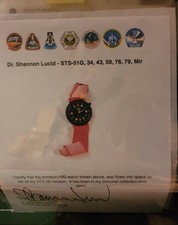
Space Flown Watch Dr. Shannon Lucid NASA Astronaut STS-58 Columbia Mir W/ COA
$50000.00