1760 Christopher Columbus Family Burial Ledger King Carlos III Cristóbal Colón

When you click on links to various merchants on this site and make a purchase, this can result in this site earning a commission. Affiliate programs and affiliations include, but are not limited to, the eBay Partner Network.

1760 Christopher Columbus Family Burial Ledger King Carlos III Cristóbal Colón:
$16184.96
La Ilustración (Spanish Enlightenment)
Los Pleitos Colombinos (Columbus Lawsuits)
Madrid 1760 Baroque Funeral of Doña Josefa Vicenta Colón de Larreátegui y Angulo
4th Great-Granddaughter of Christopher Columbus / Cristóbal Colón
Charles III | Enlightened Monarch of Spain
This intact ledger is a rare cultural map of the Spanish Enlightenment from the Capellades crown watermark, to the artisan career of Joseph Luis de los Santos, Maestro Carpintero y del Rey Nuestro Señor (Master Carpenter to the King) to the elite lineage of Columbus descendant Doña Josefa Colón and her husband's role as Governor of Madrid and represents a high-status museum artifact written and circulated within the administrative household controlling the historic Columbus legacy in Europe.
Doña Josefa Vicenta Colón de Larreátegui y Angulo was buried in the Parish Church of San Pedro el Real (commonly known today as the Iglesia de San Pedro el Viejo) in Madrid. According to official 18th-century Madrid noble mortuary records (Necrologio nobiliario madrileño), she was a registered parishioner of San Andrés but was laid to rest specifically inside the Luján family burial vault (Bóveda de los Lujanes) located within San Pedro el Real.MADRID BAROQUE FUNERAL
Based on Spanish aristocratic protocols, family records, and historical court customs of 18th-century Madrid, the burial of Doña Josefa Vicenta Colón de Larreátegui y Angulo would have been a particularly high-profile event in Madrid.
As a direct descendant of Christopher Columbus as well as the wife of one of the Kings highest-ranking administrative officials, her funeral would have been attended by close family members, senior government and royal household officials as well as elite religious figures.
Immediate Family
Don Juan Francisco de Luján y Arce: Her husband. He was the Corregidor (Royal Governor) of Madrid and a top official (later Dean) of the Consejo de Hacienda (Royal Council of the Treasury).
Pedro Isidro Colón de Larreátegui y Angulo: Her prominent brother. At the time of her death in 1760, he was a highly influential legal official serving as a Counselor (Consejero) and Camarista on the powerful Council of Castile (Consejo de Castilla).
Surviving Children
Her immediate sons and daughters, alongside extended members of the Luján and Colón de Larreátegui dynasties who resided in Madrid to protect their lineage and legal titles.
Royal and Municipal Officials
Representatives of the Council of the Treasury (Consejo de Hacienda): Out of professional respect and strict bureaucratic etiquette for Don Juan Francisco's high-ranking leadership position, fellow councilors, treasury magistrates, and senior clerks would have attended.
Madrid Municipal Authorities: Given her husband’s role as Corregidor (the King's representative over the city's municipal council), Madrid's regidores (aldermen), magistrates, and city administrators would have been formally required to attend or send representatives.
Clergy and Religious Orders
Parish Priests and Friars: Aristocratic burials in 18th-century Bourbon Spain took place inside prominent churches or convent chapels. Her service would have been conducted by high-ranking priests from the parish where she resided in Madrid, alongside Franciscan, Dominican, or Jesuit friars who typically managed the funeral masses, prayers, and processionals for nobility.
LOT DESCRIPTION & PROVENANCE, PLEASE READ
Inspected by Barry Taylor, Head of Hispanic Studies at the British Library, February 2025
PROSPECTUS / PROSPECTO DE VENTA
Item: The Intact 1760 Madrid Estate Settlement Folio of Doña Josefa Colón de LarreáteguiPrimary Signatory: Don Joseph Luis de los Santos (Maestro Carpintero y del Rey Nuestro Señor)Date of Execution: May 21, 1760 (Madrid, Spain)Medium: Handmade Laid Paper with Intact Two-Part Regional Watermark (Capellades, Summary
This extraordinary, museum-grade 1760 manuscript represents the most flawless convergence of imperial genealogy, royal architectural craftsmanship and 18th-century economic history to be found outside the walls of the national museum.
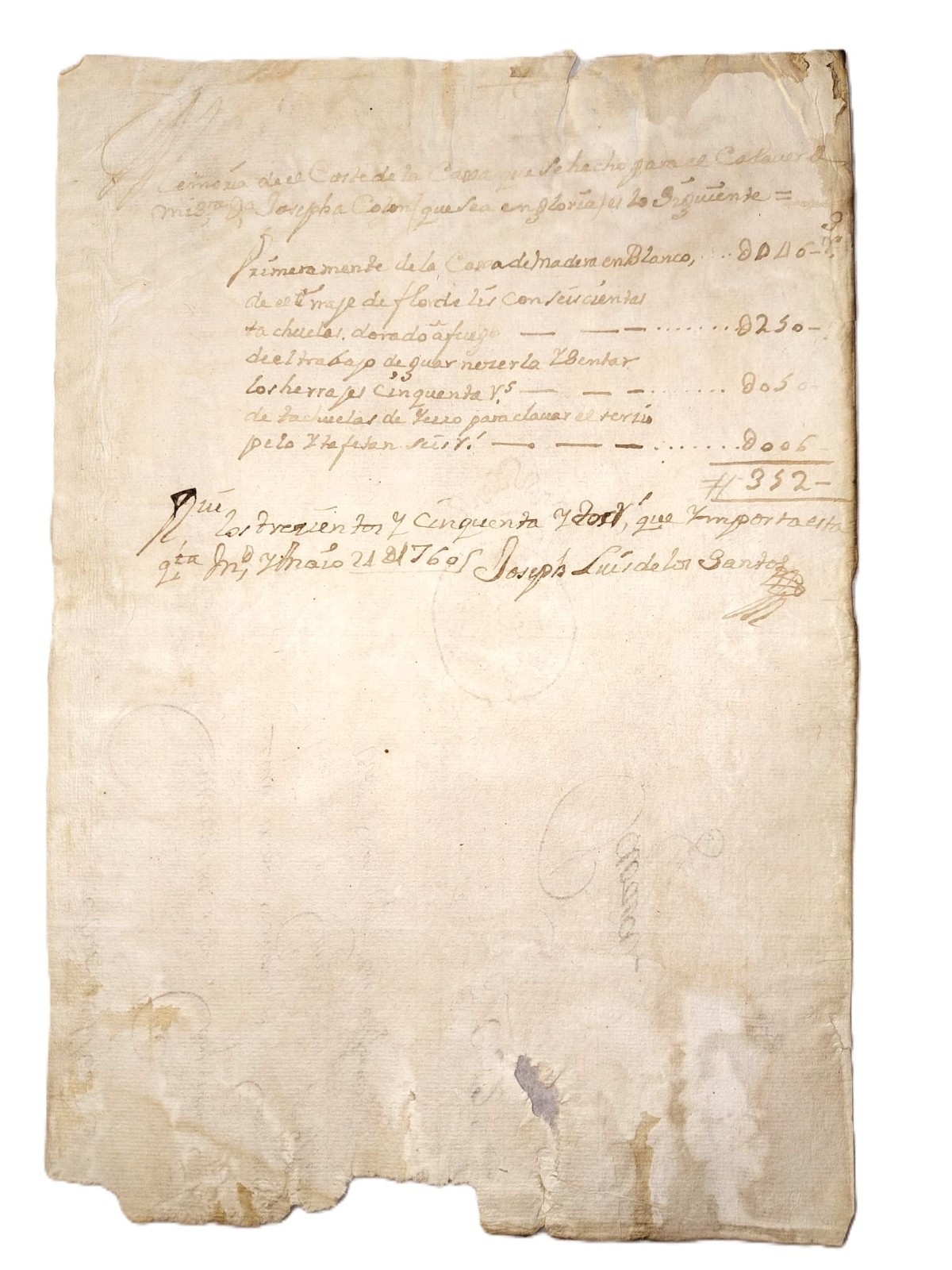
It features the complete, signed, and rúbrica-authenticated invoice of Joseph Luis de los Santos, the documented Master Carpenter to King Carlos IIIthe Enlightened Monarch of Spain for the execution of a magnificent BaroqueFuneral Coffin commissioned by the highest echelons of the Spanish Grandees (Grandes de España),and a noteworthy descendant of explorer Christopher Columbus.
For banking and economic historians, this folio also serves as a primary source artifact showcasing the early evolution of modern Financial Shorthand, displaying highly noteworthy, pre-standardized regional precursors to modern currency symbols.
This includes a pristine, early example of the hash lock symbol (#) strategically deployed as a fraud-prevention anchor to freeze the numerical ledger total, alongside other fluid, script-evolution symbols and variants.
Elite Genealogical Provenance: The Line of Christopher Columbus
The document chronicles the estate closure for Doña Josefa Vicenta Colón de Larreátegui y Angulo (d. April 1760), the direct 4th great-granddaughter of the explorer Christopher Columbus (Cristóbal Colón).
Married to Don Juan Francisco de Luján y Arce - the Royal Governor (Corregidor) of Madrid and Dean of the Royal Council of the Treasury - Doña Josefa occupied the absolute peak of Madrid court society. Her immediate household branch successfully won the historic Pleitos Colombinos (Columbus Lawsuits), securing the permanent title of the Dukes of Veragua.
This legacy confirms that the ledger was circulating within the peak administrative household controlling the historic Columbus legacy in Europe.
Nephew, Mariano Colón de Larreátegui, officially ascended to become the 12th Duke of Veragua, locking the Columbus title permanently into her immediate household branch.
The Pleitos Colombinos (Columbian lawsuits) reached their main, defining settlement on June 28, 1536, through the royal arbitration known as the Sentencia Arbitral de Valladolid.
The 1536 ruling formally stripped Christopher Columbus's heirs of their massive viceregal and governance claims over the New World.
In exchange for giving up their sweeping territorial authorities, the Spanish Crown granted the family hereditary titles, creating the Duchy of Veragua and the Marquessate of Jamaica, along with a permanent annual income. But while the core dispute over governance ended in 1536, other economic and inheritance legal actions persisted until 1790.
High Aristocratic Provenance (The Title)
The very first line at the top identifies the elite patron:
The Text: "Memoria de el Coste de la Caxa... hecho para el Cadaber de mi S.ra D.a Josepha Colon..."
The Title: It references her title as connected to the Casa de Colón (the descendants of Christopher Columbus, the Dukes of Veragua). Grandees of Spain (Grandes de España) and one of the highest-ranking aristocratic houses in Madrid.
Itemized Luxury MaterialsThe column of numbers on the right itemizes the expensive craftsmanship and materials that justify the 352 Reales tariff
The White Wood Base (40 Reales): "Primeramente de la Caxa de madera en blanco..." – This was the initial structural carpentry charge for building the inner wooden coffin frame.
The Fire-Gilding (250 Reales): "...dorado a fuego..." – This is the single most expensive line item. Fire-gilding (dorado a fuego) is a luxury technique using an amalgam of gold and mercury to heavily coat metal fittings. This confirms the coffin featured high-end, shimmering gold-plated Baroque ornaments.
The Fabric Lining (50 Reales): "...del trabajo de guarnecerla... los herrajes cinquenta r.s..." – This covers the specialized labor and textiles used to line, pad, and upholster the casket.
The Iron Tacks & Velvet (6 Reales): "...de tachuelas de yerro para clavar el tersiopelo..." – This specifies iron tacks used to physically anchor luxury velvet (terciopelo) across the exterior of the coffin.
The High Artisan & The Staggering 352-Real Premium
While ordinary 18th-century trade receipts record some significant sums, this document commands a spectacular total of 352 Reales de Vellón - three months of gross wages for a regular craftsman.
The itemized ledger details the absolute luxury of high-Baroque mourning culture for a Columbus descendant:
The craftsman signatory, Joseph Luis de los Santosis a highly catalogued figure in Spanish Enlightenment art history, a close personal friend and 12-year collaborator of Spain's supreme court architect, Ventura Rodríguez.
Joseph Luis de los Santos’ workshop helped frame the structural timber roof trusses of the Palacio Real (Royal Palace of Madrid) and the interiors of the Real Botica (Royal Apothecary).
The reverse side of the ledger acts as the official cover summary and legal receipt wrapper for the entire transaction.
In 18th-century administrative systems, bills were folded into thirds like an envelope, and this summary was written on the outside so clerks could identify the document in a filing chest without unfolding it.
This page adds critical context regarding the legal processing of the invoice and features an incredibly rare, secondary administrative marking.
The Legal Filing Summary TranscriptThe text on the right side provides a concise, formal index of the transaction for the estate's auditors:
Line 1: "Año de 1760" (Year of 1760)
Lines 2–4: "Cuenta de Mro. Carpintero Joseph Luis de los Santos de la Caxa que hizo para el Cuerpo de mi Sra. Doña Vizta. Colón..."
Translation: Bill of Master Carpenter Joseph Luis de los Santos for the coffin he made for the body of my Lady Doña Vicenta Colón...
Line 5: "(que esté en gloria)" – Parenthesized abbreviation meaning "may she rest in glory." This is a standard, respectful Baroque formula used exclusively when writing the name of a recently deceased individual.
Line 6: "su impo.te 352 rs de vn"
Translation: Its total amount, 352 reales de vellón.
Line 7: "Pagada" (PAID) – This is the final legal clearance. It features an enormous, stylish administrative flourish beneath it, indicating that the executors officially authorized and distributed the 352 Reales from Doña Vicenta's dowry or estate funds to close de los Santos' account.
The Mysterious Inverted Text on the LeftTurn the document counterclockwise, and you will see faint lines of financial ledger columns and cursive text running vertically on the left-hand margin.
The Context: This indicates that the sheet of paper was originally part of a larger blank bookkeeping ledger or a pre-ruled accounting folio from the estate before being torn or cut out to draft this specific, dedicated receipt.
A Secondary Watermark DiscoveredLook closely at the dead center of the page. There is a large, circular faint watermark ring with internal elements completely distinct from the crown watermark on the other half of the sheet.
What it is: Premium 18th-century paper de tina sheets usually featured a two-part identification system. One half of the full mold had the main emblem (the crowned orb from your first photo), while the opposite half featured a large counter-mark (often a decorative circle enclosing the papermaker's full name, a location, or an institutional shield).
The Importance: This second watermark confirms the document is a complete, intact single sheet of genuine 18th-century paper, providing an additional, independent geometric pattern used to trace the exact mill.
Bibliographic Citations for Collector Security:
The historical standing of the primary artisan on this invoice is fully peer-reviewed and verifiable inside European academic reference texts:
1. Ansón Navarro, A. & Martínez Molina, J. – Ventura Rodríguez y el Coreto del Pilar (1750-1792): La integración de las artes. (Reproduces de los Santos’ 1750 royal court deposition).
2. Laborda Yneva, J. – Aportaciones a la biografía de Ventura Rodríguez (Real Academia de Doctores de España, Vol. 4, No. 2).
3. Anales del Instituto de Estudios Madrileños (CSIC) – Historical ledger records detailing his structural cabinetry contracts for the Real Botica.
Published Book Citations
These academic volumes mentioned transcribe or directly cite Joseph Luis de los Santos’ legal, imperial, and professional activities in the capital.
Citation 1 (The Ventura Rodríguez Coreto Records)
Book Title: Ventura Rodríguez y el Coreto del Pilar (1750-1792): La integración de las artes en un proyecto artístico singular.Authors: Arturo Ansón Navarro and Javier Martínez Molina.Publisher: Institución "Fernando el Católico" (CSIC).Context for Dossier: This foundational monograph covers the 1750 court proceedings of the royal architect. It reproduces the exact handwritten deposition given by Joseph Luis de los Santos on December 19, 1750, under his full title, noting his residence directly opposite the Parish Church of San Juan Bautista, Madrid. [1, 2, 3, 4]
Citation 2 (Royal Palace Biography Bulletins)
Journal/Article: Aportaciones a la biografía de Ventura Rodríguez.Author: Dr. J. Laborda Yneva.Publisher: Real Academia de Doctores de España (RADE).Volume: Vol. 4, No. 2, pp. 200–215.Context for Dossier: This published academic paper explicitly highlights Joseph Luisde los Santos alongside Alfonso Martín (Aparejador de la Real Obra de Palacio). It transcribes his sworn declaration where he testifies that he had been an intimate friend and professional collaborator of Ventura Rodríguez "for more than twelve years" in the Madrid court. [4, 5]
Citation 3 (Madrid Institutional Guild History)
Journal/Series: [Anales del Instituto de Estudios Madrileños]Publisher: Consejo Superior de Investigaciones Científicas (CSIC) / Instituto de Estudios Madrileños.Context for Dossier: Ongoing architectural ledger volumes from this historical series index the elite craftsmen supplying the crown's infrastructure. Joseph Luis de los Santos is catalogued as a primary master wood contractor authorized to design and construct storage framing and specialized cabinetry runs for the Real Botica (Royal Apothecary and Science Laboratories) under the Palace Works Board (Junta de Obras de Palacio).
Spanish State Archive Reference Numbers (Signaturas)If a museum curator or expert archivist wants to independently verify the signature and standing of Joseph Luis de los Santos, they will look up his files using these registry codes in Madrid:
Archivo Histórico de Protocolos de Madrid (AHPM)The AHPM holds the legal notary books (escribanos) for all active court artisans in the capital.
Search Area: Fondo de Protocolos Notariales de Madrid.Notary Scribe: Vizente García
Because he held the elite legal title of Maestro carpintero y del Rey Nuestro Señor (Master Carpenter to the King), his bureaucratic footprint is distinctly recorded in Spanish cultural databases and specialized historical literature.
The exact paths to his other known contracts and payroll footprints include:
The Royal Chapel & Architectural PayrollsHis name emerges directly within the historic building accounts (Libros de Fábrica) and royal legal testimonies associated with major architectural commissions oversaw by the Crown:
The Coreto del Pilar Testimony (1750):His most notable independent signature in royal records occurs on December 19, 1750. He was called forward as a prime court character witness alongside Alfonso Martín (the Aparejador de la Real Obra de Palacio / Clerk of the Royal Palace Works) to verify the legal standing and architectural integrity of Spain's legendary royal architect Ventura Rodríguez.
A Paper Historian’s Dream: The Intact Two-Part Watermark
The sheet is an immaculate specimen of mid-18th-century paper de tina (vat paper) distributed under the tight regulations of the Spanish Crown monopoly (Estanco del Papel). It features a complete, unbroken two-part watermarking loop.
In 18th-century Spanish papermaking, the crown motif itself serves as a legal stamp, but the internal loops and counter-marks identify the manufacturer.
Looking closely at the backlit loops, the wire reveals a classic regional history:
The Monogram Inside the Crown Base
The lower band of the crown features a stylized script monogram typical of the premium paper mills supplying the capital.
The Letters: The wire shapes form the interlocking letters "C" and "S" (or a stylized "GS" variant depending on the mold tilt).
The Papermaker's Identity: In the 1750–1760 Spanish paper registries, this highly protected mark belongs to a master of the Serra or Suriá papermaking dynasties based in Capellades (Catalonia).
The Connection: The mills of Capellades held exclusive royal concessions to manufacture premium, heavy-weight paper de tina (vat paper) specifically for court officials, accounting guilds, and the nobility in Madrid.
Decoding the Wire Logic
Historical papermakers used specific wire geometry to indicate paper grade:
The Crown Arches: The loops forming the top of the crown represent the Corona Real (Royal Crown). It serves as a visual guarantee that the paper meets the rigid weight and size dimensions required by Spanish royal treasury auditors to record elite, long-term estate transactions.
The Central Vertical Pillar: The vertical braided chain running down the center of the orb is a structural support line. It keeps the wire filigree perfectly balanced against the immense friction of the wet wood-pulp mesh during manufacturing.THE COLUMBUS FAMILY RECORDS OF SUCCESSIONOfficial legal ledgers, wills and exhumation records detailing the deaths, assets, and burial relocations of Christopher Columbus’s immediate descendants are held across major national archives in Spain and the Dominican Republic.
Because these deaths occurred during the 16th to 18th centuries these transactions were recorded as notarized estates, testament ledgers (testamentos), and formal records of succession.
The remaining primary historical registries containing these ledgers and the specific documents for Columbus's direct descendants are organized below.
Primary Archival Registries
The Archivo General de Indias (General Archive of the Indies) in Seville, Spain: This is the primary repository holding the Pleitos Colombinos and the definitive estate inventories of the early Dukes of Veragua.
The Archivo Histórico Nacional (National Historical Archive) in Madrid, Spain: Holds the broader institutional nobility records, family wills, and testament distributions of later generation descendants.
The Carthusian Monastery of Santa María de las Cuevas (La Cartuja) Records: Located in Seville, this monastery served as the temporary vault for the Columbus family documents, keeping logs of family remains and legal titles.MANUSCRIPT CONDITION, PAYMENT, SHIPPING & INSURANCE
Please refer to the many large photographs provided to reassure yourself of the condition of this two hundred and fifty year old manuscript.
Sized approximately 292mm x 200mm weighing 6 grams prior to packaging.
Securely consigned fully insured, packaged and protected flat in a reinforced mailer and shipped to the buyer using Express International Courier Service.
Please note any import duty or VAT is the buyers responsibility where applicable.
My previous five UPS deliveries to my US customers arrived door to door in 4 days.
QUESTIONS - GET TO KNOW EXACTLY WHAT YOU ARE BUYING
Please take a moment to ask any questions you might have prior to purchase.
If you purchase promotional items, drafts, preparatory work or "not for sale" editions frequently these objects are very different in quality and presentation to later factory made or mass produced retail editions - so please ask questions if you are uncertain before you commit to buying.
Take a moment to understand exactly what you are buying, ask questions and reassure yourself of condition by referring to the many large photographs which accompany the listing and which are of the actual item you are buying.response
According to , statistically 60-80% of users do not leave response so happy to reciprocate with response if or when I receive yours.RESUMEN EJECUTIVO REVISADO (ESPAÑOL)
Resumen Ejecutivo
Extraordinario manuscrito de calidad de museo fechado en Madrid el 21 de mayo de 1760. Se trata del folio fundacional de la liquidación de cuentas de la Casa de Colón y Luján, que conserva la firma autógrafa y rúbrica de seguridad de Joseph Luis de los Santos, célebre Maestro Carpintero y del Rey Nuestro Señor. El documento detalla el coste y la fastuosa fabricación del ataúd de gran estilo Barroco para el cadáver de Doña Josefa Colón de Larreátegui.
De manera excepcional para los historiadores de la economía y la numismática, este folio constituye un testimonio primario de la evolución de la taquigrafía financiera global. El documento exhibe precursores regionales muy tempranos y significativos de la simbología monetaria moderna, utilizados para registrar y blindar la transacción de 352 Reales de Vellón.
Destaca el uso nítido del símbolo de almohadilla (#) como "anclaje de seguridad" contable de la época—diseñado por los escribanos de la corte para evitar la alteración fraudulenta de las cifras del libro mayor—junto con variantes caligráficas avanzadas que ilustran la transición hacia las grafías comerciales e internacionales que hoy conocemos.
1760 Christopher Columbus Family Burial Ledger King Carlos III Cristóbal Colón:
$16184.96
Related Items:
1760 Christopher Columbus Family Burial Ledger King Carlos III Cristóbal Colón
$16308.38