41pc Bush Family Archive 1743-1858 New Haven CT - Lorain County Ohio Whaling

When you click on links to various merchants on this site and make a purchase, this can result in this site earning a commission. Affiliate programs and affiliations include, but are not limited to, the eBay Partner Network.

41pc Bush Family Archive 1743-1858 New Haven CT - Lorain County Ohio Whaling:
$2495.00
An extraordinary and highly cohesive archive of original manuscripts, deeds, surveys, receipts, tax records, educational accounts, maritime papers, and deeply personal correspondence documenting the founding-era development of Elyria and the Connecticut Western Reserve through the eyes of New Haven, Connecticut investors and settlers spanning approximately 1743–1855.
At its core, this archive tells the story of how New England maritime and mercantile capital helped transform the Ohio frontier into organized communities such as Elyria and Ridgeville. The papers center around Captain Henry Bush of New Haven, Connecticut, a documented maritime figure connected to the schooner Smith during the 1820s, whose investments in Lorain County land tie directly into the earliest phases of Western Reserve settlement and development.
The archive begins with remarkable colonial-era mercantile fragments dating to 1743 tied to Daniel Tolles of the New Haven/Woodbridge area, containing references to puncheons, hogshead sugar, gauging cargo, pork shipments, and Atlantic commodity trade. These early maritime and mercantile roots evolve into the world of Captain Henry Bush and his associates, whose money and influence helped shape the settlement economy of northern Ohio.
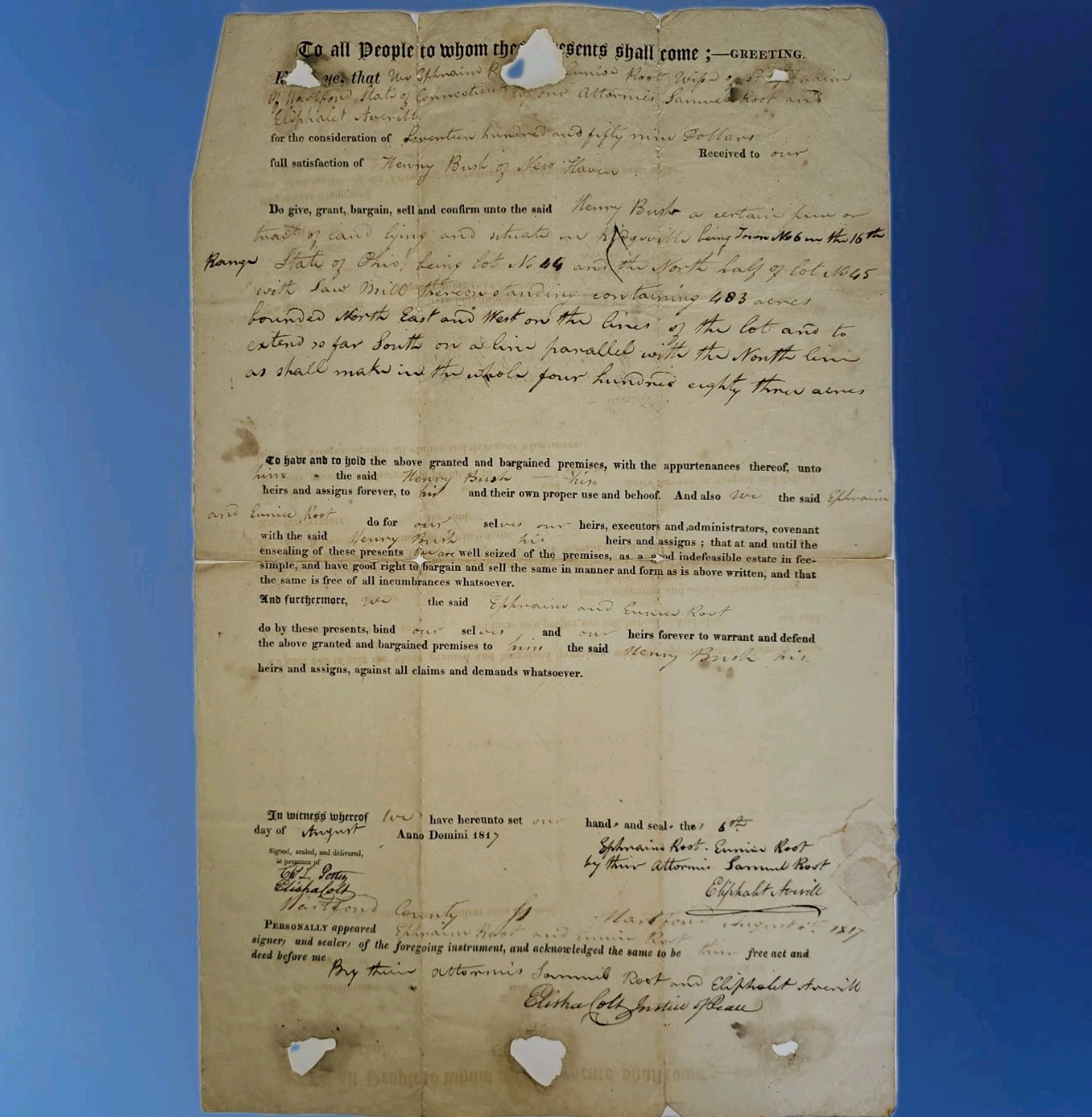
The centerpiece is an exceptional 1817 deed transferring approximately 483 acres in Ridgeville Township, Ohio from Ephraim Root and Eunice Root to Henry Bush. Ephraim Root was one of the original investors in the Connecticut Land Company and among the foundational proprietors responsible for opening the Western Reserve to settlement. The deed explicitly references a standing sawmill on the property, providing direct evidence of industrial and infrastructure development during the earliest years of Lorain County settlement. The reverse preserves both the original 1817 Cuyahoga County recording and a later 1861 Lorain County recording, beautifully illustrating the evolution of the region from frontier territory into established county government.
The archive documents the direct relationship between New Haven investors and the emerging Ohio frontier through:
• land acquisition
• absentee ownership
• tax administration
• surveying
• school funding disputes
• settlement expansion
• agricultural development
• and commercial infrastructure
A remarkable 1829 letter from Sherman Minott, one of the earliest Lorain County auditors and a foundational civil official in the newly formed county government, discusses taxation on Henry Bush’s lands and the controversial issue of school taxes imposed upon non-resident landowners. These papers offer an unusually intimate look at the mechanics of frontier governance during the earliest years of Elyria and Lorain County.
Additional documents include:
• 1825 New Haven letter from Captain Henry Bush discussing Ridgeville and Brunswick lands
• 1831 Elyria letter from Henry C. Minott discussing unpaid taxes and sawmill development opportunities
• 1850 survey of Sarah Bush’s Ridgeville lands by surveyor John Sherman
• 1847 Ridgeville land payment receipt signed by Henry Bush to Peter Lent
• Lorain County tax receipts signed by Elihu Cooley Brown and Treasurer S. S. Newman
• educational tuition and boarding receipts for Caroline Bush and Elizabeth Bush documenting women’s education in frontier Ohio
• medical retainer receipt signed by Schuyler Putnam, descendant of Revolutionary War General Israel Putnam and future Lorain County Treasurer and Justice of the Peace
• commercial and forwarding correspondence from Sandusky merchant P.P. Peck & Co. tied to Great Lakes shipping and commerce
The maritime dimension of the archive is equally compelling. The papers contain references to:
• New Haven shipping
• brigantines
• cargo gauging
• Charleston
• Hamburg
• Haiti
• Bahamas routes
• New Providence
• Atlantic storms
• sugar and pork trade
• coastal and Caribbean commerce
One particularly fascinating maritime letter references the distressed brig Confiance arriving at New Providence after a harrowing voyage from Gonaïves, Haiti, providing a vivid glimpse into early Atlantic shipping networks.
The archive also preserves an extraordinary 1852 romantic manuscript letter from Samuel Bassett to Miss Mary Bush, filled with Victorian sentiment, spiritual reflection, and commentary on marriage, female autonomy, and destiny. The letter reads almost like unpublished antebellum American literature and serves as a remarkable human counterpoint to the archive’s land, commerce, and settlement papers.
Named individuals throughout the archive include:
Captain Henry Bush, Sarah Bush, Mary Bush, Caroline Bush, Elizabeth Bush, Samuel Bassett, Ephraim Root, Eunice Root, Sherman Minott, Henry C. Minott, Elihu Cooley Brown, Schuyler Putnam, Peter Schuyler Putnam, Peter Lent, John Sherman, Timothy S. Beers, P.P. Peck, Philo P. Peck, Daniel Tolles, William Goff, J. Monteith, Nathan Roberts, Thorn, Mantor, Joseph Barber, Woodruff Barber, Henry Bissell, Mrs. Hotchkiss, Mrs. Sears, Mrs. Hine, and many other figures tied to the founding-era social and economic development of Elyria and the Connecticut Western Reserve.
Taken together, this archive forms a deeply important and unusually cohesive documentary record of how New Haven maritime wealth, Connecticut land speculation, and frontier ambition helped build early northern Ohio. Few surviving family archives so clearly document the transformation of the Western Reserve from speculative wilderness into organized community life through deeds, taxes, schools, medicine, commerce, romance, and shipping over multiple generations.
Fresh-to-market and currently undergoing active research, this remarkable 17-piece antebellum family correspondence archive documents the interconnected lives of the Bush, Barber, Sawyer, Pepper, Barton, Loomis/Lummis, Manning, Morrison, Johnson, Farnsworth, Smith, Dean, Pelton, Curtis, Mattoon, Landon, Washburn, Gildersleeve, McLeod, Clark, Dutcher, and related families as they moved between New Haven, Windsor, Hartford, and other Connecticut communities into Elyria, Salina, and broader Ohio Western Reserve settlements during the 1820s-1850s.
This remarkable archive of original 1743–1858 Ohio Western Reserve manuscripts documents three decades of frontier settlement, land speculation, commerce, family relationships, and Victorian courtship centered around Elyria, Ohio and the interconnected Bush and Minott families. The collection contains deeply personal handwritten letters, business correspondence, financial notices, and early Ohio postal history tied to some of the earliest years of Lorain County development.
The archive begins with early New England-to-Ohio migration and land management letters, including an 1825 New Haven correspondence to Sherman Minott in Elyria discussing property holdings in Ridgeville and Carlisle, tax receipts, and frontier investments. Another 1831 Elyria letter references unpaid land taxes, proposed sawmill construction, and the growing economic importance of Ohio frontier land during the settlement era.
An especially fascinating 1838 note from Elyria discusses immediate financial hardship and requests for potatoes and provisions, offering a rare firsthand glimpse into daily survival and local barter conditions in early Ohio communities.
The centerpiece of the archive is an extraordinary multi-page 1852 romantic manuscript letter from Samuel Bassett to Miss Mary Bush. Written in elaborate Victorian prose, the letter explores love, morality, spirituality, personal liberty, courtship customs, emotional restraint, and destiny. Bassett references angels, departed spirits, “drowning men grasping at straws,” fortune tellers, and the sanctity of individual happiness. The manuscript reads almost like an unpublished literary work and provides an exceptional example of antebellum American romantic expression and social values.
Additional material includes:
• 1853 Washington County Mutual Insurance Company printed assessment notice to Sarah Bush
• 1855 financial letter from prominent Sandusky forwarding merchants P.P. Peck & Co.
• Original stampless and stamped covers from Elyria and Sandusky
• Early Ohio postal history and merchant correspondence
• References to Great Lakes trade, shipping, frontier land ownership, and Western Reserve settlement
Historically, the archive captures the transformation of Ohio from frontier settlement into an organized commercial society connected by canals, Great Lakes trade, insurance networks, and Eastern investment capital. Collectively, the letters preserve an unusually intimate portrait of ordinary yet highly articulate Americans navigating expansion, economics, romance, and identity in antebellum America.
A superb research archive for collectors of:
• Western Reserve / Ohio history
• Early Elyria and Lorain County material
• Frontier settlement manuscripts
• Victorian romance and courtship
• Postal history
• Great Lakes commerce
• Genealogy and family archives
• 19th century Americana
Condition varies by piece with folds, edge wear, minor losses, and age toning typical of working manuscripts of the period. Overall an exceptionally cohesive and historically rich archive spanning approximately thirty years of early Ohio history.
The archive includes stampless folded letters, family correspondence, land discussions, health matters, migration accounts, and deeply personal reflections on religion, illness, labor, and family separation during a transformative period in American history.
The material presents an unusually vivid record of:
- Connecticut-to-Ohio migration
- women’s domestic and caregiving labor
- antebellum religious life
- family inheritance disputes
- frontier economics
- stagecoach travel
- early American medicine
- agricultural production
- illness and mortality
- and maritime/whaling culture
Among the standout documents already identified is an exceptional 1845 Salina, Ohio letter from Sarah F. Sawyer, discussing:
- migration from Connecticut
- raising children
- purchasing and improving farmland
- making cheese and butter
- local deaths and marriages
- ague outbreaks
- and the extraordinary line:
“Wm Manning started a whaling voyage, went as far as Conn and came back again.”
Another major letter dated Windsor, Connecticut, August 14, 1848, written by Phebe Barber, contains remarkable content concerning:
- chronic illness
- failing eyesight
- property inheritance
- East Windsor land boundaries
- economic hardship
- separation from family
- and treatment by a:
“German Botanic Dr from Hartford”
— a fascinating firsthand reference to alternative/Thomsonian medical practice in antebellum New England.
The emotional tone throughout the archive is deeply compelling and highly personal, with passages including:
“the kindred blood runs in our veins”
and
“During my life I have almost always been separated from my kindred.”
Referenced individuals and families identified so far include:
- Capt. Henry Bush
- Sarah Bush
- Phebe Barber
- Sarah F. Sawyer
- Ormond Sawyer
- Sarah Pepper
- Mr. Thomas Erwin
- Thomas Barton
- Sally Bush
- John Loomis / Lummis
- Henry Barton
- Harvey Barton
- Lyman Stockbridge
- Daniel
- Joseph
- Samuel
- William Manning
- Mrs. Morrison
- old Mr. Johnson
- Orton Johnson
- Charles Dean
- Minerva Pelton
- Charles Curtis
- Ansel Mattoon
- Almira Mattoon
- Edson Linberry
- Sarah Landon
- Elder Gildersleeve
- Mrs. McLeod
- Charles Washburn
- Maria
- Mary Clark
- Mr. Dutcher
- Emily
- David Smith
- Horace Smith
- Henry
- Seth
The archive also contains valuable postal history elements including stampless covers, manuscript postal rates, Connecticut and Ohio postal markings, and original folded letters carried through the early American postal system.
This is not simply a group of old family letters. It is an unusually cohesive and emotionally rich record of antebellum American life spanning New England and the developing Midwest during the era of westward expansion.
Further transcription and genealogical research are ongoing, and additional historical discoveries are expected as the archive is studied more closely.
An outstanding opportunity for collectors and researchers of:
- Americana
- manuscript archives
- postal history
- Connecticut history
- Ohio Western Reserve history
- women’s history
- maritime and whaling history
- genealogy
- religious history
- medical history
- migration and settlement history
Condition varies throughout with expected folds, age toning, handling wear, postal wear, and edge wear consistent with authentic family correspondence archives of the period. Please review all photographs carefully.
Letter 1 Transcription :
Windsor August 14th 1848
Dear Sister,
What can the reason be that you don’t never write to me. Two years last winter since I have received a single line or heard a word from you. Possibly you may have written and I not received the letter. I am often wondering what it means. If it is true that you have not I think you had better set about it very quick. I cannot tell all the scenes that have transpired since I have written where I have been and what I have been doing. Last fall and the early part of the winter my health was pretty good for me. I kept house 6 months for Mr. Thomas Erwin, perhaps you recollect the Dutch Miller merchant. He did not marry till quite an old batchelor. His wife left three children which composed the family.
I intended to write you during the winter but I had so much to attend to that I found it exceedingly difficult and it was left undone. (or if I have written 3 or 4 letters since I have received one) I must leave for I cannot write but little at a time.
Sept 20th
When I commenced this letter my health was such that I could not write but little or do any kind of work. My health failed in the spring before I left Mr. ___ for a number of weeks I struggled along about half sick until I came to Windsor about the 1st of July where I was obliged to apply to a Physician and have been under his care ever since. He thought my liver was badly diseased but I am now a good deal better so that I can walk to the nearest neighbors but I don’t know when I shall get strength enough to be of much use.
I have employed a German Botanic Dr from Hartford. He seems to understand his business and has had good success consequently I have pursued a different course from our regular medical men although this man was educated in that way.
I don’t know but I may have tolerable health again. I am unwell so much I feel that I need a great deal of patience and hope I shall be submissive to my heavenly Father’s will knowing that he knows far better than we do what is for our good. Could we but have our will wholly merged in the will of God how much happier we should be.
How empty is this world, how uncertain are all things here. O that we could feel as we ought the need of being prepared for a nobler state of existence. We have many many things to remind us that our stay here will be short. During my life I have almost always been separated from my kindred. I cannot expect to see them much if any more in this world. O that we may all meet in Heaven.
I believe I have told you that the town of East Windsor is divided and the south part called South Windsor which extends north as far as Harvey Barton. I saw Mr. Loomis in the spring. He still wishes to buy your land and I was in hopes you would have written to him something about it. When he sees me he speaks about it and wonders you don’t write to him. He would give you the information how you could send papers better than I could. He wished to have me mention that the deed must be made out in both of your names.
Mr. Loomis is an upright man and I believe wishes to do right. He says he has land enough but as it is so situated he would rather buy it. You ought to be aware that this land is surrounded by his except on the highway and our lines will go right in by his possession. If Mr. L should die you will probably have no more offers for it and if you had rather his heirs should have it than dispose of it any other way I do not think it is worth while for me to have to write about it in every letter that I write for it is rather perplexing to me. I am willing to render what assistance I can but it is a worn out subject.
I will mention the boundaries as near as I write them.
Mrs Sally Bush land that fell to her by Mr Thomas Barton. Beginning southwest corner on highway running north 109 rods bounded on John Loomis. Thence east 3 rods 10 links bounded on said Loomis. Thence south 110 rods 12½ links to the highway bounded on Henry Barton. Thence northwesterly 3 rods 20 links on highway to the first mentioned bound.
I see this man spells his name Lummis.
I was in hopes that I should have heard from Daniel ere I sent this. I wrote him some weeks since. I have not heard from Joseph or any one. I am worth comparatively nothing. I am quite discouraged in writing to you. I get no answers to my letters and feel very anxious to know the reasons. Perhaps you have written. I hope that you will write soon anyhow.
If you direct to Hartford direct to the care of Mr. Lyman Stockbridge. I lose my letters there unless they are directed to the care of some one. When you write and have not heard from me direct to Hatch Mills to Thomas Erwin or some one.
My health is slowly improving. If you write to me I will try that you shall hear again Providence permitting. One reason I do not write more is I am troubled to see. It is the worst thing I can do. I cannot see to write nights. I can hardly see my letters in the daytime. I cannot tell what ails my eyes and am afraid I shall never see with glasses.
My love to all.
Your affectionate Sister,
Phebe Barber
The terms for the land are 20 for yours and 18 dollars for Henry’s. They might both be put in one deed. I do not think any one would object to your having the share as he was indebted to you.
Mr Loomis proposed that in case that you would not do anything about it that if the other heirs would send me a line in a letter that they would relinquish their claim to brother Henry’s share that is a law certificate in my favor that he would have me make him a deed for that part and he would pay me the money.
I have no claim for this and would have them do just as they feel disposed. I have not asked any one for it and do not intend to until I hear from you. I hope I feel thankful for every favor but would not set up any paramount claim. I hardly know how my wants are supplied or what I earn in the winter I spend in the summer for medicine yet I have been comfortably provided for. When I shall earn another penny I cannot say but I doubtless can bear all with that God who supplies my wants.
Letter 2 Transcription:
Salina, N.Y., 25th 1845
Respected Cousin
It is with pleasure I take my pen to say a few words to you. We received your letter in Ohio stating uncle’s Wm’s death likewise telling of the health of your family. You speak of not being personally acquainted with me, but as the kindred blood runs in our veins I feel a nearness which I cannot feel for strangers. Likewise I trust we are sisters in Christ therefore we are not entire strangers for we draw forth from the same fountain.
O how it would rejoice me to have you come out here and see us. Ormond thinks he has had so much sickness that he does not feel able to come out there but he says he would like to see you. As for myself there was a number of years I intended to visit my friends out there but funds fell short and when I had a sister lost my attention was directed that way in hopes of getting a home and when I left there to return we had 15 acres most paid for and when we get that paid for and a house on it we shall have a good home about 100 rods from a meeting house.
I feel as if I could sympathize with you in the death of your mother. I feel as if we have lost the best of mothers. It was hard for me to take the charge of a family but I find my own family was no comparison to small children but I am thankful that I was so situated that I could come and take care of the children.
You requested to give your best respects to Sarah Pepper. She says she remembers the happy hours that you have spent together. Likewise she says she would like to see you. She says she wrote to her mother last and if she does not want to hear from her enough to answer her letter she thinks she does not want to hear from her much. Sarah’s health was miserable for a long time but now it is tolerable good. She came here this spring and stayed almost a fortnight and a good visit we had together. She says she does not know when she shall visit that place. She thinks that some of her connexions might come to see her. As for myself when Ormond settles it would be a pleasure to me to visit my friends there but you must know it costs a great deal to travel in a stage so I think I shall have to omit my visit there for I shall feel as if I shall want to see my friends in Ohio.
But give my best respects to your husband and father. Tell them we would like to receive a visit from them before I leave this place. Cousin Sylvia, it appears to me that a journey would do you good but not being acquainted with you I am not able to say. I hardly know what more to say but this much I can say, I want to have you unite your prayers with mine for the conversion of our friends is the sincere wish of your cousin and friend,
Sarah F. Sawyer
Respected Brother
I had much to say to you before you left but my tongue failed me some time or other I will write it but not now. About 2 o’clock the same day you left cousin Appleton and his wife and little girl and cousin Laura came here and stayed until Thursday when Ormond and I went and took them to Bayette Ville and visited with them there and a good visit we had with them. Laura and Harriett have been here since and stayed 10 days. The week before they came Ormond was sick 3 days. Thursday he went to work but did not feel very well. He kept up the remainder of the week and Sunday afternoon I commenced doctoring him for the inflammation in the throat in the severest degree. There was 48 hours he did not swallow a drop of anything. There it was a fortnight he did not work and the girls were here during that time.
A Friday before they came I commenced making cheese and I have made 14. It was so warm and dry I could not make butter so Mrs. Morrison and I concluded to make cheese when Samuel’s time was out. He came here to board. He spent a fortnight running around then the company hired him for $14 a year and he still boards here.
It is a general time of health with the exception of colds. I have a very hard cold and cough very hard. The children have been well except colds since you left. Not many deaths, a few children and old Mrs. Farnsworth, David Smith, Horace Smith.
William Manning started a whaling voyage, went as far as Conn. and came back again. Now from Ohio our father Seth and Henry had the ague in the spring all together but they got over it that they did their summer’s work. They had four hard frosts in May and there was no rain from March 12th to June 12th, not much wheat or grass.
They wrote to know whether you paid old Mr. Johnson for an axe before you got home. I want you should let me know as soon as you can about it so that I can send word out there. Send me a paper and write as soon as you get this to let me know about it.
Now for the marriages: Charles Dean to Minerva Pelton, Charles Curtis to a Priest, Washburn’s niece Ansel Mattoon to Almira Mattoon, Edson Linnbery to Sarah Landon.
Now the deaths: Elder Gildersleeve died in Rochester in June, old Mrs. McLeod in February, Charles Washburn died in July. Maria taught school 4 months in their district. Mary Clark 3 months in their district. Mr. Dutches has given up the west part of his land, a calico on the corner south of Seth’s.
Emily have had the ague this summer. They moved out there that the Dr. had gone for a wife and who it was to be they were all well when they wrote and we are all well except myself. I have not been very well for 3 weeks. Whether I shall go to Ohio I know not. There is no prospect of going this fall as I see the children often ask about you, where you are and what you are doing.
I forgot to tell you that little Francis talks almost everything and wants to go out to work on the farm with the men. Since I commenced this Orton Johnson has buried his wife, for you see it is a long time since I commenced this and now I must draw to a close hoping you will be a good boy and be steady to your work. Write often and let me hear from you. This from your sister,
P. B.
Horace you must excuse me for not writing sooner.
I wish you to give my best respects to uncle. Tell him we would be glad to see him out here this winter or even this fall if he could make it convenient. Now my best respects to all friends especially old Mrs. Pepper. Now farewell for the present. Send a paper as soon as you receive this or a letter so that I can send an answer about the heifer to Ohio.
P. B.
Letter 3 Transcription:
East Windsor, August 23rd 1844
I am sensible dear Sister that I have done very wrong in not writing ere this but to tell the truth it has been difficult for me to tell the sad tale of all my trouble and I felt as if I would not do it therefore I would not write. Be not alarmed, I am not sinking but have been wonderfully supported. Now what shall I say. I wish some one beside me would tell you.
When I married I thought it would be for the best but poor human wisdom sees it too late often. My husband had been engaged in speculations. Not long after my marriage he met with considerable losses. Still we might have been very comfortable but being naturally of an irritable temper, a circumstance that I did not know, he was all the time fretful and unreasonable continually finding fault with me and treating me very unkindly, added to that he resorted to strong drink and made me thus wretched. The older boys were rude and insolent to me. The youngest was very good. I took comfort with him.
For some months before I left Mr. G. seemed strange, appeared half deranged, did not view anything in the right light but it was in consequence of ardent spirits though he did not actually get drunk yet the effect on his mind was dreadful. Finally he got the idea that he must sell his place, break up housekeeping and each one take care of themselves for a time. Although this was quite unnecessary he would not be persuaded to the contrary. I tried to bring him to some terms if he would break up housekeeping to give me such a part and let me go free, but he would not do that. He said he would not part with me but I might go and take care of myself a year or two then he would go to housekeeping again. Meanwhile he would keep everything under his care and let me have nothing until I returned to him.
I knew not what to do. My prospects were very dark. I waited until the week we were to remove then during his absence I took what I could and left. I can only give you an outline but it must suffice.
I have seen trouble indeed. It is now a year last April since I left. I have not written to my friends. I felt that I would not have noticed it at the time for something more favorable but now I find if I begin to think I shall never return to my husband any more.
Once since I have written to him and heard from Daniel he was in Buffalo. I well knew I have never written him for trouble not the only way now. I do not pretend to write better still I know enough not to give it up. My eyesight troubles me some. I have never used glasses but cannot see very well to write in the evening.
It is more than two years since I heard from Joseph’s family. There was young lady that boarded in their neighborhood who acquainted me and said that Elizabeth was well married to Mr. James. Emily I expect married poor. They have since removed to Syracuse. I recommend writing. There is not all will remain there though it was rumored last spring that he would return to Warner. I was at Warner last spring. Mrs. Burnham was dead. Old Mrs. Sears still living with her daughter. Mrs. Little had gone away to live with her son who is a minister. Mr. Babcock married again. Cousin Sarah still there and Aunt Minward at the south.
My letter is but a mournful piece, contains more bad than good news. I had long since supposed Charles dead but last fall he returned this way and he was a sober man that he had not for a long time. Drinking ardent spirits even gave him pain. You know that I rejoiced at such intelligence we were poor but if he kept steady I thought it would be a great comfort if we thought to be mutual help to each other but alas poor earthly hopes are scattered as well as I could expect. One thought in this fall he might get a going and as I had some furniture we might keep house and assist each other. Thus was his plan. Well he got a place and began to have plenty of work, unlike to say the least he was fool enough to begin to drink again as he kept steady through the winter. I did not know this for weeks since he then was. It seemed as if it would almost crush me. I had given him up for lost. Those hopes had been raised then again blighted. Trouble rolled on trouble. I will not attempt to describe it so much have I suffered in consequence of this evil habit in men.
I saw him two weeks since. He appeared very penitent, was very attentive to what he will do. I cannot say. His appearance foroffers his getting work as a merchant tailor. He seemed to think he should do well. I hope he will get the dreadful habit under but none of this is spoken to him.
I will begin to see a brighter day. Sister Mary, I have been very lonely and forsaken many ways notwithstanding I have made my home in Bristol. I have good acquaintances there that have been truly kind to me. People that do not blame me but feel much interested in me. God hath raised for me many kind friends whom a few years since I had never seen. Of that not your broken family and husband who has treated me so ill. I will have enjoyed more of your kindness than I know. There is no place so pleasant as home. That my unpleasant things in my home and it was quite unnecessary that they should be destroyed for we had enough to live on. I now labor to bring my mind more to submit to whatever may be appointed me in the scenes of life to say “Thy will O God be done” is hard for flesh and blood to say.
My health is better. I have begun to move around a little and I am as comfortable and joyful as I can be. If my lot is spared I presume there are brighter days awaiting me. I have passed through such scenes for some months past that I do not think there will be a change. I spent ten or eleven days at East Windsor for a visit a few weeks since. I can settle whether I may be in Hartford or Bristol or thing &c. I wish not to write immediately on receiving this. Almost wait a month or a week for I am very anxious to hear in my next letter. I hope I can tell you something better as I do not know where I shall be. I think you had better direct to East Windsor, Hatch Mills, for they can easily send it to me. If you need not send any old acquaintance there I have parted from many. Aunt Hannah for if she lived in Buffalo I may again see Ohio but it is very uncertain.
When about you write don’t fail to mention all the little things for you won’t have anything else to fill your paper with. I suppose you have long been wondering why you did not hear from me but now you will know and can excuse me for this another time. I have not forgotten Mary but cannot write to her now. She must help you write and express all you can in the paper.
Within the last two years Uncle George, Cousin Henry, Cousin Woolcott’s second wife, Aunt Clark and Aunt Lois have died. Other friends have also. Lois still lives at home in Bristol now. I cannot think of anything more to say. Give my love to Mr. Bush and Mary.
Your affectionate Sister,
P. Johnson
Letter 4:
Transcription – Account / Memorandum Leaf (1855)
Oct 7, 1855
Bought sugar for one dollar
Shoes, 1 pair
Potatoes, 1 peck
Codfish 4 1/2
Beef 4 pound[s]
Cheese
Crockery, 2 pitchers & a bowl
Ginger
Raisins
Horse hire
Wine 1 quart
1/4 pound loaf sugar
1 pound candles
(right margin prices)
11 cents
12
16
16
35
sold 3 dozen eggs — 24 cents
9
62¢
25
6
12
Address Panel / Postal History
The cover is addressed:
Mr. Henry Bush
Care of Joseph Barber
New Haven
Connecticut
The manuscript postmark appears to read:
Sackettsville, N.Y.
June 8
with a large red manuscript “25” rate marking and an additional “12½” notation, consistent with stampless folded-letter postal accounting practices of the pre-adhesive stamp era.
This is an excellent example of mid-19th century rural New York postal history, combining:
- manuscript town marking,
- unpaid stampless rate notation,
- family correspondence,
- and surviving household accounting records.
The connection to Joseph Barber of New Haven is especially interesting given the Barber family’s prominence in Connecticut, including ties to publishing, trade, and regional mercantile networks. The fact that Henry Bush’s mail was sent “care of Joseph Barber” strongly suggests either business, lodging, or extended family association.
The grocery/accounting page itself is also historically valuable because it preserves:
- everyday commodity pricing,
- household purchasing habits,
- references to barter (“sold 3 dozen eggs”),
- and common mid-1850s staples like codfish, loaf sugar, candles, raisins, and crockery.
The listed prices reflect a transitional antebellum economy where rural families still mixed cash purchases with barter and local credit arrangements.
Letter 5:
“N. Haven June 3d 1835” (as interpreted)
Dear Caroline,
I now embrace the opportunity which presents itself of writing you as Pa goes away & this is the first we have had of writing to send by him as it is so far that we do not know when you receive it. We have all enjoyed good health since last seeing you there. I did not have the pleasure of seeing you when you left Mt. Morris as I was then in Dryburg though when I came home they told me that you were all very much pleased with the idea of going. I suppose that you have realized all your anticipations for I hear that it is a delightful country. I think you must enjoy yourself very much. Do write an answer to this & depend it would all give me pleasure to hear from everybody yourself your husband. Please write any description of your neighbors & what has happened since you have been there. Write all their names if some of coming out there to live and therefore would feel very much interested with a description of the place too.
I was in N. York about a month ago. I staid but two days. I staid at Mrs. Robbins’. She asked me a great many questions about your family which I could not answer as it is so long since I have heard from you. Mrs. Boutelle & daughter sent their love to all your family also ask much love to your family. Susan desires me to say that she is well & hopes that you enjoy the climate. She says she knows you do not think that she either speaks an idea out of her head if she could. I know that she would be very happy to write. As for Elizabeth the musketoes trouble her so much that she cannot use a pen. But I must now close so do answer this letter.
Yours affectionately,
Emily
Postscript
P.S. Susan wishes me to say in vindication of her character that she would have written if she had had time but she was prevented on account of her bad lungs.
Yours &c
Emily
Letter 6:
Hartford April 13th 1846
Dear Sister,
I received your letter this morning and hasten to write a few lines in return. I am sorry and surprised that Mr. Bush has not written to Mr. Loomis before this as he was anxious to get word back on account of making his fence. I thought he ought to write immediately. I have not been in Hartford nor seen or heard from Mr. Loomis since I wrote before and do not know what answer I shall have to tell you at all. I would in the other letter, but one thing I know is you ought to make out your debts and bring them with you and it will require both yours and Mr. Bush’s name for farther information. You must write to Mr. L. He can tell you what books you need again very as well tell you just as to let it lay there until another generation arise that does not want it.
You ask me about Mrs. G. I know nothing about him good or bad. You say I had better get a bill. It is as much as I can do to get my living without extra expenses. I have taken a room in Hartford for wages, your 20 dollars. It is a pleasant back chamber belonging to a widow lady, her sister and niece compose her family, so there is none but women here.
I am glad I have room. Think I shall enjoy myself better than to be a boarder everywhere and must trust Providence to enable me to get the means to pay for it. Took possession of my room last week at my first breakfast here last Friday morning (Saturday) had roasted clams and crackers without a bit of butter or coffee and felt truly thankful that I had so good a meal. At night I had the tea and sugar that I took from your home to me on the canal boat (or I did not need it then). I think nearly all my money to get clothing so that I am rather straitened for the present but I hope that I shall get along very well. I have good bedding and a comfortable supply of furniture.
My health was good through the winter but I cannot say so since this last spring month. Indeed I have had this dreadful headache most every week but am getting better.
I have been thinking for several days I must write and tell you that you must come this summer as I have a room and place for you to come to and perhaps I may not have another year. I am glad you say you intend to come and hope you will not fail to do it. Do not think you will ever have a better time. I will welcome you to my room and entertain you to the best of my ability.
You will not need many dresses if you have your bombazine outfit now do get ready and try to come the first of June. I think Joseph’s family will be glad to see you. They said they should.
You ask me whether you had better take Mary with you. Dear girl, I should indeed be glad to see her. I cannot answer that question. I would leave it altogether to her own choice and not force her inclination. Does she wish to visit New Haven and Hartford, those Eastern cities where there is so much parade and fashion? She might do as she pleases. She knows her own feelings better than I can.
Mary ought to be fitted for any place. I expect my plainness will give offense, but what is the use of living with mortification when it might have been remedied? I beg of you as parents, by every consideration, that you will put your child to school this summer. Do not wait one year more, two nor three years, but let it be done now. You know, you do know, that she cannot appear in good society unless she has some schooling. Why will you wrong your only child so? Why do you put off from fall to spring, from spring to fall, so year after year? If you do not bring it to a point at present time, now she will never go to school at all. If she must wait three months longer and three months must always intervene before the time that she must go, when can she go at all? The distance must always keep the same and she all the time getting older.
You need not think hard of me, my dear friend, for thus advising to the common course of events. You must leave that child in this unfeeling world without being at all prepared to take care of herself. A common education would be better for her than thousands of dollars.
When I get time I intend to write to Mary. I hardly know how to write today. Give my love to her. I want to see her much. She need not think I do not want to see her. I sent you a paper that may not amuse, but send them frequently. I should be likely to get them.
You ask which is the cheapest way of travelling. Probably by the canal. Traveling is cheaper this spring than usual fare is much reduced. You might allow fifteen dollars for one person, but if you take the cheapest way I think it will not cost so much.
I cannot describe to you where you will find Daniel. He is in Church Street not far out of Main Street. You will have to look at the directory which you will find at the public houses. You had better stop near the First Presbyterian Church. There will be carriages from all the hotels at the boat. They will carry you free from the hotel. I believe the American House is as near as any, but do not recollect. Daniel had not removed to his new place when I was there but had some boarders engaged. His own house is in Geneva Street more than a mile below Main Street. This is a very pleasant family where I am. When you get here direct to Mrs. Mary Barnard, No. 12 Chapel Street. You will find no free carriage here. If I am not at home you can take possession of my room and use whatever you may find in it. I have not minded but twice this winter of being so often alone. It has been better for me to have a room. I feel much more settled than when I wrote last. I have not been out to Windsor. Know nothing about them. They do not know as I have a room. I intend to go soon.
What a miserable pen and in such a hurry that I could not spell right. I had no idea of filling three sheets when I began this afternoon.
My respects to Mr. Bush. Have not heard anything more from Charles. Good night to you.
Affectionately,
P. B. J.
Address panel:
Capt. Henry Bush
Elyria, Lorain Co.
Ohio
Additional note written across fold:
There is a Mr. Wm. Deyo Baker in South Division Street not far from Main St. who is acquainted with Daniel perhaps he can tell where.
(near the First Church)
Letter 7 :
East Windsor March 24th 1826
Dear Sister,
I now attempt to break this long interval of silence by writing. My thoughts often recur to you and as often do I wish that you were a Christian. Think not that I make the subject grievous or unkind and wish to. I wish the invitations of the gospel were laid before you in their own magnanimity. O my sister did you but feel the need there was in your own heart such as you could not endure one moment. Heaven appears onward to eternity with astonishing rapidity. It becomes us to examine our hearts to see whether we are prepared to meet our God in peace. One falleth on our right hand and another on our left and every moment we be called to exchange this world for one that is unknown.
This is not those who have sustained only a fair moral character and done much good to their fellow creatures that will receive the plaudit of well done good and faithful servant. A person may possess many excellent qualities and very amiable dispositions and do much for the good of their fellow beings and yet be destitute of love to God. Where this is the case the very life, the main thing in religion, is wanting and they must be condemned accordingly. There are at the present day many advocates for a moral life as they term it. But this morality will I fear avail you but little my sister. There is in the natural heart the most bitter enmity against God unless this is subdued and the soul brought to bow in humble submission.
Again you doubt the necessity of possessing religion. You behold in yourself the stains of guilt and feel the remorse which the gospel is designed to remove. You are conscious of having slighted the rich favors so mercifully bestowed from God, withheld from Him your affections, disregarded His will and rejected His Son. You cannot but see that you are obnoxious to wrath and treading the path downward to ruin. The object of Christianity is to redeem you from the wretchedness and danger of this state and can there be a question as to the necessity of becoming a subject of its influence? Heaven and happiness are offered as a reward and that these are misery is threatened to every impenitent sinner.
A great change must take place in your breast unless you are led to lay down the weapons of your rebellion and bow submissively to Jehovah, to love His character and laws, to loathe your sins and to make Him the object of your supreme delight and trust. You are excluded forever from all participation in the gifts of His love and must languish throughout your existence under His frown and the reproaches of your conscience.
Is not religion then necessary? Think of the retributions assigned the incorrigible. Think of dwelling forever in the most malevolent society. Think of being forever at variance with God and feeling the terrors of His avenging justice. Cast your eyes down the scenes of your immortal existence, anticipate your unhappy minds, reflect what beings must surround them and survey the retributions justice assigns the impenitent and you cannot doubt that religion is necessary. Nor can you question the importance of making it the subject of immediate concern. To postpone it to future years is to reject it forever.
Have you any certainty of seeing those anticipated years? Are you assured that you shall live effectually shielded during the intermediate time from the shafts of death? Grant you live to old age can you expect to be more inclined to make your peace with God than now? What is to change your feelings toward Him? Will time subdue your opposition to Him? Will renewal of the invitations of Christ do His calls awaken now any more inclination to a compliance than formerly? His reproofs excite any more compunction, His warnings any more alarm?
If these awful considerations lead you to embrace religion where they not already overcoming your depravity and make you a willing disciple of Jesus. Think not of deferring this all important work to future years or to a sick and dying bed. A deathbed is the place to enjoy the consolations of religion not to gain them. Its pains, its debility, its agitation and darkness almost preclude the possibility of connected thought and those who are rash enough to defer making their peace with God until that time seldom do it then. Their reason continued they find it but a poor place for repentance.
Many are summoned suddenly without warning and unannounced to the bar of an offended Judge. This most daring presumption in the pursuit of a work of such infinite importance as preparation for death. The Lord has said “My Spirit shall not always strive with man” after having long waited for men we may be given over to hardness of heart and blindness of mind. This Spirit may cease to strive with us long ere we cease to live. O then my dear sister be entreated to attend to these important concerns before it is forever too late.
True religion will be a source of peace and joy to you from that you can derive more comfort than from any thing this world can afford. O then come taste and see that the Lord is gracious.
I do not know but you intend to return to Ohio this spring if not I hope you will find it convenient to visit us. Cousin Lois’ health is no great nor can be expected at this season of the year. She wishes to be remembered to you and would be pleased to have you send one of your boys to spend a few weeks with us. Late intelligence from Daniel states that his health had been poor through the winter but is now better. My own health is good. I wish you to write to me and to be remembered to all enquiring friends.
Should you see cousin E— I wish you to tell him that his friends are well and that no letter has been received from him since he left home.
I am my dear sister
yours affectionately,
Phebe Barber
Letter 8:
East Windsor, May 22nd, 1831
Letter from Phebe Barber to her sister Sarah Bush, New Haven, Connecticut
Sabbath Evening
East Windsor May 22nd 1831
Dear Sister,
I expect that you are anxious to hear how Elizabeth is. On the morning that you left she slept some time after you had gone. When she awoke and found that you had gone she did not weep or make any noise. She was calm but appeared not very well pleased. She did not shed a tear during the day, sometimes she looked sober but most of the time seemed to enjoy herself well occasionally saying she wanted to go home at night after returning to rest she wept some to sleep with her Mother but soon was pacified.
On Friday she appeared more contented than when you was here and said very little about home. On Saturday she was quite contented, seemed to enjoy herself much but sometimes said she was going home with cousin Ann. We thought it best to undeceive her and told her that you wished to have her stay longer. She did not exactly like this. She wept some and laughed some but did not make much ado.
After tea that you told her that she might come home with them Tuesday she has been to church. She has not been discontented but a number of times spoken of home and tonight has gone to bed without crying. Her appetite is very good. She eats more than when you was here and I do not think she will pine at all by being from home.
We tell her that she must wait till we hear from you before she can go home. I think it by all means advisable that she should go to school and do not doubt but she may be flattered there. You know it will be more for her advantage. She is at that period of life when I think a regular course pursued with her will be far better than to have her left too much to herself.
You must write soon and perhaps it would be best to direct to C for them she will consider it as coming directly to her and I presume she will be more gratified with it.
I think it best to tell her that she must go to school even if she should not go more than half a term. Perhaps you will think it best for her to come home soon but when you reflect on past scenes and on the future good of the child you will find it necessary to act with decision. I hope it will prove for her good.
Elizabeth has been a very good girl since you left her. It is very late. I waited for E to go to sleep before I wrote for I did not like to have her know it and I have written in as much haste that I can hardly read it myself.
Yours very affectionately,
Phebe Barber
P.S. I was very sorry you went away in the rain and was much afraid you would get sick. Noah expects to go to New Haven this week.
Monday Morn
Em is well and very pleasant. When she saw Hartford this morning she smiled pleasantly. She wished it was New Haven and that she was riding in the stage to go there. She is now with Miranda and is quite contented. Does not know that I have written. I expected to send this to the office this morn but may have to wait a day or two.
Letter 9:Sabbath Evening
East Windsor May 22nd 1831
Dear Sister,
I expect that you are anxious to hear how Elizabeth is. On the morning that you left she slept some time after you had gone. When she awoke and found that you had gone she did not weep or make any noise. She was calm but appeared not very well pleased. She did not shed a tear during the day, sometimes she looked sober but most of the time seemed to enjoy herself well occasionally saying she wanted to go home at night after returning to rest she wept some to sleep with her Mother but soon was pacified.
On Friday she appeared more contented than when you was here and said very little about home. On Saturday she was quite contented, seemed to enjoy herself much but sometimes said she was going home with cousin Ann. We thought it best to undeceive her and told her that you wished to have her stay longer. She did not exactly like this. She wept some and laughed some but did not make much ado.
After tea that you told her that she might come home with them Tuesday she has been to church. She has not been discontented but a number of times spoken of home and tonight has gone to bed without crying. Her appetite is very good. She eats more than when you was here and I do not think she will pine at all by being from home.
We tell her that she must wait till we hear from you before she can go home. I think it by all means advisable that she should go to school and do not doubt but she may be flattered there. You know it will be more for her advantage. She is at that period of life when I think a regular course pursued with her will be far better than to have her left too much to herself.
You must write soon and perhaps it would be best to direct to C for them she will consider it as coming directly to her and I presume she will be more gratified with it.
I think it best to tell her that she must go to school even if she should not go more than half a term. Perhaps you will think it best for her to come home soon but when you reflect on past scenes and on the future good of the child you will find it necessary to act with decision. I hope it will prove for her good.
Elizabeth has been a very good girl since you left her. It is very late. I waited for E to go to sleep before I wrote for I did not like to have her know it and I have written in as much haste that I can hardly read it myself.
Yours very affectionately,
Phebe Barber
P.S. I was very sorry you went away in the rain and was much afraid you would get sick. Noah expects to go to New Haven this week.
Monday Morn
Em is well and very pleasant. When she saw Hartford this morning she smiled pleasantly. She wished it was New Haven and that she was riding in the stage to go there. She is now with Miranda and is quite contented. Does not know that I have written. I expected to send this to the office this morn but may have to wait a day or two.
This is actually one of the strongest emotional and social-history pieces in the group so far.
1. A detailed portrait of early 19th-century child separation and schoolingThe letter documents a young girl, Elizabeth, being left away from home for schooling or upbringing purposes. Phebe is essentially reassuring Sarah Bush that the child is adjusting emotionally after separation.
That gives the archive:
- domestic parenting history
- women’s educational expectations
- emotional culture of motherhood in the 1830s
- child discipline philosophy
- family-network caregiving
The repeated emphasis on:
- “she did not weep”
- “she wanted to go home”
- “must go to school”
- “act with decision”
is incredibly revealing of period attitudes toward education and emotional restraint.
Letter 10:
New York, January 23, 1832
Mrs. Sarah Bush
New Haven
Conn.
Dear Madam,
I received your letter of the 20th instant and was glad to hear that you were well and family. Likewise we are all well except Caroline. She has had a severe attack of the quinsy sore throat. It broke on Saturday and we think her out of danger.
About ten days since I saw an account in one of our newspapers wherein the brig Confiance was spoken of. I think it was in latitude 29 North and longitude 74 West, sixty days from Gonaïves in distress and making for New Providence, one of the Bahama Islands.
One day last week I saw in another paper an account of the brig Confiance arriving at New Providence in distress. So upon the whole we may conclude that he has had a pretty hard time of it on the coast, but that he is now safe. Now at New Providence he will refit and be here in a month or six weeks.
I was going to write you, but I thought you would see the account in the papers.
In haste I remain with great respect,
Nathan Roberts
N.B. Put full confidence in the above account.
Letter 11:
New Haven, April 14th, 1832
Dear Sister,
I have been a long time thinking of writing but have deferred it until the present. It is a beautiful moonlight night and I have just been taking a walk down Chapel Street where they are very busy, as to saying that New Haven is so much altered that one would not know it there is no such thing. It is true there are a great many handsome new buildings in the outer parts of the town, but the central part is yet much familiar, although Chapel Street is altered very much more than any other. The great elm tree near Miss Hotchkiss’ old house is yet standing and the same old gate that was there twenty years ago, and it looks desolate enough.
I have been down to see Mrs. Bontine. She is quite feeble. They think she has had the common fever the two or three years. She and Eliza had a great deal of love to you. They say that they have thought of you a great deal since you left. They seemed to feel much sympathy for your afflictions.
I likewise called at Mrs. Sears’. I did not see her. The lady is pretty smart but has the rheumatism. I promised to go and spend a day. I saw Mrs. Hine who lives with her.
I have been in New Haven three weeks, or at least it is so long since I came here. Miss has been in from Hamden to take me out there and I had a delightful visit of a few days out there. It is very pleasant there. Her son-in-law has built a new house.
I have not much news and I am rather tired and hardly know how to write. I expect to go out to Hotchkiss Town (now Wyxville) in a few days. It has got to be quite a place.
Good night.
Sabbath evening. It has been very dry weather here and we have had but little rain this spring. I have been at Mrs. Babcock’s all the time that I have been in New Haven.
Mr. Joseph Barber has not sold his place here but has purchased a farm in Skaneateles, N.Y. It is a few miles from Auburn and last Monday started with his family to go there. They went with varied expectations of great enjoyment. Eliza Ann has rather feeble health, palsy in her side, lungs somewhat affected, but they think that is much a healthy place. They told me you have equal health there but I fear, and I cannot think that it is unfounded, that—
Mrs. Sanger is dead and I believe the course of the summer will make her husband expect to go with her. Emily married another to suit her father. The man’s name is Potter. In consequence of a fever he has a living to walk with a crutch. He was the son of a sea captain in this place. They live in Newburgh.
Mrs. Babcock had sent me a particular invitation to visit her, and in a day or two Mr. Babcock told Mrs. B. that I was here. He just enquired how I was and said no more. I waited a week and none of them called to see me or to enquire about you. I hardly knew what to do as I had some things there that I wanted to get and I wished to enquire about Daniel and I did not feel disposed to go there. Therefore I thought it best to send a few lines and in three or four days his wife and daughter called to have me go down and spend the day. I accordingly went and though I had been here three weeks before they went I did not spend but two days with them and when they went they neither asked to see or hear from me again. I should like to write you a more particular account than I shall be able to.
May 3rd. Although it is about a month since I began this letter, yet it has been very inconvenient to finish it. There has been so much company or one thing or another that I could not write.
I have been to Westville. George seems to have a pleasant wife. They have been married about seven years and have had no children.
Joseph received a letter from Daniel a year ago. He resided some eight or ten miles from Buffalo. He did not answer the letter and likewise lost it so that he could not tell the name of the place. His wife has two children, I believe. Daniel’s wife used to tell me that she had a brother and sister about ten miles from Buffalo near the lake as you go towards the falls, and that they wished to have them come there. Probably that is the place, but I cannot guess where it is and have no means of knowing. Perhaps you may have an opportunity to enquire.
Joseph got safe to Skaneateles.
I have been out to see old Mr. Kimberly. The old man is quite infirm so that he cannot walk but only hitch about in his chair. They gave me a little of my mother’s china.
I expect to return to East Windsor next week. Dear Bissell, who is now in college, calculates to return to Milan in July. I hope to send letters by him and I intend to write a great deal then, Providence permitting.
All kinds of provisions are very high in New Haven and I suppose it is about as easy living at the west as in this part of the country.
By what Mrs. Hotchkiss said they expected you back here, although I do not wish to advise. I think I should rather get among people there than ever think of coming back here. You will find it all changed and you will not enjoy it.
Henry Bissell has returned from Ellington all well there. I have a letter from your mother but he did not bring as he thought I might have gone or expected to return before the vacation closed. I have had a very pleasant visit here. I do not expect to remain but two days more.
When I have written since my return from Ohio I have had so much news to write that I have not written to Mary particularly as I intended. Dear child, I want much to see her and intended to write to her by Henry in July, and I would now appeal to Mr. Bush again. I would say to you both to consider the best interests of your only child and give her a suitable education.
Dear Brother, I suppose you feel at times perplexed and embarrassed with regard to your affairs, but I entreat you to consider Mary’s situation. Your love for your child, she is the only one you have left and you may be called to leave her an orphan remaining. This is a cruel hard unfeeling world and no one but myself perhaps feels an interest in her, and I do not know how. Many are situated even as I am, and the Bissell family. I do not suppose they would feel much interest for her and probably they will have enough of their own concerns to attend to.
According to common reports, Emily has made out favor enough. I therefore beg that you will endeavor to give your child good advantages and a good education. It is the very best thing that you can do for her. If she has good learning, if she has health, she can under any circumstances get her living. Nature has done enough for her and as a parent you are bound to promote her best good, but if she has but little learning, even if she has some property, she will be little calculated to take comfort, but little calculated to be useful and she will probably be obliged to resort to some means for a livelihood in which she will have to struggle through a great many difficulties. A woman cannot do as a man can. She cannot go out into the world and force her way over obstacles as he can.
Mary must not be hurried in matrimony. She will never be fit for anything. It is high time to awake to the subject. Her years for forming rapidly advance and the time for her to get an education will soon be forever gone. Do let this dear child have the advantages that she ought to have. I write from experience for if I had had a better education myself I should have been much better fitted to go through the world.
Hartford, June 1st. This letter is old enough to be worn out but really I could not attend to writing and I was determined to fill my paper. I have been here four days. Yesterday I went down to see Mrs. Dittle and spent the afternoon with Mrs. Bontine. Mrs. B. appears to be almost gone with consumption.
I went in Mrs. D’s garden. It looks as it formerly did. The rockets are in full bloom and every beautiful old name that C. and E. planted and some other flowers. Thus it is with all on earth. The very flowers wither as all other never would better than it does now. Everything is forward and so numerous are the canker worms making great ravages.
Mrs. D. sends her love to you. She lives in the house entirely alone except her niece. Mrs. Gold, who has been with her four years. Isaac has not quite completed his studies neither of her sons are married yet.
I am in Hartford yesterday. I had a very pleasant visit. I have news enough to fill another sheet but must defer it till another time. I want to know what is in your letter but cannot until I get to Ellington.
Mrs. Bush might not well understand it now. Few are to enquire to see him and anything I can assure him it is not useless. I think he will never pay a cent unless he can be compelled by law, which cannot be.
Mrs. Sears and Mrs. Hine, they send a great deal of love to you. Mrs. Peter Chaterton visited while I was in Hamden. Mr. Ellsworth’s family are well. They have moved from their old house and keep boarding house. Eliza Babcock has five children. She is six months old.
My health has been very good through the winter and this spring. I must room for more.
Your affectionate sister,
Phebe Barber
Letter 12:
Elyria, Oct. 25, 1831
Dear Sir,
The death of my father which happened two or three days since renders it necessary that you should know the situation of your lands.
The taxes are not paid and he has left no funds to do it with. In Ridgeville the taxes are $11.78 and in Carlisle $2.98.
There are those here who would engage to build a saw mill on the land in Ridgeville for the use of it a certain length of time or would pay rent for the privilege. Pity you cannot come and see to it yourself.
Respectfully,
Henry C. Minot
Capt. Henry Bush
N.B. The time of paying taxes expires about the first of January. Foreign bills under five dollars do not pass here now on account of a new act of Legislature.
The family are all in health.
H.C.M.
Letter 13:
Newhaven January 17th 1825
Mr. Sherman Minott Esqr
Respected Sir,
I embrace the present opportunity to address a few lines to you as respects our family. We are all in good health and enjoy the fruits of our industry, hoping this will find you and family enjoying the same blessings.
At present I follow the sea and expect to sail in the course of eight or ten days. I wish you to answer this by the first mail and give me every particulars respecting my property in the towns of Ridgeville and Brunswickville. You will also please to inclose the receipts for taxes from the Collector.
In all probability, if nothing materially occurs against us, I calculate to pay you a visit next spring or fore part of the summer.
You will please to remember us to the families of Child & Abner —— and inquiring friends, Mrs. Bush particular desires to be remembered to Mrs. Minot & daughter.
I remain with due respect, Humble Servt,
Henry Bush
Sherman Minott Esqr
Direct to State Street, Newhaven
Letter 14 :
Mr. Bush,
Dear Sir,
We are obliged to eat & pay money for what we eat. Perhaps you have something which we want. Have you some good potatoes? They are wanted immediately.
Yours truly,
J. Monteith
Elyria June 8, 1838
Letter 15:
Mr. Eager
Sir,
If your note to us falls due 30th instant, the amt. you will remember is one hundred Dollars 100.00
8 months interest — 4.00
$104.00
We have the note on hand that was made at your direction & shall not being able to dispose of it — we must charge you five Dollars cost if we keep it, or you can have it & we will deduct five Dollars on it in preference to making any trouble about it.
If you will deposit the money & send a certificate here we will endorse the note to you on the Bank as you may direct.
Yours,
P. P. Peck & Co.
Sandusky July 25, 1855
Letter 16:
(“The labours of the day are over; darkness covers the face of the earth, and all animated things seem to seek that repose, for which the night seems so well adapted. But there is no rest for me. As I look out upon the night, and listen, I hear no sounds; all, all is still. The stars sparkle with their most brilliant splendors, and seem to whisper to us mortals, of a brighter, and better world than this, beyond the grave. It is believed by many that the spirits of our departed friends are permitted to visit us, and minister to our spiritual welfare, to smooth the rough way of our lifes journey — and finally to receive our spirits in that world of glory beyond the grave. I could almost believe it to be so; and earnestly I pray your angels of mercy, to guard the slumbers, and protect from harm her, for whose welfare I shall ever feel the most anxious solicitude, and whose memory shall inspire me in all that is virtuous honorable, and good.”)
Evening May 10th /52
Miss Bush.
I call on all the saints in heaven, to witness the sincerity of my wish, that I might address you by a more endearing expression; but if it must not be so, I forbear.
I must again beg that you will from your abundance, bestow in charity, a little of your patience and time in reading these lines. The promptness with which you answered my letter, and the kindness of your language, deserve my deepest gratitude and respect; accept my thanks, then, although
(Page 2)
I am painfully disappointed. Had all the wisdom, sensibility, and talent in the universe been concentrated in an effort to write a letter which should excite the most profound admiration and respect, while it called into intense activity all the most holy and tender emotions of my heart, the effort could not have succeeded so well as your letter has done. If your surprise is not a matter of wonder to me, your anger, I fear, and am grateful that I have not incurred it. I had hoped that you had at least heard my name. I think I wrote that you was not so much a stranger to me, as I am to you. A few years ago, I taught a school in Avon, and passed by your father’s house so often that you became quite well known to me, by sight. Marvel not, then, that I have not forgotten you.
You advise me to think no more about you. If I would do so, I cannot; bear with me then, I pray you. It may be that I am demonstrating the truth of the saying, that “drowning men grasp at straws,” for notwithstanding what you have written, I cannot relinquish all hope; some angel seems to be whispering to my spirit “Hope, Hope on.” Why this hope has taken such a hold on my mind, I cannot tell, but it seems as if it must be realized.
You say that you have no right to think seriously on what I wrote to you; your humble servant begs permission to differ with you on that point. To think seriously of whatever may concern your happiness, is a right which no one can presume to censure you for exercising; it is the most sacred of those inalienable rights
(Page 3)
which all mankind inherit; and if I may presume to take the liberty, I would advise you never to surrender that right to any one. You write as if you was engaged to another; is your heart engaged to him; and is he worthy of the trust? If it is so may Heaven’s smiles, happiness and prosperity in all things attend you, and him, to whose care you have resigned your happiness; but pause, and consider the matter well, before you speak that vow, which when spoken is beyond recall.
I was not so romantic as to suppose that my poor letter, which I wrote with fear and trembling, would accomplish the end which I so earnestly desire. For a long time I have wished for an acquaintance with you; but how to accomplish such a delicate matter, was of serious consideration to me, hence I procrastinated the subject till the time I wrote, fearing greatly that you might misapprehend my motives. By that letter, I hoped to secure an introduction which should give you an opportunity to satisfy yourself as to my fitness to bear that relation to you which I proposed.
I have said that I may be demonstrating the truth of the saying that drowning men catch at straws, but I hope it is not so. In your admirable letter, you seem to design to impress me with the idea that you are engaged, without positively saying so. This is just such an harmless equivocation as one might expect to meet with, in a person situated as you are. I shall not gainsay that if your pledge is given; it is
(Page 4)
not to be lightly broken, sincerely as I wish it were otherwise. Nothing but considerations in which your happiness is concerned, would justify you in doing so; and as it may promote your happiness, I pray you to pause, until you have some farther acquaintance with me than by letters, and then trust to your own good sense and judgment, rather than to the prophesyings of those who pretend to read our fortunes in a teacup, or in the miraculous stone, or the cutting of cards. I have been blest with a full share of such humbugs.
I have promised that I would not attempt to address you in person, against your wishes. It would not be honorable for me to do otherwise than to adhere to my pledge, but you must pardon me, if I take the liberty to deliver this letter in person. It would gratify me exceedingly, if you would grant me an introduction; there are mutual friends, who would be pleased to make us acquainted, with your permission; and no consistent person could take offence at your doing so.
I have much more on my mind that I would write, but for the present I forbear. Perhaps you may think me very presumptuous in writing to you again, but I fear that I should not do myself much credit for perseverance, if I should drop the matter where your letter left it; pardon me then, I pray you.
No — is it possible — has time flown so swift, that the dawning day finds me thus? Farewell then, lady, for the present; and may all good Angels guard you, while I remain yours in
“Purity Friendship and Love”
Miss Mary Bush
Samuel Bassett.
Document 17:
The document is:
- an official assessment notice
- from the Washington County Mutual Insurance Company
- tied to Policy No. 99466
- assessing annual payments on a “Premium Note”
That means Sarah Bush owned or held insurable property interests significant enough to participate in an organized mutual insurance system.
In frontier and developing Western Reserve Ohio, that matters.
It suggests:
- stability
- land ownership
- structures or assets worth insuring
- participation in formal financial systems
This elevates the Bush family socially within the archive.
41pc Bush Family Archive 1743-1858 New Haven CT - Lorain County Ohio Whaling:
$2495.00
Related Items:
41pc Bush Family Archive 1743-1858 New Haven CT - Lorain County Ohio Whaling
$2495.00